Showing posts with label Who's That Queer. Show all posts

Thursday, November 12, 2009

Who's That Queer

Brought to you by Pistol Pete


Mark Leduc was a former boxer from Toronto, Canada, who won a silver medal at the 1992 Barcelona Summer Olympics.


Mark Leduc was not a hero, at least not until 1992, when he won a silver medal for Canada at the Olympics in Barcelona. Before that singular accomplishment, he was only a tough kid. To his close friends, he was a hard man who happened to be gay. By the time he was 12 years old, Leduc was certain of only two things: his sexuality and his deep love of boxing. A friend invited him along to a gym in Toronto's east end, and it didn't take long before he was hooked. His parents separated when he was 15 and Leduc went to to live on the streets.

Leduc got into trouble for robbing a jewellery store at gunpoint. He had been told by an accomplice that it was an insurance scam: the owner wanted the place turned over and hired them to make it look real. Leduc grabbed the gold and gems, passed them over, pocketed a cash fee, and was picked up by the police a few weeks later. He was sentenced to over six years in prison.

After about 18 months inside, a guard took a shine to Leduc, and tried to secure him day passes so he could train in a real gym. The first application was rejected by the warden, but Leduc was ultimately awarded 72 hours a month in the outside world. He used his 'free' time sparingly: an hour to train here, a couple of hours to train there, a few more hours for a fight. He began to acquire a smart amateur record.

The 1984 Olympics came and went while Leduc languished in prison. He was released in time for the 1988 Summer Games trials, but failed to earn a spot on the team that was to go to South Korea. Leduc decided to stick with the sport for another four years. After winning both the national championship, and the gold medal at a preliminary international meet, Leduc was on his way to Barcelona, where he won silver.

Leduc turned pro in 1992 and had limited success. He retired in 1993.

Leduc came out as a gay man in 1994 in the TV documentary For the Love of the Game and attended Toronto’s Pride parade in 1999 as grand marshal (with Savoy Howe).

Leduc worked for and volunteered with the Toronto People with AIDS Foundation. His final occupation was that of set-builder and construction worker in the film industry.

Leduc died on July 22, 2009 in Toronto. He had collapsed in the sauna of a local hotel, and doctors suggested that his death may have resulted from heat stroke.

Source: Gay for Today

Thursday, November 5, 2009

Who's That Queer

Brought to you by Pistol Pete


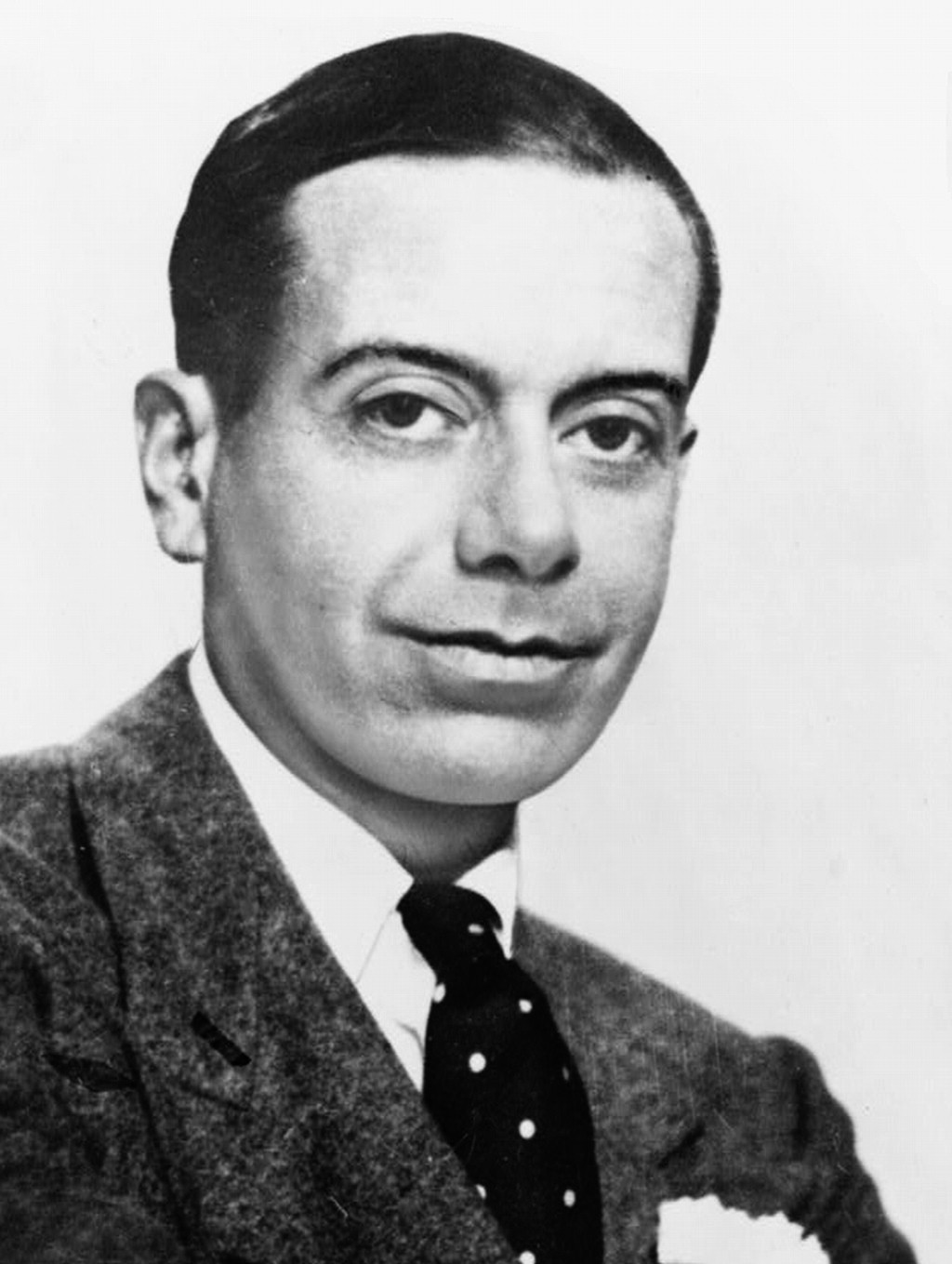
Cole Porter remains one of America's all-time greatest composers and songwriters. His work is characterized by witty and sophisticated lyrics with complex and clever use of rhythm and rhyme.


The 1930s were the golden period for Porter as he enjoyed a string of hit songs, Broadway shows and, eventually, Hollywood musicals. Porter had a gift for self-promotion and attracting and writing for the brightest talents of the age and many songs and shows were written specifically with stars such as Fred Astaire, Ethel Merman and Fanny Brice in mind.

Porter was plainly and openly homosexual, which was not a concern for his almost a decade older wife, Linda Lee Thomas. They both got what they wanted from each other. Linda was no longer interested in sex and was the glamorous wife of a world famous songwriter, who would never physically mistreat her as her first husband is reputed to have done; Cole had a beautiful woman on his arm when the situation warranted it. In those days, it was not uncommon for wealthy gay men to marry wealthy socialtes. Cole and Linda did separate in the early 1930s when Porter's sexuality became more and open during their time living in Hollywood.

He had affairs with Ballet Russes star Boris Kochnon 1925, and reportedly had a long relationship with his constant companion Howard Sturges, a Boston socialite, as well as architect Ed Tauch (for whom Porter wrote Easy To Love) , choreographer Nelson Barclift (who inspired Night and Day), director John Wilson and longtime friend Ray Kelly, whose children still receive half of Porter`s royalties. When in Hollywood, Porter was also a regular at George Cukor's Sunday pool parties - men-only affairs populated by young Hollywood hopefuls and their admirers.

In 1937, Porter was thrown from a horse and his legs badly crushed, effectively crippling him. He endured more than 40 operations on his legs and the constant pain left him with terrible depression for which he received brutal experimental electric shock therapy, although he continued to write. Eventually, ulceration led to his right leg being amputated, and he spent the rest of his long life with an artificial limb.

If you ever see the Hollywood biopic of Porter's life Night & Day (1946) starring Cary Grant and Alexis Smith as Cole and Linda, enjoy it for the music, but the story is so sanitized and romanticized as to be practically fiction.

Source: Gay for Today

Thursday, October 29, 2009

Who's That Queer

Brought to you by Pistol Pete


Audre Lorde was born in New York City to Caribbean immigrants Frederick Byron Lorde and Linda Gertrude Belmar Lorde, who settled in Harlem. Nearsighted to the point of being legally blind, and the youngest of three daughters, Lorde grew up hearing her mother's stories about the West Indies. She learned to talk while she learned to read, at the age of four, and her mother taught her to write at around the same time. She wrote her first poem when she was in eighth grade.


After graduating from Hunter College High School, Lorde attended Hunter College from 1954 to 1959 and graduated with a bachelors degree.

In 1954, she spent a pivotal year as a student at the National University of Mexico, a period she described as a time of affirmation and renewal: she confirmed her identity on personal and artistic levels as a lesbian and poet. On her return to New York, Lorde went to college, worked as a librarian, continued writing and became an active participant in the gay culture of Greenwich Village. Lorde furthered her education at Columbia University, earning a master's degree in library science in 1961.

Lorde's poetry was published very regularly during the 1960s — in Langston Hughes's 1962 New Negro Poets, USA; in several foreign anthologies; and in black literary magazines. During this time, she was politically active in civil rights, anti-war, and feminist movements. Her first volume of poetry, The First Cities (1968), was published by the Poet's Press and edited by Diane di Prima, a former classmate and friend from Hunter College High School. Dudley Randall, a poet and critic, asserted in his review of the book that Lorde "does not wave a black flag, but her blackness is there, implicit, in the bone."

Her second volume, Cables to Rage (1970), which was mainly written during her tenure at Tougaloo College in Mississippi, addresses themes of love, betrayal, childbirth and the complexities of raising children. It is particularly noteworthy for the poem "Martha", in which Lorde poetically confirms her homosexuality: "[W]e shall love each other here if ever at all."

Later books continued her political aims in lesbian and gay rights, and feminism. In 1980, together with Barbara Smith and Cherrie Moraga, she co-founded Kitchen Table: Women of Color Press, the first U.S. publisher for women of coloor. Lorde was State Poet of New York from 1991 to 1992.

Source: Wikipedia

Thursday, October 15, 2009

Who's that Queer?

Brought to you by Pistol Pete


Representative Barbara Jordan (D-Texas) was the first African-American woman elected to Congress from a southern state. She was known as an outstanding orator and Constitutional scholar.She served as a congresswoman in the United States House of Representatives from 1973 to 1979.


Jordan campaigned for the Texas House of Representatives in 1962 and 1964.Her persistence won her a seat in the Texas Senate in 1966, becoming the first African American state senator since 1883 and the first black woman to serve in that body. Re-elected to a full term in the Texas Senate in 1968, she served until 1972. She was the first African-American female to serve as president pro tem. of the state senate and served one day, June 10, 1972, as acting governor of Texas.

In 1972, she was elected to the United States House of Representatives, becoming the first black woman from a Southern state to serve in the House. She received extensive support from former President Lyndon Johnson, who helped her secure a position on the House Judiciary Committee. In 1974, she made an influential, televised speech before the House Judiciary Committee supporting the impeachment of President Richard Nixon.

Jordan was mentioned as a possible running mate to Jimmy Carter in 1976, and that year she became the first African-American woman to deliver the keynote address at the Democratic National Convention. Her speech in New York that summer was ranked 5th in "Top 100 American Speeches of the 20th century" list and was considered by many historians to have been the best convention keynote speech in modern history until the 2004 keynote by Barack Obama. Despite not being a candidate Jordan received one delegate vote (0.03%) for president at the convention.

In 1973, Jordan began to suffer from multiple sclerosis. She had difficulty climbing stairs, and she started using a cane and eventually a wheelchair. She kept the state of her health out of the press so well that in the KUT radio documentary, Rediscovering Barbara Jordan, former president Bill Clinton stated that he wanted to nominate Jordan for the United States Supreme Court, but by the time he could do so, Jordan's health problems prevented him from nominating her.

Jordan's companion of close to 30 years was Nancy Earl. Jordan met Earl, an educational psychologist who would become an occasional speech writer in addition to Jordan's partner, on a camping trip in the late 1960s. Jordan never publicly acknowledged her sexual orientation, but in her obituary, the Houston Chronicle mentioned her long relationship with Earl, interpreted to confirm her being a lesbian. However, Jordan biographer Mary Beth Rogers, author of "Barbara Jordan: American Hero," found no conclusive evidence to suggest that the former senator was a lesbian. After Jordan's initial unsuccessful statewide races, advisers warned her to become more discreet and not bring any female companions on the campaign trail.


Source: Wikipedia


Thursday, October 8, 2009

Who's That Queer

Brought to you by Pistol Pete


Walt Whitman is widely considered to be the father of modern American literature, but during his lifetime he remained more highly regarded in Europe than in the United States. In 1882 Oscar Wilde, who was on a lecture tour of America, visited Whitman's at the poet's home in Camden, NJ. Afterward he said of Whitman, "He is the grandest man I have ever seen, the simplest, most natural, and strongest character I have ever met in my life."


Walt Whitman is best known for Leaves of Grass, his groundbreaking volume of twelve untitled poems first published in 1855, which heralded a new, uniquely American style of poetry. Whitman continued to revise and expand Leaves of Grass for the rest of his life. The first few editions were poorly received. Leaves of Grass was censured by some prominent American intellectuals because of its innovative, unstructured verse and its celebration of sexuality, which they found obscene.

Whitman was born in Long Island, New York, into a Quaker family. Largely self-educated, Whitman supported himself as a printer, teacher, and journalist while he pursued his vision of a new form of literature that would express America's destiny as liberator of the human spirit. Leaves of Grass reflects Whitman's belief that poetry should be simple, with the natural rhythm of spoken language and without orthodox meter or rhyme.

During the Civil War, the poet served as an unofficial nurse in an army hospital, caring for his brother and other wounded Union soldiers at his own expense. When the war ended, Whitman, who was already internationally famous, remained in Washington, DC, working as a clerk in the Department of the Interior. However, when the Secretary of the Interior, James Harlan, discovered that Whitman was the author of Leaves of Grass, Harlan fired the poet.

Whitman's sexuality is sometimes disputed, although often assumed to be bisexual based on his poetry. The concept of heterosexual and homosexual personalities was not identified distinctly until 1868, and it was not widely promoted until Whitman was an old man. Whitman's poetry depicts love and sexuality in a more earthy, individualistic way common in American culture before the medicalization of sexuality in the late 1800s. As Whitman biographer Jerome Loving wrote, "the discussion of Whitman's sexual orientation will probably continue in spite of whatever evidence emerges." Though Leaves of Grass was often labeled pornographic or obscene, only one critic remarked on its author's presumed sexual activity: in a November 1855 review, Rufus Wilmot Griswold suggested Whitman was guilty of "that horrible sin not to be mentioned among Christians".

Whitman had intense friendships with many men throughout his life. Some biographers have claimed that he may not have actually engaged in sexual relationships with men, while others cite letters, journal entries and other sources which they claim as proof of the sexual nature of some of his relationships. Peter Doyle may be the most likely candidate for the love of Whitman's life, according to biographer David S. Reynolds. Doyle was a bus conductor whom Whitman met around 1866 and the two were inseparable for several years. Interviewed in 1895, Doyle said: "We were familiar at once — I put my hand on his knee — we understood. He did not get out at the end of the trip — in fact went all the way back with me."

In his notebooks, Whitman disguised Doyle's initials using the code "16.4". A more direct second-hand account comes from Oscar Wilde. Wilde met Whitman in America in 1882, and wrote to the homosexual rights activist George Cecil Ives that there was "no doubt" about the great American poet's sexual orientation — "I have the kiss of Walt Whitman still on my lips," he boasted. The only explicit description of Whitman's sexual activities is second hand. In 1924 Edward Carpenter, then an old man, described an erotic encounter he had had in his youth with Whitman to Gavin Arthur, who recorded it in detail in his journal. Late in his life, when Whitman was asked outright if his series of "Calamus" poems were homosexual, he chose not to respond.

Sources: Wikipedia, GLBThistorymonth.com

Thursday, October 1, 2009

Who's that Queer?

Brought to you by Pistol Pete


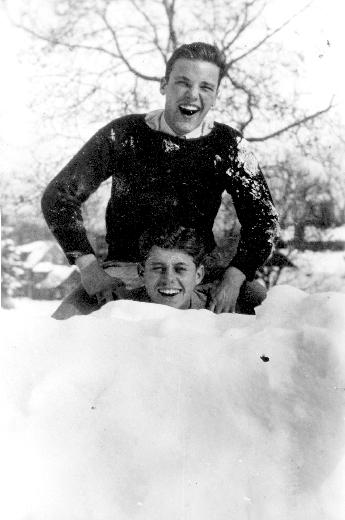
Kirk LeMoyne "Lem" Billings was a prep school roommate and then lifelong close friend of President John F. Kennedy. He had his own room in the White House and was offered several official positions by the president, but preferred to be "first friend." Lem also worked for JFK in the West Virginia and Wisconsin primaries and helped gather delegates at the Democratic convention in Los Angeles when JFK was running for President.


Lem was born in Pittsburgh, Pennsylvania, in 1916 to Frederic Tremaine Billings, a prominent physician and Romaine LeMoyne. The family went back to the arrival of the Mayflower and were ardent abolitionists who championed the education of free black Americans after the Confeder
ate States of America was defeated. Lem's father died in 1933 placing additional strain on the family's finances. Lem had extremely poor eye sight and a high-pitched voice.

Lem and Jack first met at Choate Rosemary Hall in 1933 when Lem was 17 and Jack was 16. From all accounts, they became fast friends, drawn to each other by their mutual distaste for their school and its headmaster, Seymour St. John. "But the bond between Billings and Kennedy became so strong that Billings stayed back a year so that he and Kennedy could graduate from Choate together in 1935," according to David Pitts' 2007 biography Jack and Lem. They continued to Princeton University until Kennedy withdrew for medical reasons. Billings and Kennedy took their summer trip through Europe prior to World War II. They adopted a little dachshund they named Dunker but had to give him up because of Jack's allergies.


In 1942, Lem joined the Ambulance Corps, an organization that had no problem with his eye sight and saw action in North Africa. He later received a commission in the U.S. Naval Reserve and served in the South Pacific eventually getting discharged in 1946. From 1946 to 1948, Lem attended Harvard Business School. Lem had several jobs including selling Coca-Cola dispensers to drugstores, working at a General Shoe store, Emerson Drug Company VP, and an advertising executive at the Manhattan advertising firm Lennen & Newell. He also is responsible for inventing '50s fad drink Fizzies for the Emerson Drug Company. He thought of adding a fruit flavor to disguise the sodium citrate taste.

In Victorian times, Lem might have been described as a "confirmed bachelor," although by the end of his own lifetime he would have been described as gay. In a 2007 book review of Jack and Lem, The New Haven Register interviewed the author and quoted from the book: "Jack made a big difference in my life," Billings said. "Because of him, I was never lonely. He may have been the reason I never got married."
However, the relationship between the two men was friendship. "It’s the story of a really close friendship — and one of the guys just happened to be what we think of today as gay," said David Pitts, author of the book Jack and Lem.

John F. Kennedy was well aware of his friend's sexual orientation, as Billings had conveyed his interest in Kennedy early in their friendship. Kennedy rebuffed his advances sharply but actively continued the friendship for the rest of his life. He sometimes had to explain Jack to Jackie—or vice versa. Jackie Kennedy, who liked Billings for the most part, commented to a White House usher, "He (Lem) has been a house guest every weekend of my married life."


Billings maintained close ties to the Kennedys and their children throughout his life and Lem was like a father to Bobby Jr. after his father's passing.
Lem Billings died in his sleep following a heart attack on May 28, 1981. Lem's dying wish was for the young Kennedy men to carry his coffin to its final resting place. JFK's sister Eunice Kennedy Shriver once said of Lem, “Of the nine or ten men who were close to the president, I would say Lem was number one…It’s hard to describe it as just friendship; it was a complete liberation of the human spirit. I think that’s what Lem did for President Kennedy.”

Source: Wikipedia.org

Thursday, September 24, 2009

Who's that Queer?

Brought to you by Pistol Peete

Freddie Mercury was born Farrokh Bulsara on September 5, 1946 on the small island of Zanzibar, off the coast of Tanzania. The electric frontman for the rock band Queen was of Indian nationality and his Parsi background has led many to remember Mercury as “Britain’s first Asian rock star."

In April 1970, Mercury joined with guitarist Brian May and drummer Roger Taylor who had previously been in a band called Smile. Despite reservations from the other members, Mercury chose the name "Queen" for the new band. He later said about the band's name, "I was certainly aware of the gay connotations, but that was just one facet of it."


As a songwriter, Mercury composed many international hits including "Bohemian Rhapsody", "Killer Queen", "Somebody to Love", "Don't Stop Me Now", "Crazy Little Thing Called Love", and "We Are the Champions". After the album Queen II was released, the world was conquered by the band’s outrageously fabulous performances and music.

Mercury is noted for his live performances, which were often delivered to stadium audiences around the world. He displayed a highly theatrical style that often evoked a great deal of participation from the crowd. David Bowie, who performed at the Freddie Mercury Tribute Concert and recorded the song "Under Pressure" with Queen said of Mercury, "Of all the more theatrical rock performers, Freddie took it further than the rest...he took it over the edge. And of course, I always admired a man who wears tights. I only saw him in concert once and as they say, he was definitely a man who could hold an audience in the palm of his hand."

Although he cultivated a very flamboyant stage personality, Mercury was a very shy and retiring man in person, particularly around people he didn't know well. He also granted very few interviews. Mercury once said of himself, "When I'm performing I'm an extrovert, yet inside I'm a completely different man."

By 1979, Mercury began to frequently visit gay bathhouses and clubs where he met many short-term partners. By 1985, he began a long-term relationship with a hairdresser named Jim Hutton. According to Hutton, Mercury was diagnosed with AIDS shortly after Easter of 1987. Around that time, Mercury claimed in an interview that he had tested negative for the virus. Despite the denials, the British press pursued the rampant rumors over the next few years fuelled by Mercury's increasingly gaunt appearance, Queen's absence from touring, and reports from former lovers to various tabloid journals.

On 22 November 1991, Mercury called Queen's manager Jim Beach over to his Kensington home, to discuss a public statement. The next day, the following announcement was made to the press on behalf of Mercury:

“Following the enormous conjecture in the press over the last two weeks, I wish to confirm that I have been tested HIV positive and have AIDS. I felt it correct to keep this information private to date to protect the privacy of those around me. However, the time has come now for my friends and fans around the world to know the truth and I hope that everyone will join with me, my doctors, and all those worldwide in the fight against this terrible disease. My privacy has always been very special to me and I am famous for my lack of interviews. Please understand this policy will continue.”A little over 24 hours after issuing the statement, Mercury died on 24 November 1991 at the age of 45.

The following is a quote from Mercury, and if we can learn anything from his spectacular yet short existence, it is this: “The most important thing, darling, is to live a fabulous life. As long as it's fabulous I don't care how long I live.”

Thursday, September 17, 2009

Who's that Queer?

Brought to you by Pistol Pete


Margaret Mead was an American cultural anthropologist, whose written and spoken work was frequently featured in the mass media throughout the 1960s and 1970s. Mead is remembered for her large contribution to making the insights into modern American and Western culture and is also regarded as a respected, yet occasionally controversial, academic anthropologist. Her reports about the purportedly healthy attitude towards sex in South Pacific and Southeast Asian traditional cultures amply informed the 1960s sexual revolution. Mead was a champion of broadened sexual mores within a context of traditional western religious life.


Mead had a long, eclectic professional time line. During World War II, Mead served as executive secretary of the National Research Council's on Food Habits. She later served as curator of ethnology at the American Museum of Natural History from, and taught at Columbia University as adjunct professor from 1954 to 1978. She was a professor of anthropology and chair of Division of Social Sciences at Fordham University's Lincoln Center campus from 1968 to 1970, founding their anthropology department. Following the example of her instructor Ruth Benedict, Mead concentrated her studies on problems of child rearing, personality, and culture. She held various positions in the American Association for the Advancement of Science, notably president in 1975 and chair of the executive committee of the board of directors in 1976.

Mead’s personal life was a series of peaks and valleys. She was married three times, and although they all ended in divorce, she readily acknowledged that her third husband, Gregory Bateson was the one she loved the most. She was devastated when he left her, and she remained his loving friend until her life's end, keeping his photograph by her bedside wherever she traveled, including beside her hospital deathbed.

Mead also had an exceptionally close relationship with Ruth Benedict, with whom she studied with at Columbia University before earning her master’s degree. Mead's daughter, Mary Catherine Bateson, in her memoir With a Daughter's Eye, implies that the relationship between Benedict and Mead contained an erotic element. Mead spent her last years in a close personal and professional collaboration with anthropologist Rhoda Metraux, with whom she lived from 1955 until her death in 1978. Letters between the two published in 2006 with the permission of Mead's daughter clearly express a romantic relationship. While Margaret Mead never openly identified herself as lesbian or bisexual, in her writings she proposed that it is to be expected that an individual's sexual orientation may evolve throughout life.

Thursday, September 10, 2009

Who's that Queer?

Brought to you by Pistol Pete


Truman Capote is remembered for his iconic short stories and novels that have helped shape American literary culture. At least 20 films and television dramas have been produced from Capote novels, stories and screenplays.


Rising above a troubled childhood characterized by divorce, a long absence from his mother, and multiple migrations, Capote discovered his calling by the age of eleven and spent the rest of his childhood sharpening his craft. He began his professional career as a short story writer, and the critical "Miriam" (1945) attracted the attention of the publisher Bennett Cerf, which resulted in a contract with Random House to write a novel. The result was Other Voices, Other Rooms (1948). Capote attained instant celebrity as a result of the provocative portrait photo which was used in promoting this first novel: in it he gazes smolderingly into the camera while reclining. In the 1950s, his greatest success was a novella, Breakfast at Tiffany's, which was made into a very popular film starring Audrey Hepburn in the role of Holly Golightly.

Capote earned the most fame with In Cold Blood (1965) a journalistic work about the murder of four members of a Kansas farm family in their home, a book Capote spent four years writing. The acclaimed novel was marked as a milestone in popular culture, often credited with pioneering the "true crime" genre of nonfiction. From the time of its publication, its factuality and Capote's journalistic integrity have been called into question, and this has continued in the decades since his death.

Capote was openly homosexual. One of his first serious lovers was Smith College literature professor Newton Arvin, who won the National Book Award for his Herman Melville biography. The eclectic author was well known for his distinctive, high-pitched voice and odd vocal mannerisms, his offbeat manner of dress and his fabrications. He often claimed to intimately know people he had in fact never met, and professed to have had numerous liaisons with men thought to be heterosexual. He traveled in an eclectic array of social circles, hobnobbing with authors, critics, business tycoons, philanthropists, Hollywood and theatrical celebrities, royalty, and members of high society. Part of his public persona was a longstanding rivalry with writer Gore Vidal. Their rivalry prompted Tennessee Williams to complain: "You would think they were running neck-and-neck for some fabulous gold prize." Apart from his favorite authors Willa Cather, Isak Dinesen, Marcel Proust), Capote had faint praise for other writers. However, one who did get his favorable endorsement was journalist Lacey Fosburgh, author of Closing Time: The True Story of the Goodbar Murder. He also claimed an admiration for Andy Warhol's The Philosophy of Andy Warhol: From A to B & Back Again.

In the late 1970s, Capote was in and out of rehab clinics, and news of his various breakdowns frequently reached the public. In 1978, talk show host Stanley Siegal did a live on-air interview with Capote, who, in an extraordinarily intoxicated state, confessed that he might kill himself.
In an ironic twist, Warhol (who had made a point of seeking out Capote when he first arrived in New York) provided the author with the platform for his next artistic renewal. Warhol, who often partied with Capote at Studio 54, agreed to paint Capote's portrait as "a personal gift"—rather than for the six-figure sums he usually charged—in exchange for Capote contributing short pieces to Warhol's Interview magazine every month for a year. Initially the pieces were to consist of tape-recorded conversations, but soon Capote dispensed with the tape recorder and chose instead to craft meticulously composed "conversational portraits" that applied his literary skills to the magazine's dialogue-driven format. Out of this creative burst came the pieces that would form the basis for the bestselling Music for Chameleons (1980). To celebrate this unexpected renaissance, he underwent a facelift, lost weight and experimented with hair transplants. Nevertheless, Capote was unable to overcome his reliance upon drugs and liquor and had grown bored with New York by the turn of the 1980s.

Capote died in Los Angeles, California, on August 25, 1984, aged 59. According to the coroner's report the cause of death was "liver disease complicated by phlebitis and multiple drug intoxication.” Capote's will provided that a literary trust would be established, and sustained by revenues from Capote's works to fund various literary prizes and grants including the Truman Capote Award for Literary Criticism in Memory of Newton Arvin, commemorating not only Capote but also his friend Newton Arvin, the Smith College professor and critic, who lost his job after his homosexuality was exposed.

Thursday, September 3, 2009

Who's that Queer?

Brought to you by Pistol Pete


Moran "Margaret" Cho is an American comedian, fashion designer, actress, author, gay icon, and recording artist. Cho is best known for her stand-up routines, through which she critiques social and political problems, especially those pertaining to race, sexuality, and sex. She has also directed and appeared in music videos and has developed own clothing line. Cho is a political advocate and has frequently voiced her support LGBT rights and has won awards for her humanitarian efforts on behalf of women, Asians, and the LGBT community.

Cho's comedy routines are often explicit. She has covered substance abuse, eating disorders, her bisexuality and obsession with gay men, and Asian-American stereotypes, among other subjects in her stand up. Matching her outspoken nature, her material also features commentary on politics and contemporary American culture. In addition to her shows, Cho also developed an additional outlet for her advocacy with the advent of Margaretcho.com and her daily weblog.

A substantial segment of her material and advocacy addresses gay, lesbian, bisexual, and transgender issues. When San Francisco mayor Gavin Newsom directed that San Francisco's city hall issue marriage licenses to same-sex couples in San Francisco in 2004 (until reversed by the state supreme court), Cho started Love is Love is Love, a website promoting the legalization of gay marriage in the United States.

Cho has also been outspoken about her dislike of former President George W. Bush. She began to draw intense fire from conservatives over her fiercely anti-Bush commentary. During one of her live performances in Houston, Texas, conservative groups threatened to picket outside of her show. Although protesters never arrived, she held a counter protest outside the club until security told her she had to go inside.


In 2008, Cho officially gave her support to Illinois Senator Barack Obama for the nomination on the Democratic ticket for the 2008 U.S. presidential race. After Republican Presidential candidate John McCain announced his running-mate, Governor Sarah Palin of Alaska, Cho said of Palin, "I think [Palin] is the worst thing to happen to America since 9-11."

On her recent July 20th, 2009 visit to the Late Late Show with Craig Ferguson, Cho explained that she is not lesbian nor bi, but "I" because she wants everyone to like her and be with her.

Thursday, August 27, 2009

Who's that Queer?

Brought to you by Pistol Pete


Alan Mathison Turing was a British mathematician, logician, cryptanalyst and computer scientist. Turing is often considered to be the father of modern computer science. He provided an influential formalization of the concept of the algorithm and computation with the Turing machine. In 1999, Time Magazine named Turing as one of the 100 most important people of the 20th century for his role in the creation of the modern computer, stating: "The fact remains that everyone who taps at a keyboard, opening a spreadsheet or a word-processing program, is working on an incarnation of a Turing machine."

With the Turing test, he made a significant and characteristically provocative contribution to the debate regarding artificial intelligence asking whether it will ever be possible to say that a machine is conscious and can think. He later worked at the National Physical Laboratory, creating one of the first designs for a stored-program computer, the Automated Computing Engine (ACE), although it was never actually built in its full form. In 1948, he moved to the University of Manchester to work on the Manchester Mark 1, then emerging as one of the world's earliest true computers.

During the Second World War, Turing worked at Bletchley Park, known as Britain’s code-breaking center. Turing devoted much of his time to Hut 8, the section responsible for German naval cryptanalysis. As the department’s head, he devised a number of techniques for breaking German ciphers.

Turing was homosexual, living in an era when homosexuality was considered a mental illness and homosexual acts were illegal. Subsequent to being outed, Turing was charged with gross indecency under Section 11 of the Criminal Law Amendment Act 1885, the same crime that Oscar Wilde had been convicted of more than fifty years prior. At the time, there was acute public anxiety about spies and homosexual entrapment by Soviet agents, and although Turing was never accused of espionage, his prosecution essentially ended his career. He died not long after from what was officially declared self-induced cyanide poisoning, although his mother (and some others) considered the circumstances of his death to be suspicious.

Thursday, August 20, 2009

Who's that Queer?

Brought to you by Pistol Pete


Call him what you will, “Ziggy Stardust”, “The Thin White Duke”, but if you haven’t heard of David Bowie, then you haven’t been listening to music for the past four decades. Born David Robert Hayward-Jones (yeah, I think Bowie works better too), Bowie is widely regarded as an innovator, particularly for his musical accomplishments throughout the 1970s. He has been influenced by a variety of musicians and musical styles, and is known for the intellectual depth of his work and distinctive voice.

David Bowie first caught the eye and ear of the public in the autumn of 1969, when the song "Space Oddity" reached the top five of the UK singles chart. After a three-year period of experimentation he re-emerged in 1972 during the glam rock era as the flamboyant, androgynous alter-ego Ziggy Stardust, spearheaded by the hit single "Starman" and the album The Rise and Fall of Ziggy Stardust and the Spiders from Mars. The relatively short-lived Ziggy persona epitomized a career often marked by musical innovation, reinvention and striking visual presentation.

In 1975, Bowie achieved his first major American crossover success with the number-one single "Fame", co-written with John Lennon, and the hit album Young Americans, which the singer identified as "plastic soul". The sound constituted a radical shift in style that initially alienated many of his UK devotees. He then confounded the expectations of both his record label and his American audiences by recording the minimalist album Low—the first of three collaborations with Brian Eno over the next two years. The so-called "Berlin Trilogy" albums all reached the UK Top Five.

In 1981, Bowie paired with Queen for the UK chart-topping single "Under Pressure", and reached a commercial peak in 1983 with the album Let's Dance, which yielded the hit singles "Let's Dance", "China Girl", and "Modern Love".

Bowie’s studio and performance success maintained momentum through the 1990’s. In 2003, Bowie was forced to take a break from the stage, after he suffered a minor heart attack as a result years of touring and heavy smoking. Despite his hiatus from the stage, Bowie contributed to several projects including the soundtrack for the film The Life Aquatic with Steve Zissou, which featured David Bowie songs performed in Portuguese by cast member Seu Jorge (who adapted the lyrics to make them relevant to the film's story). Bowie commented, "Had Seu Jorge not recorded my songs acoustically in Portuguese I would never have heard this new level of beauty which he has imbued them with."


In the past, Bowie’s sexuality has been a topic of discussion. He is currently married to Somalian-born Supermodel Iman Abdulmajid, but has openly talked about his bisexuality. In a 2002 interview with Blender Magazine; Bowie was posed with this question: "You once said that saying you were bisexual was 'the biggest mistake I ever made'. Do you still believe that?" His response:

“Interesting. [Long pause] I don’t think it was a mistake in Europe, but it was a lot tougher in America. I had no problem with people knowing I was bisexual. But I had no inclination to hold any banners or be a representative of any group of people. I knew what I wanted to be, a songwriter and a performer, and I felt that [bisexuality] became my headline over here for so long. America is a very puritanical place, and I think it stood in the way of so much I wanted to do.”

Source: Wikipedia

Thursday, August 6, 2009

Who's that Queer?

Brought to you by Pistol Pete

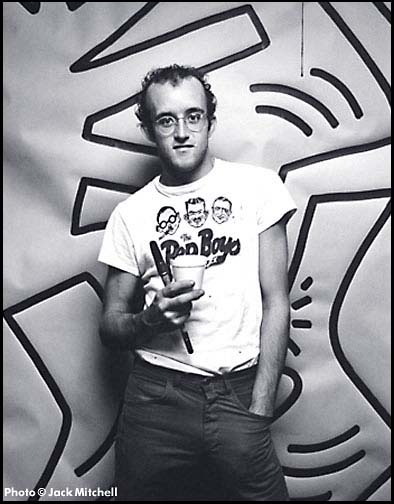
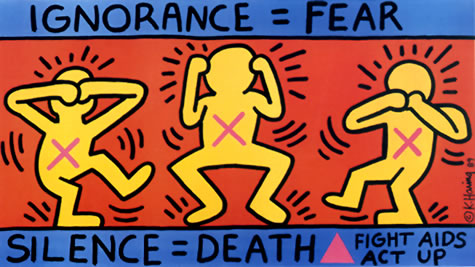
Keith Haring was born May 4, 1958 in Reading, Pennsylvania, and was raised in the nearby town of Kutztown. At an early age, Haring developed a love for drawing, and was influenced by his father’s cartoonist skills and the popular culture images created by Dr. Seuss and Walt Disney.


In 1978, Haring had his first solo exhibition and later in the same year, moved to New York City where he enrolled in the School of Visual Arts (SVA). Haring was introduced to a community of artists that was developing in the city streets and subway stations. During this time, Haring became increasingly influenced by graffiti art and immersed himself among other musicians, performance artists, and graffiti writers including Jean-Michel Basquiat.

As a student at SVA , Haring experimented with a variety of mediums and tied his hand at performance, video, and installation art while always maintaining a commitment to drawing. Between 1980 and 1985, Haring utilized the unused advertising panels that lined the walls of the New York City subway stations. These panels, covered in black paper offered Haring a forum to reach a wider audience. Haring referred to the subway stations as his “laboratory”, where he would create as many as 40 paintings in a single day.


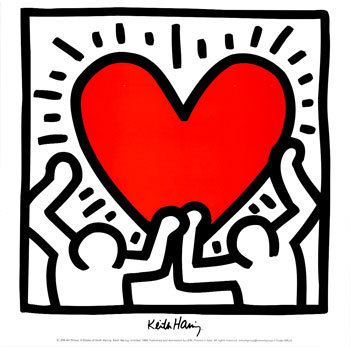
In April 1986, Haring opened the Pop Shop, a retail store in Soho selling T-shirts, toys, posters, buttons and magnets bearing his images. The shop was intended to allow people greater access to his work, which was now readily available on products at a low cost. The shop received criticism from many in the art world, however Haring remained committed to his desire to make his artwork available to as wide an audience as possible, and received strong support for his project from friends, fans and mentors including Andy Warhol.

Throughout his career, Haring produced more than 50 public artworks between 1982 and 1989, in dozens of cities around the world, many of which were created for charities, hospitals, children’s day care centers and orphanages. By then, his work had begun to reflect more socio-political themes, such as anti-Apartheid, AIDS awareness, and the crack cocaine epidemic.

Haring was diagnosed with AIDS in 1988. Soon after, he established the Keith Haring Foundation, its mandate being to provide funding and imagery to AIDS organizations and children’s programs, and to expand the audience for Haring’s work through exhibitions, publications and the licensing of his images. Haring enlisted his imagery during the last years of his life to speak about his own illness and generate activism and awareness about AIDS.


In June 1989, on the rear wall of the convent of the Church of Sant'Antonio in Pisa, he painted the last public work of his life, the mural "Tuttomondo." Haring died in 1990 of AIDS- related complications. During a brief but intense career that spanned the 1980s, Haring was able to attract a wide audience and assure the accessibility and staying power of his imagery, which has become a universally recognized visual language of the 20th century.

Sources: Wikipedia, www.haring.com

Thursday, July 30, 2009

Who's that Queer?

Brought to you by Pistol Pete

With ironic wit and spot-on social commentary, David Sedaris has quickly become one of America’s most widely-acclaimed humor writers. As of 2008, his books have collectively sold seven million copies. Much of Sedaris humor is autobiographical and self-deprecating, and often concerns his family life, his middle class upbringing in the suburbs of Raleigh, North Carolina, Greek heritage, various jobs, education, drug use, homosexuality, and his life in France with his boyfriend, Hugh Hamrick.


Sedaris was born in Binghampton, New York, and raised in a suburban section of Raleigh, North Carolina. In his teens and twenties, he dabbled in visual and performance art., but was unsuccessful. Sedaris briefly attended Western Carolina University before transferring and dropping out of Kent State University in 1977. He then he moved to Chicago, Illinois in 1983, graduating from the School of the Art Institute of Chicago in 1987.

While working a string of odd jobs across Raleigh, Chicago, and New York City, Sedaris was discovered reading his diary (which he has kept since 1977) in a Chicago club by radio host Ira Glass, who asked Sedaris to appear on his weekly local program The Wild Room. Sedaris later said, "I owe everything to Ira....My life just changed completely, like someone waved a magic wand”. Sedaris' success on The Wild Room led to his National Public Radio debut on December 23, 1992, when he read a radio essay on Morning Edition titled "SantaLand Diaries", which described his experiences working as an elf at Macy's department store during Christmas time in New York.


In 1994, Sedaris released his book of stories and essays titled Barrel Fever. Shortly after, in 1995, Ira Glass began hosting the weekly hour-long PRI/Chicago Public Radio show This American Life, and Sedaris became a frequent contributor. He also began publishing essays in Esquire and The New Yorker, and in 1997, he published another collection of essays, Naked. His next book, Me Talk Pretty One Day, for which Sedaris won the Thurber Prize for American Humor and was named "Humorist of the Year" by Time magazine, was written mostly in France over a period of seven months, and was published in 2000 to “practically unanimous rave reviews”.

In September 2007, a new Sedaris collection, When You Are Engulfed in Flames was announced for publication on June 3, 2008. Although at least one news source assumed that the book would consist entirely of fables, Sedaris said in an October 2007 interview that the collection might include a "surprisingly brief story about [his] decision to quit smoking....along with stories about a Polish crybaby, throwing shit in a paraplegic's yard, chimpanzees at a typing school, and people visiting [him] in France”.


In addition to his career as an author, David Sedaris and his sister, Amy Sedaris, have collaborated under the name “The Talent Family” and have written half-a-dozen plays which have been produced at La Mama, Lincoln Center, and The Drama Department in New York City. These plays include Stump the Host, Stitches, One Woman Shoe, which received an Obie Award, Incident at Cobbler’s Knob, and The Book of Liz, which was published in book form by Dramatists Play Service.

Source: Wikipedia.org

Thursday, July 23, 2009

Who's that Queer? Peaches!

Brought to you by Pistol Pete

You may recognize her as the stylish, loud, electro-clash rock-chic, but before she became Peaches, Merrill Beth Nisker (born 1968 in Toronto, Canada) was an elementary school music and drama teacher. The electronica musician whose songs are notable for use of explicitly sexual lyrics plays her own instruments for her songs, programs her own electronic beats, and produces her own albums. Oh, and let’s not forget her ability to rock a mullet and look darn good doin’ it! That’s an accomplishment in itself.

Gender identity is a constant subject of Peaches' music, as she has suffered from gender identity issues since childhood, and often plays with traditional notions of gender role representation. Her lyrics and live shows consciously blur the distinction between male and female; in 2003 she appeared on the cover of her album Fatherfucker with a full beard. She disputes accusations of "penis envy," preferring the term “hermaphrodite envy”, as she was determined by her physician to have "undescended testicles" in 1995. More recently, she has announced her belief that, “there is so much male and female in us all.”

She released her first album, Fancypants Hoodlum, under the name Merrill Nisker in 1995, and subsequently developed the style and persona that would take her to international fame as Peaches. Her songs have been featured in movies such as Mean Girls, Waiting..., Jackass Number Two, My Little Eye, and Lost in Translation. Her music has also been highlighted on television shows such as Showtime's The L Word and NBC’s Ugly Betty. Peaches performed guest vocals on Pink's album Try This, on the song "Oh My God," and on the Chicks on Speed album 99 Cents, on the song "We Don't Play Guitars."

Peaches’ live background band, The Herms (short for hermaphrodites) was formed in the spring of 2006. They played at small and large venues alike with sex and sex-related themes as the "shock factor" for the audience. "Herms" is also a reference to the 1970's duo Peaches & Herb, and blending of the words “her” and “him.

For her fourth album, 2006's Impeach My Bush, Peaches enlisted guest musicians Joan Jett, Greg Kurstin, Josh Homme, Samantha Maloney, Beth Ditto, Feist, Dave Catching, Brian O'Connor and Radio Sloan to perform on several of the tracks. Her most recent album, I Feel Cream, was released on May 4, 2009 in Europe and May 5 in North America. The first single from the project is a double A-side of "Talk to Me" and "More”.

Source: Wikipedia

Thursday, July 16, 2009

Who's that Queer?

brought to you by Pistol Pete

Chaz Sun Bono (born Chastity Sun Bono March 4, 1969) is an American LGBT rights advocate, writer, actor, and musician. Bono is the only child of American entertainers Sonny and Cher.

Bono was outed by tabloid press in the early 1990s and publicly self-identified as lesbian in a 1995 cover interview in The Advocate. The process of coming out to oneself and others was a central topic in Bono's two books: Family Outing: A Guide to the Coming Out Process for Gays, Lesbians, and Their Families (1998) tells the story of his own coming out as well as stories of other gay and lesbian people; the memoir The End of Innocence (2003) discusses his outing, music career, and partner Joan’s death from non-Hodgkin's lymphoma.

Bono reported that Cher, who was both a gay icon and ally to LGBT communities, was quite uncomfortable with the news at first, and “went ballistic” before coming to terms with it: “By August 1996, one year after I came out publicly, my mother had progressed so far that she agreed to ‘come out’ herself on the cover of The Advocate as the proud mother of a lesbian daughter.” Cher has since become an outspoken LGBT rights activist. Sonny gave his child immediate support.

Bono’s paternal relationship became strained after Sonny became a Republican Congressmember from California. The differences in their political views separated them, and the two had not spoken for more than a year at the time of the Congressmember's fatal skiing accident in January 1998.

Bono is in the process of undergoing a gender transition which had begun mid-2008, as confirmed by his publicist in June 2009. The publicist stated, "It is Chaz's hope that his choice to transition will open the hearts and minds of the public regarding this issue, just as his coming out did." GLAAD and the Empowering Spirits Foundation were quick to offer praise and support for his announcement.

Source: Wikipedia.org

Thursday, July 9, 2009

Who's that Queer?

Brought to you by Pistol Pete

Luke Caswell, known as Cazwell, is an American rapper and songwriter. He is best known for his explicit lyrics and collaborations with Amanda Lepore. His work focuses on gay and bisexual urban themes and content and his music and videos are heavily played on LOGO. Cazwell himself is openly gay.


A leading figure in the renaissance of New York City nightlife that has taken place over the last five years, Cazwell’s music—a ridiculously fun mix of electrified dance music and old school hip hop—is the perfect example of the new spirit of pop music. Says Caz, "When people ask me how to describe my style sometimes I say 'Just imagine if Biggie Smalls ate Donna Summer for breakfast.'"

Having collaborated over the years with a who’s who of downtown New York and abroad— including Amanda Lepore, Larry Tee, Boy George, David Lachapelle, The Ones, Chris Joss, Peppermint, GoodandEvil, Karl Giant and Lost Daze—"Watch My Mouth" is the natural next step for a performer schooled in clubland, pulling together some of Cazwell’s most effortlessly catchy singles and pushing things forward with new tracks perfectly-suited to bring the party. Club bangers like “All Over Your Face” (which first tore up the Top 40 dance charts in '06) and the recent viral video sensation “I Seen Beyonce At Burger King." "All I wanna do is party and have a good time! I think everyone can relate to that right about now," explains Cazwell.

Sources: cazwell.com, wikipedia.org

Thursday, July 2, 2009

Who's that Queer?

Brought to you by Pistol Pete

Oliver "Billy" Sipple was a decorated Marine and Vietnam veteran widely known for saving the life of President Gerald Ford during an assassination attempt in San Francisco on September 22, 1975. The subsequent public revelation that Sipple was gay turned the news story into a torch for gay activists.

Sipple was part of a crowd of about 3,000 people who had gathered outside San Francisco's St. Francis to see President Ford on September 22, 1975.

Ford, just emerging from the building, was vulnerable despite heavy security protection. Sipple noticed a woman next to him had pulled and leveled a .38-caliber pistol at Ford as he headed to his limousine. Reacting instinctively, Sipple lunged at the shooter, Sarah Jane Moore, just as her finger squeezed the trigger. While the gun did go off, the impact was enough to deflect her aim and cause the bullet to veer wide of its mark. The bullet hit John Ludwig, a 42-year-old taxi driver. Ludwig survived.

Despite his wishes, gay activist Harvey Milk publicly proclaimed Sipple a 'gay hero' and said his act 'will help break the stereotype of homosexuals'. Gay liberation groups petitioned local media to give Sipple his due as a gay hero. Then columnist Herb Caen published the private side of the former Marine's story in the San Francisco Chronicle. Six other papers ran the column as well. After discovering her son's secret, Sipple's mother reacted to the knowledge of her son's sexual orientation by cutting off contact with him. Sipple's mother was reportedly harassed by her neighbours. When her son called to talk to her, she hung up on him. According to a 2006 Washington Post article, Sipple went through a period of estrangement with his parents, but the family later reconciled with his sexual orientation.

Sipple's mental and physical health sharply declined over the years. He drank heavily, gained weight, was fitted with a pacemaker, became paranoid and suicidal. On 2 February 1989, he was found dead in his bed, at the age of forty-seven. Earlier that day, Sipple had visited a friend and said he had been turned away by the Veterans' Administration hospital where he went concerning his difficulty in breathing.

Sources: wikipedia.org, gayfortoday.blogspot.com

Thursday, June 25, 2009

Who's that Queer?


Brought to you by Pistol Pete

Alexandra Billings, actor, teacher and activist is the Grand Marshal for this year's Chicago 40th Annual Pride Parade. Alexandra has dozens of stage, television and film roles to her credit. In the last few years she has had guest-starring roles on hit television shows including and in 2007 she completed her first film, "Socket" directed by Sean Abley.

Alexandra has starred in numerous plays at the Torso Theatre, Bailiwick Theatre, Healthworks Theatre, Light Opera Works and also the Steppenwolf Theater. She also appeared in plays in New York City and Los Angeles, including Larry Kramer's pivotal AIDS piece, "Just Say No" playing Nancy Regan to Gregg Louganis' "Jr." That year (1999) she shared a cover of the Advocate with Gregg Louganis, she had a feature in POZ magazine, and she was chosen as one of the Chicago Tribune's Top 10 People of the Year.

Alexandra, who along with her wife Chrisanne, moved to California in 2004, returns to Chicago frequently where she is a (summer) teacher at Steppenwolf Theater. She is also an Artistic Associate at the Bailiwick Theatre and About Face company member.

Alexandra will be riding in a classic car near the front of the Pride Parade on Sunday June 28.

Thursday, June 18, 2009

Q&A: An Interview with Porn Star Buck Angel


By Pistol Pete

Buck Angel has taken the world by storm since he first appeared on the adult film industry scene in 2003. According to his website, www.buckangel.com, Buck was the first Female to Male to sign a deal with a mainstream porn company when he partnered with Robert Hill Productions in 2004. In 2005, he also became the first FTM to feature in an all-male porn film produced by an exclusively gay porn company. This was the Titan release Cirque Noir. In January 2007, Angel won Transsexual Performer of the Year at the AVN Awards, the first female-to-male performer to do so. In October 2008 Angel appeared in director Ed Powers' new book NAKED about the adult film industry. He filmed a sex scene with porn star Wolf Hudson for an accompanying documentary film NAKED, produced by mainstream photographer Justin Lubin. (Sources: buckangel.com, wikipedia.org)


PP: Why did you decide to get into the porn industry, and what are the positive things that have come out of your career?

BA: I did it because I wanted to show how a man with a vagina is sexy and can have a great sex life. It is important for me to also show that safe sex is very important in the making of my films. I believe that what I do is also educational and want people to see my work as something very positive. I have also started doing workshops about my work and have been asked to speak at some schools and Universities regarding my impact on human sexuality.


PP: What has the public reaction been to your work?

BA: In the beginning of Buck Angel Entertainment, many FTM guys wrote me very nasty emails telling me that what I was doing was bad for the “FTM community." What they failed to realize was that my work was and is not about the FTM community, it is about “Buck Angel” and my way of dealing with and showing sexual expression. Things have changed but I still get hate mail from more of the old school FTM's who still believe that you need to have a penis to be a man.


PP: You've been through some very tough times before coming out as transgender. How have you been able to remain healthy and stable through all the controversy that surrounds you?

BA: By loving myself first and foremost, learning that I had to take my life into my own hands and not rely on everyone else telling me how I had to be; when I did that I just never felt happy. I had to overcome a very bad drug and alcohol problem which was really the first step. Then I just went to therapy to deal with my gender issues. As I grew as an individual I started feeling stronger about myself. I started working out and getting my body into shape - the kind of male body I always dreamed of - and I believe this also really helped my self esteem. Just live life for yourself and not for anyone else.


PP: Well, you've certainly been a trailblazer, and opened many people's eyes to just how sexy and manly FTMs can be. Thanks for your time and keep up the good work.

BA: Thanks, Pete. WOOF!

You can check out Buck at buckangel.com, transsexual-man.com and on Facebook.

Related Posts Plugin for WordPress, Blogger...

select key words

2007 National HIV Prevention Conference 2009 National LGBTI Health Summit 2011 LGBTI Health Summit 2012 Gay Men's Health Summit 2012 International AIDS Conference ACT Up AIDS AIDS Foundation of Chicago Africa BUTT Bisexual Bisexual Health Summit Brian Mustanski Center on Halsted Charles Stephens Chicago Chicago Black Gay Men's Caucus Chicago Task Force on LGBT Substance Use and Abuse Chris Bartlett Coaching with Jake Congress David Halperin David Munar Dr. James Holsinger Dr. Jesus Ramirez-Valles Dr. Rafael Diaz Dr. Ron Stall ENDA Ed Negron Eric Rofes FTM Feast of Fun Feel the love... Friday is for Faeries Gay Men's Health Summit 2010 HCV HIV HIV care HIV drugs HIV negative HIV positive HIV prevention HIV stigma HIV strategic plan HIV testing HIV/AIDS HPV Howard Brown Health Center IML IRMA Illinois International AIDS Conference Jim Pickett LGBT LGBT adoption LGBT culture LGBT health LGBT rights LGBT seniors LGBT youth LGBTI community LGBTI culture LGBTI health LGBTI rights LGBTI spirituality LGV Leon Liberman LifeLube LifeLube forum LifeLube poll LifeLube subscription Lorenzo Herrera y Lozano Lymphogranuloma Venereum MRSA MSM Monday Morning Perk-Up National AIDS Strategy National Gay Men's Health Summit One Fey's Tale Peter Pointers Pistol Pete PnP PrEP President Barack Obama Presidential Campaign Project CRYSP Radical Faerie STD Senator Barack Obama Sister Glo Sisters of Perpetual Indulgence Susan Kingston Swiss declaration Ted Kerr Test Positive Aware Network The "Work-In" The 2009 Gay Men's Health Agenda Tony Valenzuela Trans Gynecology Access Program Trans and Intersex Association Trevor Hoppe Who's That Queer Woof Wednesday You Tube abstinence only activism advocacy african-american aging issues anal cancer anal carcinoma anal health anal sex andrew's anus athlete ball scene bareback porn barebacking bathhouses bears big bold and beautiful bisexuality black gay men black msm blood ban blood donor body image bottom chubby chaser circumcision civil rights civil union communication community organizing condoms crystal meth dating dating and mating with alan irgang depression disclosure discrimination domestic violence don't ask don't tell douche downlow drag queen emotional health exercise female condom fitness gay culture gay identity gay latino gay male sex gay marriage gay men gay men of color gay men's health gay pride gay rights gay rugby gay sex gay youth gender harm reduction hate crime health care health care reform health insurance hepatitis C hiv vaccine homophobia homosexuality hottie hotties how are you healthy? human rights humor hunk immigration international mr. leather internet intimacy leather community leathersex lifelube survey love lube lubricant masturbation mental health microbicides middle music negotiated safety nutrition oral sex physical health pleasure podcast policy politics poppers porn post-exposure prophylaxis prevention prostate prostate cancer public health public sex venues queer identity racism recovery rectal microbicides relationships religion research safe sex semen sero-adaptation sero-sorting seroguessing sex sexual abuse sexual addiction sexual health sexual orientation smoking social marketing spirituality stigma stonewall riots substance abuse treatment substance use suicide super-bug superinfection syphilis testicle self-examination testicular cancer testing top trans group blog transgender transgender day of remembrance transgendered transmen transphobia transsexual universal health care unsafe sex vaccines video violence viral load writers yoga youtube