Showing posts with label gay latino. Show all posts

Sunday, December 30, 2012

The BEST of Lifelube - "Gay + Latino + American Dream = ?" From Monday, August 25, 2008


Gay + Latino + American Dream = ?


Reflection by Julio Maldonado
Latino Health Specialist at Howard Brown Health Center

Wow… I almost forgot…all about it!

It’s been more than 11 years since I left my country maybe “looking for the American dream” as many people say. Is this true? Who knows…? But I know who knows… I am sure I know about it!

Many, if I can say thousands, of Hispanics left our countries because we wanted to experience for ourselves all that people say when they come back from “Los Estados Unidos.” No matter where in the US, the fact was that it sounded amazing, incredible, and had many opportunities. For me, there was one more thing: to be who I want to be. No more persecution, no more mistreatment, no more hiding who I am and “who I want to be in this life.”

I am a gay man.

Of course, this demands a sacrifice, sadness and questions…. But the final decision always brought us here – to the US.

That was exactly what happened to me. I decided to come to the United Stated, but I really wanted to do it good. So I said to myself, “I want to go, but I want to go to New York.” Well, that happened. A cold and tough winter was waiting for me while leaving the JFK airport. But, I was here…and that was all that mattered….

How we see big, huge, tall buildings, I am sure is not the same way that others see them. Many times, I almost fell because my sight was focused on those incredible buildings. I heard it called “the vertical city” once. It really is, especially when I crossed to Queens and I had all that skyline. We will never forget that… never….nunca….

But, we didn’t come only to see the buildings; we came because of “the American dream.” So, at first, we felt so different, like we needed to work a lot in order to fit in here. Culture, language, the city, the thousands of people walking on the sidewalks… but we were so happy to be here… very happy!

Identification with this new culture, language, city and people; comes with time. Its timely …it’s just time…

Now, what about …. “who I want to be in this life,” because we are here for that reason too…. So, we have our first time in a club-bar, a “gay life in Los Estados Unidos.” Just as the first look to the skyline, this moment is also unforgettable. To see all the gay community together with no feelings and fears about persecution, without being mistreated by anyone, no hiding who we are: gay men.

Gay men walking on the street holding hands, kissing each other, meeting other friends on the corner of Christopher St. and 7th Avenue. It was like we were living in another world, better than we had thought; just lovely; just inspirational and full of pride. “PROUD” is a word that is not really related to gay community in our countries. But here, you start feeling it and living it. That’s great!

Hispanics, Latinos: We don’t need too much time to meet and start talking with our community co-members. “Los gringos,” there we go, saying “Hi,” “How are you,” and we go even to “What’s up?” All of that because we want to be more part of this and “who I want to be in this life.”

Unfortunately, as with all our dreams, they have painful and bad parts. And when those come to the “American dream” I can still feel my eyes getting watery.

Just to mention a few: housing, work, partners, friends, health… and many, many more that make Hispanic-Latinos think about how life was in our countries. Which one is better in the end???

To have a house with food, warm and always waiting for us every day… or no house… just worried “I don’t know where I can stay at tonight.”

To have decent work … or wake up one morning somewhere and go to our pockets and not find anything, no money, no ID, no idea of what to do…. I don’t have work, I don’t have anything to eat and still, I can see all these people sitting at sidewalk cafes having delicious good-looking, warm food?

To just chill with old gay friends in your neighborhood in your country,… or a partner, who at one point told me “I love you,” now saying “you got to leave, now.”

To having the old gay friend and knowing you can always count on him/her… or a friend telling you that is the last day in his house because you are not productive and you are giving him/her problems. And that’s all.

To living with HIV, but still my mother can understand and still is giving me housing, food, and love as she can… or I don’t know what to do. Will I die here?Alone?

What happened to the “American dream?”

Well, I understood. That’s why I told myself, this cannot happen. I need to do something, I promised myself that I will do something.

I fill my soul and all of me with courage, love, compassion, understanding and I turn more Hispanic-Latino than ever. I will get together, I will knock on doors, I will touch base with people that I believe are still there, I will be a leader, I will do whatever I have to do… and remember myself as a morning prayer that “life is just one” and nothing is done if you don’t, at least, try.

If I can do that, I will give that gift from God to anyone who will be passing through the same, the same that I passed though more than 11 years ago.

Wow… I almost forgot… all about it!

Wednesday, May 2, 2012

HBGC Event: Black and Latino Gay Men on Pornography

By: Chuck Colbert/TRT Reporter– The Rainbow Times
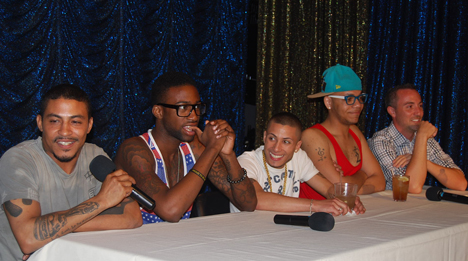
 Photo credit — Chuck Colber

It was a hot topic of conversation.
And talk about pornography they did as more than 50 people (mostly men of color) gathered Saturday evening, April 21, for an event sponsored by the Hispanic Black Gay Coalition (HBGC).
Held at Club Café, the panel discussion featured porn stars and research experts and dealt with the effect of pornography on Hispanic and black gay identity, behavior, and culture.
The title of the panel was “The Raw Realty: Pornography & Black and Latino Gay Representation.
The two-hour conversation was designed as “an innovative way to discuss safe-sex, sexuality, and the LGBTQ community with recognizable faces that are often glorified,” said Corey Yarbrough, HGBC’s executive director.
The panel was the closing session of HGBC’s two-day “Fantasy vs. Reality Weekend.”
Panelists included black porn star Tiger Tyson owner of Pittbull Productions, Latino porn star June Quinones, and black porn star HotRod.
Other panelists were Blake Rowley, a senior epidemiology research associate at Fenway Health, and Joshua Rosenberger, Ph.D., a professor of global community health at George Mason University. He also serves as a research consultant for Manhunt Cares.
Karyn Smith, a local transgender activist and HGBC member, served as moderator.


Thursday, February 16, 2012

Queer in Immigration Detention

via HuffPost, by Jonathan Perez

There I stood in South Louisiana Correctional Center, hundreds of miles away from my home in sunny California. Immigration detention means the end of the line for most undocumented immigrants. But I was not worried when or if I would be released. In the first place, I went in there on purpose.

I also knew there were people organizing to get me out, including Dreamactivist, Immigrant Youth Coalition, and people from all over the country. It was part of a "silent action" challenging the Obama administration's immigration policy, which allegedly does not detain undocumented persons without criminal records. But there I was.

After dozens of civil disobedience actions, we learned that Immigration Customs Enforcement (ICE) would not detain us during public events.

We would simply get arrested and go undercover pretending to be the type of immigrant that they usually detain, and not the ones who know their rights and have connections to advocacy groups. But most importantly, we pretended to be afraid.

My home for the next 10 days would now be "Wolf 1," a pod with a dozen grown men from different parts of Latin America. I knew it wasn't going to be easy to adjust but I felt okay about it.

I was there because I needed to organize and help them out in any way I could. We created a team of a couple other detainees that were ready to organize a hunger strike.

We weren't sure exactly how or when it would happen, but we knew we needed a number of issues to focus our efforts around. In the meantime we began to take stories of people who were detained and connected them to their families and immigration attorneys.

We took on deportation cases for those that can be won, like people who have been here for more than ten years, have citizen children, no criminal record and even DREAM Act eligible youth.

But there was always a splinter in my mind, something that always told me to be careful. Although I was detained with a friend who supported me, I knew he could never understand fully what I felt, and much less what I was thinking.

Looking at all the sweating men exercising and running by me only made it harder to ignore. There was Jose from Honduras; he was a father of three and a super nice guy with hazel eyes. He was caught driving without a license, and "Secure Communities" kicked in when he was booked. He was debating whether or not to sign a voluntary removal to get to his family as soon as possible.

One day, I began to think that I maybe I could tell the guys the truth -- that they wouldn't see a problem, since I had gotten to know them and they trusted me. I was wrong!

Dead wrong. As we walked back to our pod after lunch, I noticed two other men just like me on the other side of the fence. I felt relief, and I was glad to know that I was not alone.

But then the taunting began. They were mocked, whistled at, and harassed by the other detainees. They were called names like, "putitas," 'maricones," "jotitas," etc., pretty much different ways of saying faggots. I was shocked at first, and then I became sad.

It took me to a place I had not been to in a long time. It felt like I was in elementary school or middle school again. I was forced to mask my identity with a tough exterior, and had to be careful of what I said and did.

We only saw them when they walked by on their way to their pod, and every time they were ridiculed with enthusiasm by detainees. Their gender expression was more "feminine" than mine.

They were openly queer, and so they became targets. Most people never realized, and therefore didn't make fun of me or hit me. They actually assumed I was just like them.

A few days later, I was transferred to "Wolf 2," an adjacent pod where the two queer men, along with seventy other men were housed. I was afraid.

For all of the times I claimed to be undocumented and unafraid, I was out of my element. But I saw one of the Queer guys walk by 70 beds with his head held up high, with such energy and pride, and it made me feel so ashamed.

Ashamed that I could not do what he did, to be out and proud in a place where everyday there was someone harassing you and trying to put you down.


Read the rest

Monday, January 9, 2012

4 Colored Boys Like Me

via HuffPost Gay Voices, by Dane Harrington Joseph

I am not a racist.

There's a perfectly sound reason why my new project, Langston's, is subtitled "a film by (4) colored boys." Besides the obvious answer (it's a collaboration between four noted black and latino filmmakers), there's also a much more personal reason, dating back about 20 years to when I was a little colored boy myself (as my grandma would affectionately call me).

Back then, I would occasionally wet my bed at night. After such incidents I'd hide my gold-tinted "tighty whities" from my father, who would undoubtedly "whoop" me if he found them.

Nonetheless, despite my best efforts, he would sniff them out after they had festered for a few days in some ill-concealed location.

He would then call out for me in his ironically shrill, baritone voice, and, after a series of insults, proceed to beat me, accentuating verbally my various flaws with each lash.

My worst offense, however, would be crying, because "black men don't cry," an adage he'd bark at me whenever my eyes started to well up.

So I would just bite my lip until he was finished, then retire to my room and cry secretly into my pillow, all the while thinking, "I need help."

Of course, I didn't mean I needed to be rescued from my father's "tough love." Rather, I needed help controlling my compulsion to be me. I didn't want to be me. I hated me.

"Me" needed help, and I knew no other little "colored" boys like me who could show me the way.

So I looked to pop culture for guidance: music, movies, TV. Bill Cosby? No. Montel Williams? Denzel Washington? No. Flava Flav? Hell no.

There was not one media personality or public figure that reflected me. I wasn't relevant. I didn't matter.

I grew up, cried a little less, and, as a teen, became even more obsessed with the idea of finding someone to connect with -- other little colored boys like me. I discovered this newfangled thing called "the Internet" at the library.

I made new virtual "friends" and consequently put myself in unsafe situations, sexually and emotionally, just to feel something, to relate to someone.

I thought that love manifested physically between a 41-year-old Italian bear and a 15-year-old little colored boy could fill a void, could help substitute for the lack of love I felt for myself; it didn't.

I recall going to my mom a few months later and having her take me for my first HIV test, and crying, and then her crying, and then us crying again when the results came back negative.

And I remember thinking I would never be self-destructive in that way again.

I must admit, however, that the lure of boys and booze to fill a void still lingers, to gain instant gratification to temporarily replace constant feelings of illegitimacy.

And while this could, in truth, be the story of anyone of any race, I find that my existence as a gay man of color has rarely been validated; how I felt as a little colored boy looking to the media for validation still resounds today as a grown colored man.

Aside from a slew of big black men in pretty dresses (RuPaul, Tyler Perry, Eddie Murphy, Martin Lawrence, Jamie Foxx, and Flip Wilson, all of whom I admire, but almost all of whom aren't gay) and some admirable attempts by a few noted filmmakers (Patrick Ian Polk, Maurice Jamal, and Roger Omeus, to name a few), there has not been a constant presence of gay men of color in mainstream media or popular culture.

Coupled with negative societal perspectives on homosexuality, the diminished presence of black-themed entertainment that was so pervasive in the '80s and '90s, and the Euro-centric focus of most gay entertainment and advertising, it's not so surprising that self-destructive actions among young gay black men are on the rise, with the CDC reporting that new infections among said demographic saw a dramatic increase of 48 percent in recent years, with 59 percent of those carrying the disease unaware of their status.


Read the rest

Friday, November 18, 2011

Black and Latino MSM Identity and HIV Risk

via Poz, by Trenton Straube

New research uncovers mistaken assumptions fueling HIV rates among black and Latino men who have sex with men (MSM).

The belief that having sex with someone of your own race lowers your risk of contracting HIV is a misperception that needs to be addressed among black and Latino men who have sex with men (MSM).

What’s more, health care workers are missing opportunities to test this population for HIV—even when the men are engaged in care and disclose their sexuality to their doctors.

These are just two findings of research looking at black and Latino MSM who are HIV positive but unaware of their status. The Centers for Disease Control and Prevention (CDC) estimates that 53 percent of new HIV cases in the United States are among MSM and that 54 percent of these MSM are black and Latino.

In addition, HIV-positive black and Latino MSM are less likely than their white counterparts to know their status—which is one factor that amplifies HIV rates among these populations.

To explore these dynamics, researchers led by Gregorio A. Millett, MPH, the CDC/HHS Liaison to the White House Office of National AIDS Policy (ONAP), analyzed data from 1,208 MSM (597 black and 611 Latino) who participated in studies in Los Angeles, New York City and Philadelphia.

Eleven percent of them (18 percent black, 5 percent Latino) turned out to be HIV positive but unaware of their status (referred to as “HIV-positive unaware”).

Researchers found that certain variables were more common among the MSM in this group.

For example:

Black HIV-positive unaware MSM were associated with:

•Gay identity
•Earning a moderately higher income
•Having health insurance
•Disclosing sexuality to current health care provider
•Fewer than three lifetime HIV tests
•High perceived risk of testing HIV positive
•Belief that sex with other black men reduces HIV risk

Latino HIV-positive unaware MSM were associated with:

•Nongay identity
•High perceived risk of currently being HIV positive
•Belief that sex with other Latino men reduces HIV risk


POZ spoke with Millett, who arrived at ONAP via the CDC, about the implications of these findings, which were printed in the September Journal of Acquired Immune Deficiency Syndromes in an article titled “Mistaken Assumptions and Missed Opportunities: Correlates of Undiagnosed HIV Infection Among Black and Latino Men Who Have Sex With Men.”

We also asked Millett how his team in DC might use the data as they implement the National HIV/AIDS Strategy.


Read the rest

Monday, September 26, 2011

Meet my Partner or Boyfriend?

by Sebastino Aviles

Language is one of the few things in life that we don’t really think about, I mean unless you’re a linguist or something like that, I consider it something that we take for granted.

That being said I’ve noticed that I catch myself changing up my language, depending on different circumstances, such as where I’m at, who I’m with, and what I’m doing.

 I’m sure everyone experiences this phenomenon all the time in their lives but do we really take the time to notice when and why we are doing it?

I believe that my language is reflected on who I am in terms of social constructions such as gender, race/ethnicity, sexuality, class, and age. If I use those social constructions I would describe myself as a young working class gay Latino man.

Language itself is a social construction and as a social construction it is subject to change depending on who is using it. Which brings me to my next point, as a gay man I often monitor my language depending on where I’m at, who I’m with, and who I’m talking to.

My prime example is how I change up my language is when talking to people about a significant other. Depending on who I’m talking to or where I’m at I would either call my significant other my partner or my boyfriend.

If I were to talk to a heterosexual person and I have my significant other with me I would normally introduce him as my partner, however if I’m talking to someone who belongs to the LGBTQ community or identifies as LGBTQ I would introduce him as my boyfriend.

On the other hand if I know the heterosexual person well enough like if they are a family member or a close friend I would introduce him as my boyfriend.

Once again my language would change depending on where I was at, for example if I were in a formal setting like at a reception for some event I would introduce my significant other as my partner, and if I were in an informal setting like a bar or something he would turn back into my boyfriend.

I think for me having two options as to what I call my significant other can be problematic at times because it seems that I am conforming to what other people would find acceptable and thus creating a dichotomy that doesn’t need to be there, but at the same time I feel that having two options is also important because it gives me the choice of choosing how I want to define my relationship and how I want my relationship to be perceived to myself as well as to society.

Monday, September 19, 2011

VIDEO: Coming out in a Cuban Family

via Towleroad, by Nathan Manske

On the Tour, I especially loved hearing stories where I learn even a little about new cultures. That's why I was excited when Nicholas, who grew up in Little Havana in Miami, wanted to share his story.

With Nicholas's story, I never knew where it was going until the very end. The way he sets up Cuban culture, the workplace discrimination, then finally the moment when he tells his parents...you're waiting to find out if it ends happily or not right up until the last bit of his story.

Saturday, September 10, 2011

Gay Latinos Fighting BS: Bias and Stereotypes


Carolina Ramos has seen the struggle over and over again. She is the Latino/a services coordinator for the LGBT (Lesbian, Gay, Bisexual and Transgender) Community Center in San Diego, where she sees families torn and battered, as they try to come to grips with a child who has a different sexual orientation.

"A lot of people think LGBT issues are one thing, and Latino issues are another," Ramos said. "But for many people, you cannot separate them."

Ramos traveled to Sacramento recently to testify at an Assembly hearing on the subject. In general, she said, health risk factors increase in severity with societal pressures -- and Latinos in the LGBT community have multiple stressors, Ramos said.

For instance, lower-income people have difficulty accessing health care. Language can be a barrier. Distance from health care facilities is a barrier. Gay patients have an additionally difficult time communicating with providers. Immigrants face discrimination. Gay Latinos face discrimination from family, from friends, from church. There is the social pressure of machismo. All of those pressures add up, Ramos said.

"Everything from low income to race are stressors," she said. "You know, I've had parents say, 'Hey, they're your responsibility now, your responsibility if they die,' and that [kind of situation] was very painful."

That's the kind of situation often faced by gay Latinos and one reason for convening the recent hearing, according to Assembly member Ricardo Lara (D-South Gate), who also is chair of LGBT issues for the California Latino Legislative Caucus.

"We have individual and unique circumstances that LGBT Latinos face," Lara said, "not only in mainstream society but in the Latino community, as well."

That culture clash within the Latino community is the biggest barrier to cross for many people, according to Lara -- himself included.

"At the end of the day, you can't take away my rice and beans," he said with a laugh. "But how I feel is, you shouldn't have to choose between your culture and your sexual orientation."


Tuesday, July 26, 2011

How are Roberto and Naes healthy?[Our first "How are you healthy?" video]

Since the launch of the "How are you healthy"' series  in 2009, LifeLube has had contributions from 143 wonderful individuals who have provided insight on staying healthy in a world where making unhealthy choices is fashionable.

Keeping up with what's hot in 2011 (though, yes, we are a little late to the party), LifeLube has uploaded its FIRST video to the "How are you healthy" series. Watch how Roberto and Naes maintain a healthy relationship and lifestyle as a couple.

LifeLube would like to encourage YOU to reflect on your own healthy choices and make video to provide tips to others on LifeLube! Stay Fashionable! Be Healthy! Live Long! LifeLube!Send your video link or written post to lifelube@gmail.com.


--Roberto and Naes
Philadelphia


How are you healthy?
Please join the hundreds who have shared their tips.

Tell us HERE. Send a pic to the same place.
And we'll blog it, right here on LifeLube.
Gay men and all allies welcome to participate.

Read past posts.
Learn more about the campaign

Thursday, March 10, 2011

Chicago POZ Guys of Color! Regain control of your healthcare with Project IN-CARE

Project IN-CARE is a new program offered by AIDS Foundation of Chicago, Brothers Health Collective, Howard Brown Health Center, Ruth M. Rothstein CORE Center and Test Positive Aware Network.

IN-CARE is about men supporting men in regaining control of their healthcare and their lives. This project is designed specifically to assist bisexual, gay/same-gender-loving and down low/discrete men of color who’ve recently tested positive for HIV or have been positive for some time but haven’t seen a doctor in at least 6 months.

IN-CARE participants are paired with a Peer Health Navigator - someone who is successfully managing their own health care and knows the resources available in Chicago as well as how to access them. Peer Health Navigators work with participants to help them access HIV medical care, as well as the knowledge needed to gain and maintain their health and many other resources they may need.

For further information please contact …

Test Positive Aware Network – Juan Mercado 773-989-9400 ext. 294

CORE Center – Kathy Jacobs-McLoyd 312-572-4633

Brothers Health Collective – Leveon Perkins 773-363-0055

Howard Brown Health Center – Julio Maldonado 773-388-1600

Wednesday, March 2, 2011

Chicago POZ Guys of Color! Regain control of your healthcare with Project IN-CARE

Project IN-CARE is a new program offered by AIDS Foundation of Chicago, Brothers Health Collective, Howard Brown Health Center, Ruth M. Rothstein CORE Center and Test Positive Aware Network.

IN-CARE is about men supporting men in regaining control of their healthcare and their lives. This project is designed specifically to assist bisexual, gay/same-gender-loving and down low/discrete men of color who’ve recently tested positive for HIV or have been positive for some time but haven’t seen a doctor in at least 6 months.

IN-CARE participants are paired with a Peer Health Navigator - someone who is successfully managing their own health care and knows the resources available in Chicago as well as how to access them. Peer Health Navigators work with participants to help them access HIV medical care, as well as the knowledge needed to gain and maintain their health and many other resources they may need.

For further information please contact …

Test Positive Aware Network – Juan Mercado 773-989-9400 ext. 294

CORE Center – Kathy Jacobs-McLoyd 312-572-4633

Brothers Health Collective – Leveon Perkins 773-363-0055

Howard Brown Health Center – Julio Maldonado 773-388-1600

Thursday, November 11, 2010

Who's That Queer? [Pedro AlmodĂłvar}

Brought to you by Pistol Pete

Pedro AlmodĂłvar is an openly gay Spanish film director, screenwriter and producer. He is the most successful and internationally known Spanish film maker of his generation, having won numerous Academy Awards, BAFTAS, Golden Globes and many more both as writer and director.


AlmodĂłvar’s films enjoy a worldwide following and he has become a major figure on the stage of world cinema. The success of his movies has brought awareness to the cause of equal rights. He can also be credited with bringing two Spanish stars to an international audience - Antonio Banderas and Penelope Cruz.

Read more at Gay for Today.

Friday, November 5, 2010

Latino in Chicago? Take the Survey!


Chicago's own Vida/SIDA has began the Lesbian, Gay, Bisexual and Transgender Latino Survey! Please spread the word and encourage others to complete the survey!

This survey will help to define the basic needs of the adolescent and young adult LGBTQ Latino population in the greater Chicagoland area, (including surrounding communities and counties). Although the survey is open to anyone who identifies as Latino and LGBTQ, they are most interested in youth between 15-24 years of age. There will be questions on access to housing, healthcare, employment and education.

English version

Spanish version

Thursday, October 28, 2010

Who's That Queer? [Eric Alva]

Brought to you by Pistol Pete

Marine Staff Sgt. Eric Alva was the first American wounded, losing his leg in the war in Iraq and was awarded a Purple Heart and received a medical discharge from the military. After being honorably discharged, Alva came out as gay, and has been one of the most vocal veterans to speak out against the military's "Don’t Ask, Don’t Tell" policy.

Having survived a war injury, Alva felt he’d been given a second chance at life. He discovered a new calling. “I had to use my voice,” he says. “I had fought and nearly died to secure rights for others that I was not free to enjoy. I had proudly served a country that was not proud of me.”

In 2003, Alva received the Heroes and Heritage Award from La Raza. People magazine honored him with the Heroes Among Us Award (2004). He received the Patriot Award from the city of San Antonio (2004), and the Public Citizen Award from the National Association of Social Workers (2008).

Alva earned a Bachelor of Social Work in 2008, and is studying for a master’s degree in that field. He lives in San Antonio with his long-term partner, Darrell Parsons.

Friday, September 10, 2010

The Art of Protection, presented by the Chicago Black Gay Men's Caucus


An HIV/AIDS awareness and testing event highlighting the artistic talents of the LGBTQ Youth

WHEN?
September 29th, 2010, 6:00 PM

WHERE?
ROOM 43 located at 1039 E. 43rd St in Chicago

WHO?
LGBTQ Youth ages 18 - 24 encouraged to attend

WHAT?
  • The best poets, singers, dancers and rappers will be there, all fighting HIV through artistic expression.
  • Free confidential HIV Testing will be provided by TaskForce Prevention and Community Services
  • Following the show there will be a youth speed dating session and an after party.
  • Refreshments will be served FREE for all youth 18-24

RING!
For more info call 312-629-2988 ext 12 or call 773-66 YOUTH

Wednesday, August 25, 2010

Tuesday, August 24, 2010

Older Gay and Bisexual Men Needed for UIC Research Study


Are you 55 years of age or older and African American or Latino? We need your input!

We are recruiting men to participate in a focus group discussion or an individual interview.

Focus groups will last 90 min and you will receive $10 in compensation. Individual interviews will last 1 hr and you will receive $20 in compensation. Focus group and interviews will be conducted in either English and/or Spanish depending on participant’s preference, and audio tape-recorded.

If you are interested please call us at 312-996-6346 or e-mail: valles@uic.edu to see if you qualify.

________________________________________

La Salud de Hombres Gay y Bisexuales de Edad Mayor

Estamos buscando hombres gay y bisexuales de edad mayor para participar en un estudio sobre la salud, las relaciones sociales, y la discriminaciĂłn.

¿Tienes 55 años de edad o más? ¿Eres Latino o Afro-Americano?

¡Necesitamos tu participaciĂłn!

Estamos reclutando hombres para una discusión grupal o una entrevista individual. La discusión grupal durara 90 minutos y recibirás $10 por tu participación. Entrevistas individuales duraran 1 hr. y recibirás $20 por tu participación.

La discusión grupal y la entrevista individual se harán en Ingles o Español para acomodar tu preferencia y serán grabadas en audio.

Si estas interesado por favor contáctanos: 312-996-6346 o e-mail: valles@uic.edu para ver si calificas.

Thursday, August 19, 2010

Older Gay and Bisexual Men Needed for UIC Research Study


Are you 55 years of age or older and African American or Latino? We need your input!

We are recruiting men to participate in a focus group discussion or an individual interview.

Focus groups will last 90 min and you will receive $10 in compensation. Individual interviews will last 1 hr and you will receive $20 in compensation. Focus group and interviews will be conducted in either English and/or Spanish depending on participant’s preference, and audio tape-recorded.

If you are interested please call us at 312-996-6346 or e-mail: valles@uic.edu to see if you qualify.

________________________________________

La Salud de Hombres Gay y Bisexuales de Edad Mayor

Estamos buscando hombres gay y bisexuales de edad mayor para participar en un estudio sobre la salud, las relaciones sociales, y la discriminaciĂłn.

¿Tienes 55 años de edad o más? ¿Eres Latino o Afro-Americano?

¡Necesitamos tu participaciĂłn!

Estamos reclutando hombres para una discusión grupal o una entrevista individual. La discusión grupal durara 90 minutos y recibirás $10 por tu participación. Entrevistas individuales duraran 1 hr. y recibirás $20 por tu participación.

La discusión grupal y la entrevista individual se harán en Ingles o Español para acomodar tu preferencia y serán grabadas en audio.


Si estas interesado por favor contáctanos: 312-996-6346 o e-mail: valles@uic.edu para ver si calificas.

Monday, July 12, 2010

30 Years of Advocacy: Black & White Men Together Celebrate DIVERSITY

[part 1 of 2]

...commitment to a kaleidoscope of social justice issues rather than pandering to stereotypes or promoting a racist module of creating a group for people who prefer dating others based on their race or ethnicity. 

by Cornelius Mabin

The National Association Black and White Men Together (NA) is a nationwide collective network of affiliated and developing chapters in over 20 cities that identify themselves as Black and White Men Together (BWMT), Men of All Colors Together (MACT), or People of All Colors Together (PACT) in keeping with the cultural dynamics of their respective areas.

Conceived conceptually by Michael Smith in 1980 in San Francisco, the organization offered an outlet for individuals and couples sharing their lives inter-racially amidst racial challenges within gay male culture.

Two fundamental objectives guided the group and its many local chapters. First, was to explore our own attractions to men of different colors and ethnic backgrounds as well as it's impact in  a racially segregated society. And secondly, to began seeking answers about overt racism that were witnessed as a part of the gay construct.

With the success of it's initial beginning from posted ads in The Advocate and other news sources, BWMT's unique appeal and message grew additional chapters incrementally. Ultimately creating a national entity known as the "NA" to centralize it's leadership while designating support for local endeavors.

Continued development of the organization’s mission required additional structure and direction resulting in adopting it's Statement of Purpose citing NABWMT as “a gay, multiracial, multicultural organization committed to fostering supportive environments wherein racial and cultural barriers can be overcome and the goal of human equality realized. To these ends, we engage in educational, political, cultural and social activities as a means of dealing with the racism, sexism, homophobia, HIV/AIDS discrimination and other inequities in our communities and in our lives.”

During it's 30 year odyssey, the organization has pursued the course of addressing systemic oppression and cultural indifference with numerous coordinated projects such as a 1983 Discrimination Response System in reference to local bars with excessive carding  practices resulting in discrimination complaints with the Washington, D.C. Office of Human Rights. During the 1988 Boston convention, the group formed the National Task Force on AIDS Prevention funded in part by the first million dollar Centers for Disease Control and Prevention grant.

Continuing to confront racism and homophobia, NABWMT established the Bush-Mallon Institute, offering workshops with trained facilitators to it's network of chapters, community organizations and Fortune 500 companies across the nation as well as published a supportive reference manual utilized for the program.

Throughout the nation, local chapters have participated in pantry drives, health fairs, Pride activities, eco activities and social interaction agendas determined by individual chapter members and leadership.

By it's nature and namesake, the organization over the decades has had it's detractors and espoused misconceptions concerning it's goals and motivations. As a revolutionary concept from it's inception, NABWMT has affirmed and demonstrated through it's enduring work, its commitment to a kaleidoscope of social justice issues rather than pandering to stereotypes or promoting a racist module of creating a group for people who prefer dating others based on their race or ethnicity.

The iconic legacy has set the tone for the future of the organization, while mandating that human rights messages continue to resonate in the 21st century.  


Part 2 in LifeLube tomorrow will detail information about the NA’s upcoming 30th Anniversary Convention called DIVERSE 2010, in Ft. Lauderdale, FL, July 26th - August 1st.  Click for more information about Chicago’s excellent chapter, Men of All Colors Together.

Thursday, April 22, 2010

Who's That Queer [Marisa Demeo]

Brought to you by Pistol Pete


Marisa Demeo, is an openly gay District of Columbia magistrate judge. In the past she has worked as a lobbyist and advocate for Hispanic causes. On April 20th, 2010, Judge Demeo was confirmed by the United States Sentate to a 15-year term on the Washington D.C. Supreme Court.


Judge Marisa Demeo was born in Washington, D.C. and raised in Dale City, Virginia. She graduated from Princeton University in 1988, where she received her Bachelor of Arts degree in Politics with a concentration in Latin American studies. She went on to receive her Juris Doctor from New York University School of Law (NYU) in 1993, where she served on the Law Review.

After graduating from law school, Ms. Demeo served with distinction as an Honors Program trial attorney in DOJ’s Civil Rights Division Employment Litigation Section, where she prosecuted public employers for pattern or practice employment discrimination in federal courts around the country and received two awards for her work. In 1997, she left DOJ to work for the Mexican American Legal Defense and Educational Fund (MALDEF), a national Latino civil rights organization, where she advocated on immigrants’ rights issues. In 2004, Ms. Demeo joined the United States Attorney’s Office for the District of Columbia (USAO) as an Assistant United States Attorney, then in 2007 became a magistrate judge.

In March 2009, President Obama appointed Demeo to the DC superior court, but Senate Republicans, spearheaded by Sen. Jim DeMint, blocked a vote on her appointment for more than a year. On April 20th, 2010, Demeo's appointment was confirmed by a 66-32 vote.
Related Posts Plugin for WordPress, Blogger...

select key words

2007 National HIV Prevention Conference 2009 National LGBTI Health Summit 2011 LGBTI Health Summit 2012 Gay Men's Health Summit 2012 International AIDS Conference ACT Up AIDS AIDS Foundation of Chicago Africa BUTT Bisexual Bisexual Health Summit Brian Mustanski Center on Halsted Charles Stephens Chicago Chicago Black Gay Men's Caucus Chicago Task Force on LGBT Substance Use and Abuse Chris Bartlett Coaching with Jake Congress David Halperin David Munar Dr. James Holsinger Dr. Jesus Ramirez-Valles Dr. Rafael Diaz Dr. Ron Stall ENDA Ed Negron Eric Rofes FTM Feast of Fun Feel the love... Friday is for Faeries Gay Men's Health Summit 2010 HCV HIV HIV care HIV drugs HIV negative HIV positive HIV prevention HIV stigma HIV strategic plan HIV testing HIV/AIDS HPV Howard Brown Health Center IML IRMA Illinois International AIDS Conference Jim Pickett LGBT LGBT adoption LGBT culture LGBT health LGBT rights LGBT seniors LGBT youth LGBTI community LGBTI culture LGBTI health LGBTI rights LGBTI spirituality LGV Leon Liberman LifeLube LifeLube forum LifeLube poll LifeLube subscription Lorenzo Herrera y Lozano Lymphogranuloma Venereum MRSA MSM Monday Morning Perk-Up National AIDS Strategy National Gay Men's Health Summit One Fey's Tale Peter Pointers Pistol Pete PnP PrEP President Barack Obama Presidential Campaign Project CRYSP Radical Faerie STD Senator Barack Obama Sister Glo Sisters of Perpetual Indulgence Susan Kingston Swiss declaration Ted Kerr Test Positive Aware Network The "Work-In" The 2009 Gay Men's Health Agenda Tony Valenzuela Trans Gynecology Access Program Trans and Intersex Association Trevor Hoppe Who's That Queer Woof Wednesday You Tube abstinence only activism advocacy african-american aging issues anal cancer anal carcinoma anal health anal sex andrew's anus athlete ball scene bareback porn barebacking bathhouses bears big bold and beautiful bisexuality black gay men black msm blood ban blood donor body image bottom chubby chaser circumcision civil rights civil union communication community organizing condoms crystal meth dating dating and mating with alan irgang depression disclosure discrimination domestic violence don't ask don't tell douche downlow drag queen emotional health exercise female condom fitness gay culture gay identity gay latino gay male sex gay marriage gay men gay men of color gay men's health gay pride gay rights gay rugby gay sex gay youth gender harm reduction hate crime health care health care reform health insurance hepatitis C hiv vaccine homophobia homosexuality hottie hotties how are you healthy? human rights humor hunk immigration international mr. leather internet intimacy leather community leathersex lifelube survey love lube lubricant masturbation mental health microbicides middle music negotiated safety nutrition oral sex physical health pleasure podcast policy politics poppers porn post-exposure prophylaxis prevention prostate prostate cancer public health public sex venues queer identity racism recovery rectal microbicides relationships religion research safe sex semen sero-adaptation sero-sorting seroguessing sex sexual abuse sexual addiction sexual health sexual orientation smoking social marketing spirituality stigma stonewall riots substance abuse treatment substance use suicide super-bug superinfection syphilis testicle self-examination testicular cancer testing top trans group blog transgender transgender day of remembrance transgendered transmen transphobia transsexual universal health care unsafe sex vaccines video violence viral load writers yoga youtube