Showing posts with label social marketing. Show all posts

Tuesday, August 16, 2011

New Campaign: Testing Makes us Stronger

lboards. “Your HIV test result expires every time you have risky sex. Stay strong and informed
Your HIV test result expires every time you have risky sex. Stay strong and informed.
lboards. “Your HIV test result expires every time you have risky sex. Stay strong and informed

Read about the CDC's new HIV testing campaign focused on gay black men which takes an assets-based approach to the effort - looks very nice. Some images from the campaign below. Waddya think?


Tuesday, February 15, 2011

NYC Forum: WHAT IS THE MESSAGE?! A community discussion on HIV prevention campaigns targeting gay and bisexual men

[Remember that awful campaign the NYC department of health launched a while back?]

WEDNESDAY, FEBRUARY 23, 2011
6:30 pm to 8:00 pm
GMHC - The Tisch Building
119 West 24th Street – 12th floor
(between 6th and 7th Avenues NYC)


Guest panelists include:

Oriol R. Gutierrez Jr., Deputy Editor, POZ; Editor-in-Chief, Tu Salud

Jacoby Johnson, Managing Director - Black Men’s Initiative, Harlem United

Les Pappas, President & Creative Director, Better World Advertising

Tokes Osubu, Executive Director, Gay Men of African Descent (GMAD)

Daniel Siconolfi, MPH, Project Director - Center for Health, Identity, Behavior, & Prevention Studies (CHIBPS)

Monica Sweeney, MD, MPH, Assistant Commissioner – HIV/AIDS Prevention and Control, NYC Department of Health and Mental Hygiene


Guest moderator: Sean Cahill, PhD, Managing Director - Public Policy, Research & Community Health, GMHC


Topics to be discussed include:

  • What are effective HIV prevention messages that reach gay and bisexual men?
  • Do scare tactics work?
  • How should AIDS service organizations and government agencies involve community in the development of campaigns

The discussion is free and open to the general public. Please bring your ideas for future HIV prevention campaigns.

For more information, please call (212) 367-1016 or write to krishnas@gmhc.org.

Friday, January 14, 2011

Gay billboards put knots in panties

[This goes in the WTF column. One of our favorite campaigns ever is being attacked by the goon squad - of which there is no shortage.]

via Bilerico, by Alex Blaze


A billboard campaign is up in Schenectady, New York, showing that black gay men do exist and attempting to start conversations about sexual minorities. As I understand it, there are three billboards, each with a different picture from the right of this banner with the text "I am gay, and this is where I (stay/pray/play)."

Daycare provider Pamela Spicer told the City Council that the billboards were so vague they were worthless.
"These messages are a failure. I think the Department of Health needs their money back," she said. "The intent is to instruct them not to spread HIV if they have it ... That does not come across in the message."
Instead, she said, the billboards allow "inappropriate sexual expression."
She argued that the messages should be limited to adult business zones -- mainly industrial areas at the outskirts of the city.
She told the council that her clients read the billboards as she drives them to events in the city. She offers daycare to a 2-year-old, 4-year-old and 8-year-old.
"When I'm driving them to the Schenectady Public Library and they say, 'What does gay mean?' how do I answer that question?" she said. "How do I expose them to such content?"
Read the rest. 

Wednesday, January 5, 2011

'It's Never Just HIV' Ad Campaign Oversimplifies the Issue - Sean Strub on HuffPo

via Huffington Post, by Sean Strub

If the NYC Department of Health pursued a campaign to combat transmission of HPV, does anyone think they would, for a moment, consider using a close-up image of a horribly diseased vagina? 
Excerpt 1:


I think this advertising campaign is terrible, mostly because it may contribute to further spread of the virus. The only good it has accomplished is that it has provided a brief moment when a few more people are thinking about and paying attention to HIV-prevention issues. That is an opportunity that I hope we will not waste.

Supporters of these ads claim HIV prevention has been a failure, and they are angry that the epidemic has disappeared from the media and fallen off the list of priorities for LGBT organizations and others who once were leaders in the fight against AIDS.

I share that anger. It is profoundly frustrating, disempowering and, quite frankly, depressing to see so many one-time activists, caring friends and neighbors, concerned journalists, political and public policy leaders disappear like a puff of smoke once combination therapy brought a relative cure to those with the privilege of healthcare access.

Excerpt 2:

In 1983, very early in the epidemic, Joseph Sonnabend, MD, famously and courageously said, "the rectum is a sexual organ and it deserves the respect a penis gets and a vagina gets." Eric Rofes, Walt Odets and other pioneering thinkers about gay male health and sexuality have subsequently explored similar themes.

I couldn't help but think of this when I saw the close-up image of a man's anus, covered in cancerous lesions, in the NYC DOH ad. Anal cancers are preceded by genital warts, which are caused by strains of HPV, the Human Papiloma Virus. Last year, 4,000 women in the U.S. died of cervical cancer; in virtually every case the cancer was caused by HPV.

If the NYC Department of Health pursued a campaign to combat transmission of HPV, does anyone think they would, for a moment, consider using a close-up image of a horribly diseased vagina?

The bodies and sexuality of gay and bisexual men are seen as dangerous and our sexuality as threatening. We are so little respected that it is acceptable to show an exceptionally intimate part of a gay man's body, one visibly riddled with cancerous lesions, and put it on television as a tool to frighten us.
Read the rest.

Sunday, December 12, 2010

The Role of Fear in HIV Prevention


We've been rather animated on this topic of late, owing to the repugnant new "It's Never Just HIV" campaign from the wizards at the NYC Dept of Public Health.

Guess what, fear doesn't work. Check out this short, well-sourced brief on the role of fear in HIV prevention strategies and learn why.

And if you're too lazy, here are the 5 key points:

• Fear arousing imagery can be good at attracting attention and is often memorable.

• Fear-based campaigns are more persuasive for individuals who are already engaging in the desired, health-protective, behaviour.

• Arousing fear in individuals can have many unintended consequences, such as denial or othering.

• Most homosexually active men are already fearful of HIV.

• Arousing fear is not an effective means of facilitating sexual behaviour change.


*** Also of interest, from the American Journal of Public Health (1988) Effective and ineffective use of fear in health promotion campaigns.


Friday, October 1, 2010

I Love My Boo Campaign Launches October 4 NYC


We LOVE the gawjuss "I Love My Boo" campaign. The images of loving/caring gay boy-next-door/on the block couples - sans the ubiquitous nipple pony, gleaming 8-pack, pornstrosity look - is so refreshing and so needed. Eye candy is nice, love it, okay, but is that all there is? Really? Is our only value as gay men in how little body fat we have and how bubbly our booties are?

The campaign images send a powerful message to those who would demean us and worse - and there are plenty, hello. Besides the haters, we need to see ourselves represented in ways that demonstrate our love and commitment to one another - which can happen in the context of a couple as well as single men and their friends and families. We all got a boo, whether we're banging each other or not.

Frankly, we are sick and tired tired tired, and OVER the worn out and false meme that "all gay men are dogs" and we're all selfish, irresponsible, and incapable of loving anyone or anything outside the image we see in the mirror.

Blech.

Bravo to GMHC for this great work.

The campaign kicks off Monday, October 4th on the New York City MTA subway system with ads in 1,000 trains and on 150 platforms. There is a rally that day at Christopher Street Park (7th Ave & Christopher St) - so show up if you are in NYC, eh?


Check out their FB page. And make an "I Love My Boo" image your profile pic in support of the campaign. You should also post a pic of you and your boo. Do it.

Lovin the boo!

Monday, July 19, 2010

What do the numbers add up to?

Not all sex has the same risk.

Vancouver campaign steps away from standard 'use a condom' message:
Do the math. Calculate your risk.


via xtra!, by Natasha Barsotti

That’s the catchy title of a new ad campaign the Health Initiative for Men (HIM) is rolling out for gay men seeking more information than the standard “use a condom every time you have sex” refrain.

Initially, it was going to be a condom campaign, HIM project coordinator Jody Jollimore says, but that approach quickly morphed into a more nuanced campaign about risk.

Among the campaign’s key messages: “Not all sex has the same risk. Your risk of picking up or passing on HIV depends on the kind of sex you’re having and who you’re having it with.”

Read the rest.

Wednesday, May 12, 2010

Frankengay HIV Campaign Inspires the Photoshop Set

via Feast of Fun


[ALSO - read a NEW post on "he's the one" from one of the campaign models (left)
on  the UngayGuy.com]


Did you hate the creepy HIV awareness ad as much as we did?
When the Illinois Department of Public Health gives you lemons, make something fabulous! We’re doing a Photshop contest, asking people to make their own images of the scary “Frankengay” from the bizarre “He’s the One” ad campaign.

Here’s all you have to do:

1- Download the Frankengay Monster Face
2- Make anything fabulous with it (image or video)
3- How about an “awareness” campaign? “Until there is a cure…” or “Because there is hope…”
4- Post it in the comments below.

Five winners get a Feast of Fun t-shirt and phone call from us, plus one lucky winner gets to come on the podcast and plug your blog, site or group. Through the phone, of course. 

[read lifelube's post on the messiness of it all]

Monday, January 25, 2010

How is Kylon Hooks healthy?


In order to stay healthy, I check in with my inner circle of friends, and focus on improving my martial art, which helps to tie together my physical, emotional and spiritual fitness.

-- Kylon Hooks
Chicago


How are you healthy?
Join in the conversation.
Tell us HERE. Send a pic to the same place.
And we'll blog it, right here.

Read past posts.
Learn more about the campaign.

Monday, September 28, 2009

Pleasure and Risk


Garrett Prestage gave the following talk at the Australasian Society for HIV Medicine conference held in Brisbane, Australia in September 9 - 11, 2009 as part of a community organization (ACON) panel. Please give it a read. (Thanks to Michael Hurley for putting this on the LifeLube radar.)


For 25 years I’ve noted various attempts to ‘sell’ condoms to gay men as though they could be erotic or fun, usually using bright colours or a sexy pose or some cutesy addition – the latest being a banana. But it’s never worked – it just seemed to because most gay men have practised safe sex throughout the epidemic.

What do they really think about condoms?

Like most straight men, they hate them – they’ll use them because the circumstances require it but if they had some other option they’d go for it.

In PASH (Pleasure and Sexual Health - a survey conducted in Australia) two thirds of men (including 81% of men who did UAIC - unprotected anal intercourse with casual partners) said that if there was no longer any need to worry about HIV it’d be unlikely they’d continue using condoms. Less than a third (29%) of men who did UAIC agreed that condoms can ever be fun or erotic – even among those who ALWAYS used condoms with casual partners only half could agree with the statement. Three quarters – 78% (including almost all – 93% – of the men who did UAIC) said that sex just feels better without condoms. Over half the men who did UAIC said that condoms are a hassle, they slow down the sex & are a nuisance.

Lots of the men in PASH noted that using a condom makes it harder to keep their erection, or makes getting fucked less comfortable, but they also spoke about the sheer pleasure of sex without a condom & how a condom just gets in the way.

So what’s the point? Well, I would argue that gay men appreciate honest and realistic information that enables them to make up their own minds – and they don’t automatically buy what we tell them. Although I know that most organizations have tried to respond to changes in HIV and changes in how gay men think about risk, we basically continue to give them a message that can be reduced down to ‘but really, you should just use a condom’.

In PASH, the majority (59%) think HIV messages are all the same, and that they never say anything new (58%), & three quarters (75%) say that all HIV messages tell you is to use condoms. So do they have any impact: Well, half the men who did UAIC say they see HIV messages but don’t pay much attention. But that doesn’t mean they’re ineffective. Of course condom reinforcement works in a more subliminal way to reinforce a safe sex culture – and we should retain that. And even though large numbers probably ignore much of the content of the messages, they mostly appreciate their value. Despite their general hostility to condoms, almost all men in PASH, whether they used condoms consistently or not, agreed that condoms provided a sense of security either from infection or from the possibility of infecting their partners and so they agreed they were necessary for this reason.

They’re not idiots and they’re not irresponsible. They know how useful condoms are – but that doesn’t mean we ever fooled them into liking them.

However, as I’ve said on previous occasions, at the beginning of this epidemic, when we had to start promoting condoms & safe sex, the common feeling was that once there was a cure, we’d throw one huge orgy to celebrate. And the reality is that some men have quietly begun to celebrate. Not all men: Some men remain locked into a morbid fear of HIV and couldn’t possibly contemplate taking any sort of risk; But others, still just a minority, but undoubtedly growing, are reassessing the situation. They’re not quite ready to throw caution to the wind – they know it isn’t quite over yet – but they feel the risk has decreased enough that they can relax a bit.

In PASH, one third (31%) including a little under half (41%) the men who did UAIC feel that HIV has become controllable, similar to diabetes, & one in six (18%) including a third (32%) of the men who did UAIC say they’re now willing to try some things that they used to think were too much of a risk.

The sorts of things that some men said in PASH about the risk of HIV transmission are the same as what I’ve heard many of us say quietly as well: For example, one PASH respondent said, “I guess I genuinely believe there's a very low chance of passing on my HIV as a bottom, and because I take my own meds so regularly, I believe there is next to no chance of passing on HIV to another partner."


So, my question is how much longer we think we can get away with treating gay men like children and trying to frighten the minority into submission with a boogie-man that even we don’t really believe in any more?

Sure, HIV is still quantitatively different to other STIs and we all think we should avoid getting infected or infecting anyone else – but it’s now no longer an absolute. It’s a question of how much do I want to avoid it.

People tell me I should eat more healthily. Probably I should if all I cared about was getting all my health indicators into perfect alignment. But, really, if my health is generally pretty good and I have other things in place that make me think the risk of anything really bad happening is probably fairly low, why should I sacrifice eating things that give me so much pleasure? It’s pretty unlikely.

In life we all judge relative risks and pleasures, and pleasure always wins unless the risk is judged to be relatively great.

Until the mid-90s, the risks posed by HIV appeared very great indeed, especially to gay men, and so, of course, they mostly sacrificed their pleasure, at least to a significant extent. But nowadays an increasing number of gay men – still a minority, but definitely increasing – are coming to a different conclusion. They’re not abandoning all caution – they mostly still practice some sort of risk-minimisation. But condoms are no longer an automatic part of that.

I’m going to quote something from Elizabeth Pisani’s writing in the Guardian a couple of days ago to put this in context. She’s talking about the tension between trying to promote HIV-prevention at the same time as let people know that if they get HIV they’ll still be able to live a normal life. I’m selectively quoting from a fairly long article.

She says: “If there’s absolutely nothing wrong with having AIDS then why should be bother with HIV prevention messages? … AIDS industry dinosaurs like myself know that AIDS really is something bad. What we’re not so good at admitting is that it is practically non-existent in rich countries… Treatment readily available means you can have HIV without getting AIDS for decades, maybe forever. And the treatment is free for patients (LifeLube note - not in the USA), if not for the taxpayers… HIV is no longer a mass murderer in rich countries. It’s an inconvenient disease that will have you taking pills for the rest of your life, cost taxpayers lots of money and make big pharma rich… ‘HIV increases your tax bills. Protect yourself!’ Not really a line that’ll get you reaching for the condoms is it?”

And, really, plenty of gay men know this is the reality. They still try to reduce risk, but it isn’t a life-or-death priority any more.

What is a big part of gay men’s decision making though is the question of trust. How well they know someone, how well they can trust the situation they’re in, how much they can trust their sexual networks. And key to this is knowing someone’s HIV status.

Most men when asked will recite what we’ve all been taught is the correct line: In PASH 93% agreed that you can never really be sure of someone’s HIV status – but two thirds (66%) also believed that there are some men whose HIV status they could be sure of, plus three quarters (72%) felt that knowing someone’s HIV status is a way to reduce HIV risk. And when they were asked about the casual partner that they’d last engaged in UAI (unprotected anal intercourse) with, nearly half said they were very confident that they knew his HIV status.

So, all these serosorting campaigns that are based on telling men that they can’t really be sure of knowing someone’s HIV status are probably fairly meaningless. Yes, gay men nod approvingly to this statement, but for many the statement is only meaningful in the abstract. And then it simply doesn’t apply to this particular guy, because I know him, or I trust him, or I trust this situation.

We don’t provide him with any tools to minimise his risk in these situations – other than to imply that he’s a fool for trusting anyone. And we mostly justify this because the Seroconversion Study is full of stories where this trust was misplaced – but of course it is. These are the stories of the men who were unlucky enough for it to go wrong.

But when we look at data from our other research what we see is that many others are doing the same thing and not seroconverting: A substantial proportion of men are engaging in UAIC with partners they believe they know, and mostly with partners they believe they can trust. And the HIM data (Health in Men study in Sydney) tell us that while these sorts of decisions may be riskier than using condoms, they’re significantly more protective than when they have UAI with men whose HIV status they don’t know.

Nonetheless, we know from the Seroconversion Study that often this trust can go awry. This statement from a PASH respondent tells us a lot about why it can go awry: “He asked me if I was neg. If he'd been positive I would have assumed he wouldn’t have cared."

So, he’s placing his trust in the situation. His logic was that a pos man wouldn’t have bothered asking if he was neg & then proceed to have UAI with him. His implication about the irresponsibility of pos men is clearly misplaced but his assumption that this guy was neg based on the interaction was probably a reasonable one but even so a pos man might have used that information to decide whether he should be top or bottom.

When we look at the Seroconversion Study data, the lesson we need to learn from them is not that we need to get gay men to behave like they did a decade ago and return to absolutely consistent universal condom use with casual partners. Not because it’s not a worthy ambition to get gay men to take up condom use in the same way again – but it’s simply not reality. It won’t happen.


The lesson from the Seroconversion Study is that we need to provide gay men with some practical tools so they can make informed decisions about the safest circumstances for them to discard the condoms, and so they start to reflect on what’s really going on for them when they feel they can trust the situation they’re in.

When is that trust rational and when is it misplaced?

Mostly, gay men still want to protect themselves and their partners from HIV, but not at the expense of enjoying themselves. It’s not our job to decide for them that there’s only one way they should behave, or that virtually no degree of risk is acceptable. Our job is to provide them with the tools to enable them to put into practice their perfectly reasonable decisions about relative risk and pleasure.

After 25 years I think we can trust them to get it right.

How is Pierre Cameron healthy?


I’m a 40 year old Graphic Artist and Photographer by profession. However, there is one more thing that I’ve been doing for over a year now and not only does it make me happy, but it keeps me healthy and very active. I am a Certified Zumba Fitness Instructor and I teach 5 classes per week.

Zumba Fitness is a dance fitness class inspired by International beats, and it is also known as exercise in disguise because at a glance it looks like a group of people dancing and having a blast. However, every single routine is infused with fitness moves that leave you drenched in sweat by the time class is over.
When I am not teaching I find mental health in designing, writing in my journal and spending more time with the positive people in my life. I love to laugh and take the positive route whenever trouble is near; I honestly believe that both aspects play a major part in my overall health.

-- Pierre Cameron
Chicago


How are you healthy?
Join in the conversation.
Tell us HERE. Send a pic to the same place.
And we'll blog it, right here.

Read past posts.
Learn more about the campaign.

Monday, September 21, 2009

How is Robin Booker healthy?


Staying healthy is not just limited to consuming the right foods and staying physically active; it also includes sustaining low stress levels, conserving healthy social networks, and keeping a healthy sex life.

I try to consume meals that I prepare and avoid fast food. My meals consist predominately of fresh or frozen fruits and vegetables and lean meats. I try to avoid too much read meat or products that contain high fructose corn syrup. I take a once a day multivitamin for men in conjunction with Omega 3 capsules. I exercise for at least 30 minutes a day, partaking in an activity that I enjoy.

I usually start my mornings with prayer and meditation. I visualize all of the positive things I would like to have transpire that day. Prayer and meditation helps lower my stress levels.

I surround myself with positive people who are loving and supportive and share similar points of view. A healthy sex life helps manage my stress levels as well as grant me the opportunity to intimately bond with a person while sharing a passionate and creative experience.

-- Robin Booker
Chicago


How are you healthy?
Join in the conversation.
Tell us HERE. Send a pic to the same place.
And we'll blog it, right here.

Read past posts.
Learn more about the campaign.

Toot Toot! "How are you healthy?" campaign nominated for GLAAD award

[GLAAD = Gay and Lesbian Alliance Against Defamation]

LifeLube is delighted that our little "How are you healthy?" campaign - which many of you have contributed to - has been nominated for a GLAAD Media Award in Advertising. We almost feel like Sally Field ('You like me, you really like me") - but of course, we can't get too carried away because we haven't won yet.

As they say - it's an honor to just be nominated. But, dammit, we wanna win! Wish us luck - MWAH.

Check out all the nominees and see if we have a hope in hell.

More info via GLAAD website:

Alan Cumming hosts the Inaugural GLAAD Media Awards in Advertising on October 27, 2009. As with other forms of media, advertising has the power to change hearts and minds. Advertisers that promote fair, accurate and inclusive images of the lesbian, gay, bisexual and transgender community send an important message to their customers, to corporations and to any consumer who sees their ads. We will be honoring those companies that do just that.

Media release.

Wednesday, September 9, 2009

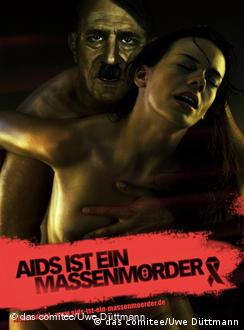
Is Invoking Hitler the Right Way to Fight the AIDS Epidemic?


Germany's latest AIDS-awareness commercial evokes some strong emotions: shock, disgust, nausea. And that's exactly the point. The controversial ad, which was released online on Sept. 3 and starts running on German TV on Wednesday, shows a couple having steamy sex in a dimly lit room with menacing music playing in the background. The viewer only sees the back of the man's head until the very end, when the camera pans to his face — to reveal that he's Adolf Hitler. Then the slogan flashes across the screen: "AIDS is a mass murderer."

It's a strong message, but HIV/AIDS organizations in Germany are arguing over whether it's the right one. Rainbow, the AIDS awareness group spearheading the campaign — which also includes newspaper ads and posters featuring the images of other dictators like Stalin and Saddam Hussein — says it deliberately wants to provoke people, especially young Germans, into using condoms to help prevent the spread of HIV. "We want to give this terrible virus a face," Jan Schwertner, spokesman for Rainbow, tells TIME. "AIDS is a forgotten issue in Germany. It's been swept under the carpet. This shock campaign is necessary to get people thinking again."

Read the rest at Time.

Read an item about this on ABC News.

Read commentary by Shawn Syms on xtra.ca


Tuesday, September 1, 2009

How is Patricio Battani healthy?


How am I healthy? Well, let me put down this cheeseburger and tell you. I don’t often think of health only in terms of my physical body…if I did I would be in some big trouble! Health to me is about the total person…Body, Mind, Sprit, and Experience. I am healthy because I am Powerful and Free!

I have always been lucky enough to have parents who taught me accept everyone. When I came out my mother said “that’s nice…go clean your room!” The one person I never learned to accept was myself! Growing up I was always the kid who was made fun of. So I learned very early to play the victim. Nothing was ever my fault, I was fat because of my genetics, and I wasn’t stylish because I was poor, and so on and so on. That led to abusive relationships and broken hearts. Anyone feel sorry for me? Good, me either!

I would stand in front of mirror and pick myself apart, I told myself I was fat, ugly and that no one would ever want me. I degraded myself and played victim to the bondage of our society’s cookie cutter image. Finally this voice went off and said “SHUT UP!” That was the day that I realized I was who I was because I chose to be that way.

What is Power? Well, my parents always told me “Knowledge is power”. (Until they got the tuition bill and then my dad called and said “ignorance is bliss”) I see power as a choice and I had lost my Power and Freedom! I just handed all of that along with my self-esteem over to those “bullies” in life. The process of becoming powerful is like making a path through the Amazon. It’s about not knowing what is lying ahead but remembering where you come from.

I gain power these days by looking in that mirror and saying “Unlike Visa you do not need to be accepted everywhere…but like MasterCard you are Priceless!” In this process, I have learned to own my faults, character flaws, and how to be free. I am constantly working on who I am, but I choose to be powerful and therefore I am healthier because of it.

My health is about living my life free from the bondage of insecurities, taking back my power, and setting myself free! Oh and I stopped smoking and am losing weight, too!

Un fuerte abrazo de tu amigo,

Patricio Battani
South Bend, Indiana


How are you healthy?
Join in the conversation.
Tell us HERE. Send a pic to the same place.
And we'll blog it, right here.

Read past posts.
Learn more about the campaign.

Thursday, August 20, 2009

How is Kevin Jackson healthy?


I am healthy by living my life to the fullest. I bike ride, eat right, take my meds and get regular check ups.

My soul is also anchored in the Lord. My family and loved ones and especially my dog and a positive outlook on life help. All these things keep me healthy.

-- Kevin Jackson
Houston, Texas

How are you healthy?
Join in the conversation.

Monday, August 10, 2009

Lost generation: Are modern HIV campaigns failing younger gays?


via Pink News, by Ramsey Dehani

As someone reminded me recently, people born in the early nineties are now reaching adulthood. It is safe to say that these younger gays will not remember the images of the AIDS scare in the 1980s and 1990s.

With modern HIV advertising focusing less on condom use, are the younger generation being ill-advised on the dangers of unsafe sex?

The Terrence Higgins Trust (THT), Britain's largest sexual health charity, has recently launched a campaign called 'THIVK' aimed at knowing your HIV status and getting tested. It is the first 'testing' campaign in ten years.

Advertising advocating condom use has become harder to find, with many gay magazines containing none at all.

THT itself has come under scrutiny over its refusal to use hard-hitting campaigns because it does not want to "demonise" HIV sufferers.

The modern promotions are a world apart from the infamous 'tombstone' and 'iceberg' ads of the 1980s.

But it appears many people still "die of ignorance". With infection rates among gay men climbing 110 per cent between 1999-2007 (1,450 cases to 3,050), there is an argument for more hard-hitting campaigns.

I spoke to a 20-year-old gay student about his views on safe sex. He said: "Condoms are really important. I always try to use them." But he added: "Sometimes I forget though, especially when I'm drunk."

Read the rest.

***Interested in how porn, and bareback porn, affects our sexual desires and practices? Are videos depicitng edgy sex a hot but safe way to get off, or does condomless porn signal a dangerous normalizing of risk? Join us for "Risky Business - Reclaiming Pleasure" - a live podcast forum at the Center on Halsted this coming Monday, August 17. Click here for more info, and to RSVP for this free event. We will talk about the kind of sex, intimacy, fantasies and pleasure we crave, and how we can get there.


Wednesday, July 29, 2009

How is Jim Pickett healthy?


I have the good fortune to be able to travel - one of the greatest joys of my life. Chicago is my home and my favorite place in the world - but it is always a treat to leave and explore new places, food, cultures, people.

The act of getting away - out of my normal, harried routine and surroundings - allows me to toss my day-to-day responsibilities, re-charge, reflect and ultimately remember who I am.

Oh yeah, I am not just a cog in the machine that spits out work product every day - talking and emailing incessantly - I actually have interests that extend beyond my professional obsessions and obligations. WOW! Nice to recall. It's the act of travel that brings me back to myself and keeps me healthy.

Where I can improve - NOT checking email or the CrackBerry while on holiday. I still find myself doing too much of that. And the worrying and the fretting that goes along with it. Perhaps its the narcissistic belief that the world may just stop revolving if I don't weigh in on something or the other. And/or the Type A on steroids personality. Am making progress, however, which is really all you can ask for, isn't it.

Luckily my partner is wonderful to travel with - we are both easy going, relatively adventurous and like to do the same things (eating and drinking for two) and each of us tends to take turns having the occasional meltdown while the other keeps the boat from capsizing. For instance - last year, when we were trying to depart from the Seven Rings of Hell that is the New Delhi airport - he remained calm as I was about to be arrested for getting sssssuper ssssssnarky with an armed guard. For my part, I maintained my cool - even giggling a little - as he insanely chased various airport staff around the mayhem DEMANDING ANSWERS... that never materialized, natch. If we had both been in crazed lunatic mode at the same time, we'd likely never have made it out of that awful, awful place. A nice little set-up we have.

I have had some challenges with my mental and emotional health over the last few years - part of it no doubt comes with the territory of living with HIV for 14 years. And being nuts. So, hopping on that jet plane and zipping off to Cape Cod or Cape Town is often just the ticket - with a Lexapro chaser... and Ambien for those long-hauls.

-- Jim Pickett
Chicago


How are you healthy?
Join in the conversation.
Tell us HERE. Send a pic to the same place.
And we'll blog it, right here.

Read past posts.
Learn more about the campaign.

Related Posts Plugin for WordPress, Blogger...

select key words

2007 National HIV Prevention Conference 2009 National LGBTI Health Summit 2011 LGBTI Health Summit 2012 Gay Men's Health Summit 2012 International AIDS Conference ACT Up AIDS AIDS Foundation of Chicago Africa BUTT Bisexual Bisexual Health Summit Brian Mustanski Center on Halsted Charles Stephens Chicago Chicago Black Gay Men's Caucus Chicago Task Force on LGBT Substance Use and Abuse Chris Bartlett Coaching with Jake Congress David Halperin David Munar Dr. James Holsinger Dr. Jesus Ramirez-Valles Dr. Rafael Diaz Dr. Ron Stall ENDA Ed Negron Eric Rofes FTM Feast of Fun Feel the love... Friday is for Faeries Gay Men's Health Summit 2010 HCV HIV HIV care HIV drugs HIV negative HIV positive HIV prevention HIV stigma HIV strategic plan HIV testing HIV/AIDS HPV Howard Brown Health Center IML IRMA Illinois International AIDS Conference Jim Pickett LGBT LGBT adoption LGBT culture LGBT health LGBT rights LGBT seniors LGBT youth LGBTI community LGBTI culture LGBTI health LGBTI rights LGBTI spirituality LGV Leon Liberman LifeLube LifeLube forum LifeLube poll LifeLube subscription Lorenzo Herrera y Lozano Lymphogranuloma Venereum MRSA MSM Monday Morning Perk-Up National AIDS Strategy National Gay Men's Health Summit One Fey's Tale Peter Pointers Pistol Pete PnP PrEP President Barack Obama Presidential Campaign Project CRYSP Radical Faerie STD Senator Barack Obama Sister Glo Sisters of Perpetual Indulgence Susan Kingston Swiss declaration Ted Kerr Test Positive Aware Network The "Work-In" The 2009 Gay Men's Health Agenda Tony Valenzuela Trans Gynecology Access Program Trans and Intersex Association Trevor Hoppe Who's That Queer Woof Wednesday You Tube abstinence only activism advocacy african-american aging issues anal cancer anal carcinoma anal health anal sex andrew's anus athlete ball scene bareback porn barebacking bathhouses bears big bold and beautiful bisexuality black gay men black msm blood ban blood donor body image bottom chubby chaser circumcision civil rights civil union communication community organizing condoms crystal meth dating dating and mating with alan irgang depression disclosure discrimination domestic violence don't ask don't tell douche downlow drag queen emotional health exercise female condom fitness gay culture gay identity gay latino gay male sex gay marriage gay men gay men of color gay men's health gay pride gay rights gay rugby gay sex gay youth gender harm reduction hate crime health care health care reform health insurance hepatitis C hiv vaccine homophobia homosexuality hottie hotties how are you healthy? human rights humor hunk immigration international mr. leather internet intimacy leather community leathersex lifelube survey love lube lubricant masturbation mental health microbicides middle music negotiated safety nutrition oral sex physical health pleasure podcast policy politics poppers porn post-exposure prophylaxis prevention prostate prostate cancer public health public sex venues queer identity racism recovery rectal microbicides relationships religion research safe sex semen sero-adaptation sero-sorting seroguessing sex sexual abuse sexual addiction sexual health sexual orientation smoking social marketing spirituality stigma stonewall riots substance abuse treatment substance use suicide super-bug superinfection syphilis testicle self-examination testicular cancer testing top trans group blog transgender transgender day of remembrance transgendered transmen transphobia transsexual universal health care unsafe sex vaccines video violence viral load writers yoga youtube