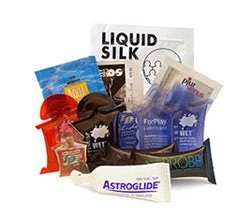
Showing posts with label lubricant. Show all posts

Wednesday, February 23, 2011

MORE ON LUBE: Study Authors Call for More Testing of Personal Lubricant Safety

via About.com, by Cory Silverberg

Last May two studies were released that got a lot of attention for pointing out the potential role personal lubricants might play in STD transmission during anal intercourse. Specifically, lab studies raised the possibility that lubricant could actually make transmission easier by irritating the rectal lining.

The work was supported by the interdisciplinary group, International Rectal Microbicide Advocates, who have been doing their best to help researchers and health care providers contextualize the findings so they are neither blown out of proportion, nor cast aside as irrelevant.

This week more findings were published in the journal AIDS Research and Human Retroviruses. Researchers studied forty-one brands of lubricants (taken from the IRMA list of most frequently used lubricants), looking for any anti-HIV-1 activity, toxicity, and essentially the salt content of lubricants that could contribute to damage at the cellular level.

Read the rest.


Wednesday, February 16, 2011

Lube Alert! Population Council Releases New Data on Safety of Lubes Used for Anal Sex

via AIDSmeds, by David Evans

A forthcoming research report suggests a number of personal lubricants can damage anal tissue cells and increase HIV replication, potentially heightening the risk of contracting HIV, notably if condoms aren’t used.

The “personal lubricant” market is a thriving one. One popular website sells 53 different brands, with many boasting several varieties. If you’d like one that tastes like fruit or chocolate, or adds the sensation of heat, you’ve got multiple options to choose from. The same goes for the degree of slipperiness, the type of sex you want to have, the ease of cleanup and, most important, condom compatibility.

What sexual accoutrement retailers can’t tell you is whether a lube will increase, decrease or have no effect on your chance of becoming infected with HIV if the condom breaks or you decide not to use a condom in the first place. Until recently, it wasn’t a question high on the list of researchers’ or manufacturers’ priorities—lubes are intended to keep condoms from tearing during sex, end of story. But for scientists at the Population Council, a New York City–based research organization at the forefront of HIV microbicide development efforts, the positive or negative effects of lubricants on HIV transmission has been a nagging issue for years.

New research results from the nonprofit organization suggest there may be reasons for concern. According to laboratory studies the group conducted—on schedule to be published in a forthcoming issue of AIDS Research and Human Retroviruses and currently available online—a large number of popular lubes may actually make it easier for HIV to get past the body’s defenses, notably during anal sex without a condom. Even more alarming is the finding that four lubes in particular cause HIV to reproduce up to four times faster than it does in the absence of such products.

Read the rest.

Read the Q&A on Lube Safety produced by IRMA - International Rectal Microbicide Advocates.

PODCAST: LifeLube Helps Get Your Butt Out of the Sand

via Feast of Fun (one of the exclusive places LifeLube advertises, cuz they're worth it)

Your body is a magical wonderland waiting to be explored, but proceed with caution because risks may be lurking around the backside. You can’t just stick your butt in the sand and pretend there’s nothing behind there to deal with.

Today health advocate (and LifeLube minion) Jim Pickett joins us to answer your vital questions about your butt. Yes, your derriere, your bon bon, your gluteus maximus, because overcoming our bashfulness over the booty is key to gay men’s health.(And rectal microbicides too!)

Why do gay men enjoy anal sex? How do I know if my boyfriend is good for me? Are some types of lube safer than others? How do I keep my booty fresh and fabulous?

Plus we take a closer look at the Asset Based Lifestyle- the secret every gay man needs to know about focusing on what works in your life in order to bring about the change you need to shine.

And of all the hot hot hot news... Listen.

Friday, October 15, 2010

IRMA releases lube safety documents; helps explain current research


Yesterday, our friends at IRMA (International Rectal Microbicide Advocates) released two important documents to help you gain a better understanding of the safety issues around lubricants used for anal intercourse. You may remember that some new research came out in May that threw into question the the safety of the lubes we're putting up our booties.

Many men, women and transgender people use lubricants (lubes) during sexual intercourse. Yet we know very little about their safety when used during anal intercourse (AI).

Very few studies have examined the effect of lubes on human rectal tissue, but those that did showed mixed results. Most water-based lubes tested in these studies were shown to be damaging to rectal tissue. However, some lubes were more damaging than others. Furthermore, in one study the use of lube for AI was associated with the presence of rectal sexually transmitted infection (STI).

Based on current evidence:
  • More research is urgently needed to explore if there is a link between lube use and acquiring HIV and/or rectal STIs.
  • It is unclear whether any particular type or brand of lube might increase, decrease or have no effect on acquiring HIV and/or rectal STIs.
  • Using male or female condoms is still considered the best way to prevent acquiring HIV and STIs during AI. In addition, the use of condom-compatible lubes has been associated with a decreased risk of condoms breaking or slipping.
  • It is not possible at this time to recommend for or against using lubes if having AI without condoms.
  • Lube use on its own is not a proven method of HIV or STI prevention.
For more detailed information:

Monday, August 2, 2010

More lube, more fun - India spices up the condom

Now, gays can play safe
via Mid Day, by Alisha Coehlo (Mumbai)


Excerpt:
A preliminary feedback indicates that discomfort was one of the major reasons why same sex couples do not use condoms during intercourse. Since most condoms are suited for vaginal and not anal sex, the new 'gay condom' will contain extra lubrication. 

"We are still in the process of developing the product. As far as the costing goes, we are still unsure if it must be sold in the socially marketed category or in genera one. However, this concern is secondary to product development," said an executive from the company's family planning trust, requesting anonymity. The new condom will be called Spice Up.
Read all of it. 

Wednesday, July 7, 2010

Peter, I need some info on the safety of lubes, lubricated condoms, and SKYN!

[Peter Pointers is here 4 YOU, as a service to LifeLube readers - whatever question you may have regarding sexual health, physical health, mental/emotional and spiritual health - ask him. He will find the answers you are looking 4. helped by a team of experts. Below is a recent Q&A you may be interested to read.]


 Question:  I have recently read that a study indicates that the most common lubes can cause anal tissue damage, and that the brands that do not cause such damage are PRe and Platinum Wet.  So, I am switching to these.  However, most condoms come pre-lubed, and there is no information on what they are lubed with. Do you recommend using non-lubed only, and using the safest lubes, or is there so little lube on the lubed condoms for it to be inconsequential?

Also, when I went to get the new (and much more expensive) lube, a clerk steered me to a new type of condom, SKYN by Lifestyle.  On their web page they discuss polyisoprene and polyurethane condoms as alternatives to latex. I have gotten myself through the AIDS epidemic without infection thanks to latex, but the clerk says these new non-latex condoms feel better, and I'd like to go with them, but is there research about how they hold up in anal intercourse?  What do you think are the best condoms for safety?


Answer: Thank you for your question.  I'm happy that you have been so successful with condom use throughout the last few decades.  Keep that up - because despite anything we talk about here, that is still your best security against HIV and other infections.

Regarding the recent studies looking at lubricants and anal tissue, the jury is still out. It sounds like you have a good grasp of what the studies found, but there is a lot of information that remains missing.  In fact, Beau Gratzer, the Director of HIV/STD prevention at Howard Brown Health Center states, "we do not have enough info/data to make definitive statements one way or the other about the safety of specific lubes" based on the two recent studies.

And Jim Pickett, Director of Advocacy at the AIDS Foundation of Chicago and chair of IRMA -  International Rectal Microbicide Advocates, agrees, "We are not sure if the lab findings translate into the real world. And the epidemiological study (which showed a correlation between lube use and rectal sexually transmitted infections among respondents in LA and Baltimore, whether condoms were used or not) did not have enough info on the lubes used to make any conclusions."

There certainly needs to be more investigating!

So what do we know?

-One of the most important messages from both of the above professionals is that, regardless of what lube you use, your history of successfully using condoms has been the most critical protective factor for you.  Using condoms with lube is still the gold
standard for protecting oneself because lube prevents condom breakage.

-The finding of the studies, while incomplete, are most important to situations where condoms are used inconsistently, incorrectly, or not at all.

-Definitely, it is important to avoid any lubricants containing Nonoxyl-9 (N-9), which years ago, was found to be damaging to anal linings.  Some condom companies (Trojan and Lifestyles) do still have N-9 in their condoms.  So, avoid any condoms containing N-9 or other spermicides. Spermicides do not kill HIV or other STDs.

There are many reasons why the research into lubricants is difficult. I have a rather lengthy statement from IRMA, a group that does a lot of advocacy around anal lubricants.  I would be happy to share it if you want more information.

Now, regarding condoms that are pre-lubed, I am unable to find much information on the specific lubes that they use.  Their product websites may give a little more info, but they do not tell what the specific chemical make-up is or what the specific brand they use is.

About the second part of that question:

The SKYN condom is a -plastic- condom, so it is a little different that latex. Polyurethane and polysoprene condoms were originally developed for people that suffer from a latex allergy.  All three of these condoms are effective at preventing HIV/STDs and are approved by the FDA.  Polysoprene is a little stretchier than the polyurethane condoms that were the earlier alternative to latex.  Non-latex condoms also conduct heat better than latex, so some people prefer them.  Feel free to try out the SKYN condom if you'd like.  Just like with latex condoms, using lube will reduce the chances that it will break.  There is lots of information out there about the differences in these condoms, so feel free to read more here [sorry for the pregnancy/heterosexist viewpoint] and here.


Be Well,
Peter
Peter Pointers on LifeLube, Friend Peter on Facebook


What do  you think about the advice Peter Pointers gives?   
We'd like to learn what you think by taking this very short survey. 
Please take a couple seconds and fill it out. Thank you!

Friday, June 18, 2010

Got Lube? Sure, but is it safe?

via Windy City Times, by Bob Roehr

Water-based lubes that scored poorly were Astroglide, Elbow Grease, ID Glide and K-Y Jelly. 


New research has found that some lubricants used in anal or vaginal sex can cause damage to those tissues that can leave people more vulnerable to sexually transmitted infections, including HIV. 

Surprisingly, this is the first time that anyone has even looked at the question of whether basic sexual lubricants can cause damage to rectal tissue. The studies were presented at the Microbicides 2010 conference in Pittsburgh at the end of May.

Read the rest.

[More lube info/discussion here, on the International Rectal Microbicide Advocates' blog.]


Monday, May 31, 2010

Understanding New Research on Lubricant Use During Anal Intercourse

[great article - a must for anal sex enthusiasts!]


via About.com's Sexuality Blog, by Cory Silverberg

Excerpt:
As usual, sexual pleasure isn't being talked about at all, and this too needs to be addressed in both the conducting and reporting of future research. The end goal of all this research is awareness of risk and behavior change. We aren't talking about dental hygiene here. We are talking about activities people engage in for a reason, and sexual pleasure is often part of that reason. To talk about anal intercourse and lubricant, particularly to talk about lube as a risk factor, outside of the context of pleasure makes sense only in the lab, only in theory. It doesn't matter how good the research is, if you want to affect change in people's lives, you have to speak to us in a way that we can connect with. If the only argument you make for behavior change is numeric, it might scare us for about three minutes, but it's not likely to help us at all.
Read the whole thing.

Thursday, May 27, 2010

LUBE MANIA!

The whirlwind of anal lubricant news - let's get a grip!

via the International Rectal Microbicide Advocates (IRMA)

Many of you have likely come across some new research that was recently presented at the Microbicides 2010 conference calling into question the safety of lubricants used for anal sex.

Check out this post from IRMA for some important context/perspective. And keep your panties un-bunched and the pearls un-clutched.

Tuesday, March 9, 2010

Grease Guns and Lube Launchers - making anal sex easy, breezy

LifeLube was surfing porn and politics over the weekend and came upon a product called The Lube Launcher on the adam4adam website. The Launcher is gadget designed to make it easier to apply the lube of your choice prior to the ole anal in-and-out.

Not only does the device look handy AND dandy, but we were especially interested by it in terms of rectal microbicides - anti-HIV products in development that could be inserted into sexual lubricants and provide protection in the absence of condoms. There is a lot of research going on to develop an applicator to deliver such a rectal microbicide once one is approved - and we think researchers just might want to check out the devices that are out there already. No one really thinks about getting a "dose" of lubricant - right - but rectal microbicides will need to be applied in very specific quantities to be effective. A Lube Launcher could be just the ticket. 


And in the meantime, why not give it a sit-and-spin?

Other similar products you can find on the site: The Aneros Marksman Lube Shooters, The Grease Gun, Water-Based Anal Lube Shooters.

Wednesday, February 17, 2010

The Advocate shows some love for booty butter researcher/advocate Leo Colemon


There is a condom fatigue within our community. Gay men like the natural feeling, and I look to a future with that being an option. That’s what rectal microbicides will do.

Leo is one of 23 LGBT people profiled regarding their "perfect" jobs in the March 2010 edition of The Advocate. Check out his blurb below.


LEONARDO COLEMON
Research manager in epidemiology
Los Angeles, 37

Gay men have long had a complicated relationship with condoms. Anyone who’s fought a losing battle with a prophylactic due to a latex allergy or loss of an erection may one day owe a debt of gratitude to Leonardo Colemon. The affable Mississippi native manages a team of researchers at the University of California, Los Angeles, and in collaboration with Pamina Gorbach and Peter Anton is developing a lubricant that would be applied to a receptive partner prior to anal sex. This lube (referred to as “booty butter” in an online educational video produced by the group) will contain microbicides designed to kill HIV and other STIs to a certain degree. “There is a condom fatigue within our community,” Colemon says. “Gay men like the natural feeling, and I look to a future with that being an option. That’s what rectal microbicides will do.” This cutting-edge infection-prevention tool is “being developed and targeted to men who have sex with men and don’t use condoms consistently,” says Colemon. “But it will also be useful to heterosexuals who want safer options for anal intercourse.” Colemon, who also volunteers as an HIV/STI counselor at the Los Angeles Gay and Lesbian Center, notes that Food and Drug Administration approval could take five to 10 years, and he readily admits that while rectal microbicides “are unlikely to be 100% effective, they will certainly reduce the potential for transmission.
Read about other folks with cool jobs.

Learn more about rectal microbicides at the International Rectal Microbicide Advocates (IRMA) website.

Friday, November 13, 2009

Showin' Us the Money - Rectal Microbicides Get a Healthy Raise


Magee-Womens Research Institute Receives $17.5 million 

for Rectal Microbicide Research


Dr. Ian McGowan* (pictured below), an investigator with the Magee-Womens Research Institute (MWRI), recently received a total of $17.5 million from the National Institutes of Health (NIH) to conduct two studies involving the development of rectal microbicides.

"This is exciting for the field of HIV prevention research, and especially important in terms of moving the research and development of rectal microbicides forward," said McGowan. "We applaud the leadership and vision of our sponsors at the NIH."
[Microbicides are topical products that can be applied to the rectal or vaginal mucosa with the intent of preventing, or at least significantly reducing the risk of HIV acquisition in either compartment.]
Recognizing the fact that women in the developed and developing world are at risk of HIV infection through anal and vaginal intercourse, the Microbicide Trials Network (MTN), based at MWRI, is currently evaluating the rectal safety of microbicides designed for vaginal use.

Dr. McGowan’s new studies focus the research towards developing microbicide products specifically designed for rectal use.

The first grant is entitled the Combination HIV Antiretroviral Rectal Microbicides or CHARM program. This is an $11 million, five year, multicenter U19 grant that brings together research groups from the University of Pittsburgh, University of North Carolina, Johns Hopkins Medical School, CONRAD, and the University of California at Los Angeles. The U19 grant is part of the NIH funded Integrated Preclinical Clinical Program and is intended to advance candidate microbicides from discovery into early clinical development.

The second grant is a $6.5 million, four year, R01 grant entitled Microbicide Safety and Acceptability in Young Men with Dr. Alex Carballo-Dieguez as the Co-Principal Investigator. The focus of this grant is to evaluate the safety and acceptability of rectal microbicides in young, ethnic minority men who have sex with men (MSM). Funding for this study comes from the National Institute of Child Health and Human Development as well as the National Institute of Mental Health and will generate critical data from a population of young African American and Latino men who are at the highest risk of HIV infection in the United States. Clinical trial sites will be in Pittsburgh, Boston, and Puerto Rico.

"We need to develop safe, effective, acceptable and accessible rectal microbicides for the millions of women and men worldwide who need options beyond condoms," said Jim Pickett, chair of the International Rectal Microbicide Advocates (IRMA) said. "Our global network of advocates, scientists, policy makers and funders is encouraged to see this work moving forward."

Together with ongoing MTN rectal safety studies and another collaborative grant with the University of Oxford, UK, these two new grants establish MWRI as a leading center for rectal microbicide translational research and will hopefully lead to the development of safe and effective products for individuals at risk of HIV infection through unprotected receptive anal sex.
 

* Dr. McGowan is also a Professor of Medicine in the Division of Gastroenterology, Hepatology, and Nutrition at the University of Pittsburgh Medical Center, with a secondary appointment in the Department of Obstetrics, Gynecology and Reproductive Science.

Thursday, September 17, 2009

Craptastic - Rick Santorum's Presidential Poo Problem

via Truthdig

Rick Santorum (pictured above with his family) is thinking of running for president, but he has a serious PR problem. The former senator’s rampant homophobia inspired sex columnist Dan Savage to launch a campaign to usurp the conservative’s name. The result: If you type “Santorum” into Google, you’ll find that, in addition to a former senator, it refers to “that frothy mixture of lube and fecal matter that is sometimes the byproduct of anal sex.”

A Web site launched by Savage to propagate the new word ranks among the top spots in Google’s search results, as of this writing. Also rotating at the top were a Wikipedia article on the former senator and another Wikipedia article titled “Santorum (sexual neologism),” which is quoted below.

Comparing a U.S. senator to the byproduct of anal sex may be sophomoric, but is it more offensive than saying, as Santorum did in 2003, “If the Supreme Court says that you have the right to consensual [gay] sex within your home, then you have the right to bigamy, you have the right to polygamy, you have the right to incest, you have the right to adultery. You have the right to anything”? —PS

Read the rest.

Thursday, May 7, 2009

Who would you rather sleep with?

The fear attached to sex with positives
is deeply misplaced.


via NOMOREPOTLUCKS, by Nicholas Little

When Ontario’s campaign against HIV stigma within the gay community came out last fall, some men (mostly HIV- men, but some poz guys too) reacted negatively to the campaign slogan: If you were rejected every time you disclosed, would you?

While delivering campaign materials to one of the local gay bars a few months back, the bartender cornered me and said, "I don't like that message." When I asked him why, he said, "Well, what is it saying? That it's okay for poz guys not to disclose? Are they trying to excuse non-disclosure because rejection hurts so bad?"

These questions weren't always easy to answer, and this campaign really stretched my thinking as a result. As an outreach worker with gay men, I was meant to be able to answer questions just like these.

I actually like the slogan because it is provocative and probably accounts for much of the attention that this campaign received. The success of HIV prevention campaigns aren't measured in terms of the number of viewers reached, but rather in the appreciable ways they improve people's lives, thereby leading to reduced HIV transmission rates. But you have to get people paying attention to, thinking about and discussing your message if it's going to have any impact. A controversial slogan helped make this happen.

I think folks who disliked the campaign slogan felt most uncomfortable when they read it as being aimed at HIV+ men. The campaign is, in fact, targeting HIV- guys. It isn't saying, "Hey poz guys, sick of negative assholes treating you like shit each time you stick your neck out and disclose your status? Well then just don't bother!" Rather, it’s saying, "Hey negative guys! (or perhaps: Hey guys who think you are negative!...) We know the vast majority of you would very much like to remain HIV- and that's a worthy goal. But a lot of you are trying to remain negative by keeping HIV+ men as far away from you as possible. And science shows that that strategy just doesn't work. So let's rethink things a little."

Read the rest.


Monday, March 9, 2009

Darkroom safety tips


by Tony Valenzuela, via The Guide

I was christened into the rituals of darkroom sex by blunder. New York's Wonder Bar in the East Village had a walk-in-closet-sized backroom when I visited in 1995. I entered through a tarp-like curtain and paused at the doorway, hesitating long enough to annoy the breathy men inside who glowered at the beam of light I was allowing to slice through the room. Using my hands as eyes I treaded carefully, shifting through gropes and hairy tentacles and settling on some thick arms that shoved me to the ground. When I was vertical again and ready to leave I dusted myself off, patted myself down and noticed my wallet was no longer in my back pocket.

Read the rest.

Saturday, January 3, 2009

Culture made him do it?


Sometimes I think the best way to lower the incidence of HIV transmission would be to stop talking about anal sex. No more talk of anal sex, condoms, lube, water-based this or that. Ditch the lot.

Read the rest on Xtra.ca

Friday, December 28, 2007

N-9 contraceptives must carry warning label... but not condoms


[LifeLube tip - check that condom before you buy it or use it. If it contains nonoxynol-9, N-9, as many Trojan and Lifestyle brand condoms do... don't use it! Instead, use a condom that doesn't have this dangerous ingredient! Buy and use Durex, Kimono and Johnson and Johnson brand condoms - none of which have N-9.]

The federal Food and Drug Administration is adopting a new rule that will require warning labels on contraceptive products that contain the spermicide nonoxynol-9 but the federal agency is delaying the establishment of a similar rule on condoms containing N-9.

"It's still not sufficient," said Judy Auerbach, the deputy executive director of science and public policy for the San Francisco AIDS Foundation.

Echoed Anna Forbes, the deputy director for Global Campaign for Microbicides, "It seems to me that they are completely stalling about this."

The FDA is considering labeling requirements for N-9 condoms separately because it classifies condoms as "medical devices." The two major manufacturers of N-9 condoms, Church and Dwight, the makers of the Trojan brand, and Ansell, the maker of the LifeStyles brand, wrote to the FDA suggesting that warning consumers about N-9 condoms could be confusing and could cause fewer consumers to use condoms at all.

That objection was the major factor in causing the FDA to delay N-9 labeling rules.

Citing that objection, the FDA opted to study the issue further. The first phase of the study will be completed by February and the second phase, which will take about 17 weeks, will begin after the FDA analyzes the first study, according to FDA spokeswoman Peper Long.

A number of organizations, including the Global Campaign for Microbicides and SFAF, have called for the removal of N-9 from condoms.

Read the rest in the Bay Area Reporter.

Monday, November 5, 2007

World Premiere of Survey Results re: Lubes Used for Anal Sex


LifeLubers ---- many of you participated in the survey on lubricants used for anal sex - nearly 9,000 people in fact took part from 108 countries!

Thank you from the bottom of our, well, bottoms!

[remember this little ad?]

This coming Thursday, November 8, the International Rectal Microbicide Working Group (www.IRMWG.org) will be holding a teleconference releasing some of the preliminary results. You are invited to call in and be the first to hear all the juicy data.

World Premiere!

Preliminary Results of Global Lube Survey

Please join IRMWG November 8, 2007 for our next teleconference and get a first glimpse of the data from our global lube survey. This “World Premiere” will focus on general findings from the quantitative data from the surveys, which has been analyzed by our stellar colleagues at UCLA: Ryan Murphy, Marjan Javanbakht and Pamina Gorbach. As analysis continues, we will be able to provide more updates in the future, including the qualitative data.

Click www.IRMWG.org for all the info, including call time and toll-free dial-in instructions.

Speakers: Ryan Murphy from UCLA and Marc-André LeBlanc, IRMWG Secretary and Lube Survey Coordinator.

Many thanks to AVAC for hosting the call.


Related Posts Plugin for WordPress, Blogger...

select key words

2007 National HIV Prevention Conference 2009 National LGBTI Health Summit 2011 LGBTI Health Summit 2012 Gay Men's Health Summit 2012 International AIDS Conference ACT Up AIDS AIDS Foundation of Chicago Africa BUTT Bisexual Bisexual Health Summit Brian Mustanski Center on Halsted Charles Stephens Chicago Chicago Black Gay Men's Caucus Chicago Task Force on LGBT Substance Use and Abuse Chris Bartlett Coaching with Jake Congress David Halperin David Munar Dr. James Holsinger Dr. Jesus Ramirez-Valles Dr. Rafael Diaz Dr. Ron Stall ENDA Ed Negron Eric Rofes FTM Feast of Fun Feel the love... Friday is for Faeries Gay Men's Health Summit 2010 HCV HIV HIV care HIV drugs HIV negative HIV positive HIV prevention HIV stigma HIV strategic plan HIV testing HIV/AIDS HPV Howard Brown Health Center IML IRMA Illinois International AIDS Conference Jim Pickett LGBT LGBT adoption LGBT culture LGBT health LGBT rights LGBT seniors LGBT youth LGBTI community LGBTI culture LGBTI health LGBTI rights LGBTI spirituality LGV Leon Liberman LifeLube LifeLube forum LifeLube poll LifeLube subscription Lorenzo Herrera y Lozano Lymphogranuloma Venereum MRSA MSM Monday Morning Perk-Up National AIDS Strategy National Gay Men's Health Summit One Fey's Tale Peter Pointers Pistol Pete PnP PrEP President Barack Obama Presidential Campaign Project CRYSP Radical Faerie STD Senator Barack Obama Sister Glo Sisters of Perpetual Indulgence Susan Kingston Swiss declaration Ted Kerr Test Positive Aware Network The "Work-In" The 2009 Gay Men's Health Agenda Tony Valenzuela Trans Gynecology Access Program Trans and Intersex Association Trevor Hoppe Who's That Queer Woof Wednesday You Tube abstinence only activism advocacy african-american aging issues anal cancer anal carcinoma anal health anal sex andrew's anus athlete ball scene bareback porn barebacking bathhouses bears big bold and beautiful bisexuality black gay men black msm blood ban blood donor body image bottom chubby chaser circumcision civil rights civil union communication community organizing condoms crystal meth dating dating and mating with alan irgang depression disclosure discrimination domestic violence don't ask don't tell douche downlow drag queen emotional health exercise female condom fitness gay culture gay identity gay latino gay male sex gay marriage gay men gay men of color gay men's health gay pride gay rights gay rugby gay sex gay youth gender harm reduction hate crime health care health care reform health insurance hepatitis C hiv vaccine homophobia homosexuality hottie hotties how are you healthy? human rights humor hunk immigration international mr. leather internet intimacy leather community leathersex lifelube survey love lube lubricant masturbation mental health microbicides middle music negotiated safety nutrition oral sex physical health pleasure podcast policy politics poppers porn post-exposure prophylaxis prevention prostate prostate cancer public health public sex venues queer identity racism recovery rectal microbicides relationships religion research safe sex semen sero-adaptation sero-sorting seroguessing sex sexual abuse sexual addiction sexual health sexual orientation smoking social marketing spirituality stigma stonewall riots substance abuse treatment substance use suicide super-bug superinfection syphilis testicle self-examination testicular cancer testing top trans group blog transgender transgender day of remembrance transgendered transmen transphobia transsexual universal health care unsafe sex vaccines video violence viral load writers yoga youtube