Showing posts with label violence. Show all posts

Friday, February 10, 2012

Legalized Hate in Uganda?

via HuffPost Gay Voices, by Kerry Kennedy

On Tuesday, Feb. 7, hours before the Ninth Circuit ruled "Prop 8" unconstitutional in the state of California, raucous cheers rang out in the Ugandan Parliament as legislators reintroduced a controversial bill that would in effect legislate hate against the Ugandan lesbian, gay, bisexual, transgender, and intersex (LGBTI) community.

The proposed bill, known as the Anti-Homosexuality Bill (AHB), would compel families, doctors, and counselors to report on all those suspected of being members of the LGBTI community, and would impose criminal sanctions, possibly even the death penalty, for those who fail to turn in their fellow citizens.

Combined with other proposed legislation before the Parliament, like portions of the HIV/AIDS Prevention Control Bill, the AHB would also hinder Uganda's HIV-prevention efforts, contributing to the alarming rise in HIV infection rates.

This poses a serious threat to the rights and freedoms of all Ugandans and is a clear violation of international law. It denies LGBTI citizens their rights to health care, education, and work.

It creates an atmosphere of hate, intolerance, and fear. It criminalizes the actions of civil society organizations and individual citizens who work to defend the legal rights of their fellow Ugandans.

And it puts the imprimatur of the law behind discrimination based on sexual orientation or gender identity.

This is a blatant suppression of the rights of all Ugandans and an attempt to curtail the freedoms of speech and assembly of a vibrant civil society in Uganda.

The bill's supporters claim to be acting in the name of protecting Ugandan children -- playing on the common prejudice that equates homosexuality with pedophilia.

In fact, the bill places children squarely in harm's way. The bill calls on Ugandan families to betray trust and turn in their siblings and children.

The bill would have doctors break confidentiality and deny care to Ugandans. In fact, this bill would disrupt Ugandan families, increase the HIV prevalence in the country, and set a frightening precedent for the silencing of rights advocacy of any group deemed undesirable by politicians.

Moreover, the bill's possible passage into law is not the only threat to Ugandans. The reintroduction of the bill imminently threatens the safety of the LGBTI community and the safety of anyone assumed to be LGBTI.

Vigilante violence and hate speech amplified by sensationalist media and homophobic rhetoric by religious leaders is all too real today in Uganda.

Across the country, LGBTI people already face physical attacks and rape, extortion by neighbors, and arbitrary arrest by police.

If we support the human and civil rights of our LGBTI citizens in the United States, we must also vigorously advocate against the passage of this bill and act to stop state-sanctioned homophobia from taking root in any country.

If we support human rights, we cannot ignore legalized brutality against any group of our global community.


Read the rest

Friday, July 29, 2011

Facebook's Randi Zuckerberg: Anonymity Online 'Has To Go Away'

via Huffpost

Facebook requires all members to use their real names and email addresses when joining the social network -- a policy that has been difficult at times to enforce, as the prevalence of spam accounts or profiles assigned to people’s pets suggest.

Zuckerberg, who is Facebook co-founder Mark Zuckerberg’s sister, argued that putting an end to anonymity online could help curb bullying and harassment on the web.

“I think anonymity on the Internet has to go away,” she said during a panel discussion on social media hosted Tuesday evening by Marie Claire magazine. “People behave a lot better when they have their real names down. … I think people hide behind anonymity and they feel like they can say whatever they want behind closed doors.”

Read more. 

Thursday, July 21, 2011

As tensions in Lakeview increase, community groups step up efforts

via Windy City Times, Kate Sosin

Many "Take Back Boystown" members aimed to clarify that they are not advocating for racial profiling in Lakeview, and comments on that page appeared considerably less controversial than in recent weeks, with few blaming youth of color outright for neighborhood crimes.

LGBT organizations stepped forward and offered their resources for mediating those discussions. Both Taskforce Prevention and Community Services, a West Side HIV-service organization, and Center on Halsted announced initiatives to deal both with crime and with LGBT youth issues.

Center on Halsted has taken heat in recent weeks from residents who claim that the organization attracts youth who loiter and commit crimes to the neighborhood. Modesto "Tico" Valle, CEO of the Center, had said the Center was helping the situation, not making it worse. Making good on that promise, Valle announced a new taskforce "to build a safer and more welcoming community" as well as new self-defense and conflict mediation classes for the community.

"These are challenging times for our community," said Valle in the July 15 announcement. "Now is the time to work together again so we can build a safer and more welcoming environment for all people."

Sitraka Andriamanantenasoa, the Center's new community relations director, also spent much of the week meeting with community members about their concerns and hopes for the Center.

Taskforce Prevention and Community Services announced its own taskforce for addressing similar issues.

Read more.

Monday, July 18, 2011

Queer advocacy group says youth being "scapegoated" for Boystown crime

 via GoPride.com

Young black man claims officer told him to go back to the south side....

A new video by a queer rights advocacy group, asserts that youth, particularly young people of color, are being "scapegoated" for the recent increase of reported crimes in Boystown. 

Video Action League says that homeless gay youth have been unfairly blamed for the "purported increase in crime" and that they wanted to give youth a space to "express themselves without the threat of being silenced."

"All the youth that hang around here are getting blamed for it," 24-year-old Cat, a lesbian who is homeless, said of the increased crime in Boystown.

"Our Youth Belong In Boystown," which was posted to YouTube on July 12, 2011, includes interviews with Cat and two African-American men, who have also been shunned by their family and community after coming out gay. 

"When people constantly call the police on me and harass me, it makes me feel less than a person," said Tyrone Strickland, who has been staying in Boystown since leaving his South Side neighborhood when he was 15 years-old.

."It's so important that we advocate for safe spaces for youth that aren't 21 so they have a community they can go to," Lindsey Dietzler, co-founder of the Video Action League, said at the end of the 7 minute video.

Read more.


Thursday, July 14, 2011

Boystown needs a reality check

via Redeye, By Lenox Magee

As a gay man from the South Side, I understand the plight of the youth who are congregating in Boystown.

We have no place to go on the South or West sides where we can be ourselves. Boystown is the one place where we can be "us" without looking over our shoulders, worried about whether we'll be verbally or physically attacked.

I don't visit Boystown as often these days, but it wasn't that long ago that I was that gay black teenager going to the North Side to walk around Halsted, take in the openly gay atmosphere and mingle with the locals. My friends and I used the neighborhood as meeting spots to talk and laugh in ways that just wouldn't be possible on the West or South sides.

But we didn't always get a warm reception. I vividly remember the strange looks from the locals that made us feel unwelcome in the one part of the city where we most wanted to belong. At the restaurants, service would be extra slow—even when the place was empty. It wasn't overt racism, but the message was clear: We weren't always welcome.

Read more.

Monday, July 11, 2011

Nervous days come to Boystown

via Chicago Sun-Times, By Laura Washington

Last week, a YouTube video of a mob brawl and stabbing went viral, creating widespread outrage and ubiquitous headlines.

Over the July 4 weekend, a midnight street brawl among a dozen or so young people hospitalized a 25-year-old man and fed fear and outrage among community residents and business owners. It was the third violent attack in the area in recent weeks, according to news reports.

It’s been a long time coming. For years, the neighborhood has been plagued by security concerns, racial antipathies, transgender intolerance, economic divides, business consequences, political gamesmanship and dysfunctional behaviors.

In Chicago, street crime is a growing and complex phenomenon. In Boystown, it is overlaid by a clarion call for diversity, personified by the Center on Halsted. When the nationally recognized LGBT oasis opened in 2007, the community came.

Those LGBT youths who came farthest — from the city’s South and West sides — had nowhere else to go, being pariahs in their own homes. Insidious and rampant homophobia in African-American communities sent them scrambling for the “safe” confines of Boystown. The Center offered an exhaustive and alluring smorgasbord of services. And an open door.

They came in droves and rainbow colors, looking for excitement, adventure, acceptance. Some — gay and straight — were looking for trouble.

Thursday, July 7, 2011

Diversity is Welcome - Crime is Not

Thank Goddess for young people. And thanks to Gay Chicago Magazine for taking and sharing this pic below.

Community activist Ed Negron (one of LifeLube's very BFFs) shot a ton of pics from the CAPS meeting last night in Lakeview, held to address the recent spate of violence in the neighborhood.

Check them out here on Facebook. And check out Windy City Times coverage of the event.

Wednesday, July 6, 2011

VIEWS Boystown Is Burning: Prejudice takes root in the community

via Windy City Times, Keith Ecker

Watch out Boystown! The Blacks are coming to get you! At least that's the message that some in the community seem to be broadcasting.

In response to violent criminal incidents in the gayborhood, Facebook users launched a page on June 28 called "Take Back Boystown." In one day, the group garnered more than 700 members. While some are thinking progressively by lobbying for increased citizen-led patrols and communication with police, others seem to be capitalizing on this issue to voice their racial prejudices.

For example, one fan of the page writes, "It's all of us innocent people that are being attacked by the blacks." Another echoes the words of many by placing blame on the Black GLBT youths that seek services at the Center on Halsted, posting that "We have a center full of 'kids' who don't live in the neighborhood just wandering around the streets because they lack the funds and/or age required to get into bars. So, what happens then? Well, I think we've all seen what happens..."

This ignorance reflects a growing schism that has taken root in Chicago's gay community. On one side are the mainstream gays. We are those who are portrayed in the mass and GLBT media and serve as the target audience for Lady Gaga and Glee. Politicians court us, and businesses cater to us.

On the other side are the disenfranchised gay Black youths. These young adults have no public platform. Many come from extraordinarily intolerant communities. Some are homeless. Few have much money to their names. For the mainstreams, it gets better. For the others, not so much.

Read more.

Wednesday, January 12, 2011

Transgender Homelessness and Safety Pilot Success

A pilot policy that allows transgender individuals to choose between staying in a men's or women's shelter has reduced trans-based violence in New York City.

Besides permitting transgender shelter-seekers to stay in shelters appropriate to their identity, the policy states that "staff will address individuals with names, titles and other terms appropriate to their gender identity" and "staff at Intake/Shelter assignments will receive training on diversity, transgender and intersex issues."

The policy defines transgender as "an umbrella term that includes anyone whose gender identity and/or gender expression does not match society's expectations of how an individual assigned a particular sex at birth should behave or appear." The broad definition includes people who are androgynous, drag queens or kings and cross-dressers.

The policy was implemented as a four-year pilot program in January 2006 at three men's and three women's shelters. The written policy has not been updated since the program's inception. But it now applies at all homeless shelters that receive city funding.

Read the rest.

Monday, January 10, 2011

The Climate of Hate - Krugman in the NYT

via New York Times, by Paul Krugman

Excerpt:
The point is that there’s room in a democracy for people who ridicule and denounce those who disagree with them; there isn’t any place for eliminationist rhetoric, for suggestions that those on the other side of a debate must be removed from that debate by whatever means necessary.

And it’s the saturation of our political discourse — and especially our airwaves — with eliminationist rhetoric that lies behind the rising tide of violence.
Where’s that toxic rhetoric coming from? Let’s not make a false pretense of balance: it’s coming, overwhelmingly, from the right. It’s hard to imagine a Democratic member of Congress urging constituents to be “armed and dangerous” without being ostracized; but Representative Michele Bachmann, who did just that, is a rising star in the G.O.P.

And there’s a huge contrast in the media. Listen to Rachel Maddow or Keith Olbermann, and you’ll hear a lot of caustic remarks and mockery aimed at Republicans. But you won’t hear jokes about shooting government officials or beheading a journalist at The Washington Post. Listen to Glenn Beck or Bill O’Reilly, and you will. 
Read the rest.

Sunday, January 9, 2011

Gay intern helped save Rep. Gabrielle Giffords' life; Tucson sheriff calls out vitriolic hate speech (video)

via ChicagoPride.com

"When I heard gunshots, my first instinct was to head towards the congresswoman to make sure that she was OK," Daniel Hernandez Hernandez told ABC's "This Week" on Sunday.

"I had to lift up the congresswoman, because she was severely injured, and I wanted to make sure that she was able to breathe OK because there was so much blood," he said. "We had to grab whatever we could. And because we were outside of a grocery store, the employees from the grocery store brought out smocks that are used by the meat department that were clean, so that we may use them as bandages, because that was really the only clean cloth that we had."

Read it all.

Wednesday, October 20, 2010

Bullying Only One Part of Violence Against Gay Youth


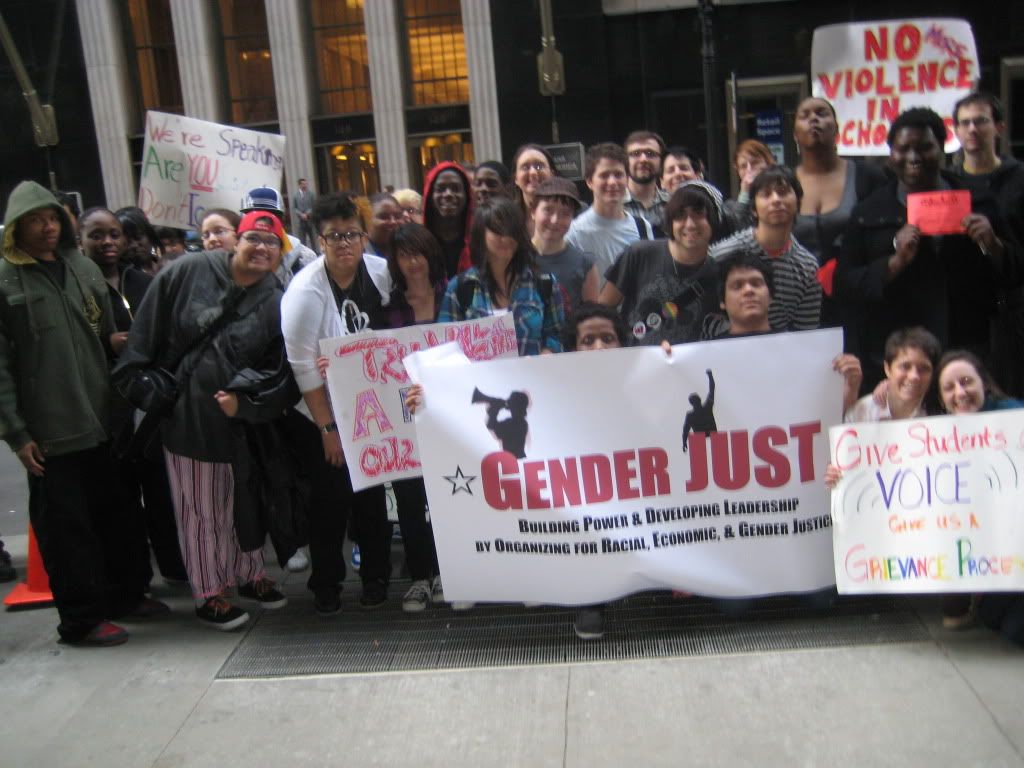
The nation has been totally swept up in Dan Savage's "It Gets Better" project, but Gender Just is skeptical about how much better it gets:

We have seen an overly simplistic and un-nuanced reaction to the recent violence; from Dan Savage telling young people to wait it out until "it gets better" and from Kathy Griffin declaring that passing Gay Marriage and overturning Don't Ask Don't Tell would somehow stop the violence in our lives, we have found this response to be as misguided, irrelevant, and offensive as the conservative LGBT Movement itself.

While youth violence is a very serious issue in our schools, the real bullies we face in our schools take the form of systemic violence perpetrated by the school system itself: a sex education that ignores queer youth and a curriculum that denies our history, a militarized school district with cops in our schools, a process of privatization which displaces us, increasing class sizes which undermine our education and safety. The national calls to end the violence against queer youth completely ignore the most violent nature of our educational experience.


Read the entire post at Gender Just.

Wednesday, July 21, 2010

Ensuring that Hook Up Comes with a Happy Ending

Hooking up online can be sexy good time, or it can be dicey/scary/deadly. There are some sick freaks out there who have no interest in getting off with you, and have other plans for your meeting.


The Center on Halsted has a great set of tips for leaving the virtual world and meeting Mister Right Now. You know, stuff like getting a face pic and phone number and first meeting in public.

Find out what a Silent Alarm is, and check out all the other great advice, here. And have a lovely time!

Friday, July 9, 2010

When Virtual Becomes Reality - tips to hook up safely

Hooking up online can be sexy good time, or it can be dicey/scary/deadly. There are some sick freaks out there who have no interest in getting off with you, and have other plans for your meeting.


The Center on Halsted has a great set of tips for leaving the virtual world and meeting Mister Right Now. You know, stuff like getting a face pic and phone number and first meeting in public.

Find out what a Silent Alarm is, and check out all the other great advice, here. And have a lovely time!

Tuesday, June 29, 2010

Tips for cruising the net

Hooking up online can be sexy good time, or it can be dicey/scary/deadly. There are some sick freaks out there who have no interest in getting off with you, and have other plans for your meeting.

The Center on Halsted has a great set of tips for leaving the virtual world and meeting Mister Right Now. You know, stuff like getting a face pic and phone number and first meeting in public.

Find out what a Silent Alarm is, and check out all the other great advice, here. And have a lovely time!

Friday, July 24, 2009

Gay Men's Beauty Pageant: Contestant, Judge Accused of Beating Another Judge with Trophy


In the WTF story of the week, two Chicago men were ordered held on bond Wednesday after they were charged with beating a judge with the trophy at a gay men's beauty pageant on Chicago's West Side. I know not to mess with an angry queen, but Jesus!

Leroy Tinch, 28 and Anthony Johnson, 23, were both charged with aggravated battery with great bodily harm, a class one felony, said Andrew Conklin, a spokesman for the Cook County state's attorney's office.

The men were ordered held on $75,000 bond by Circuit Court Judge Maria Kuriakos Ciesil.

Johnson allegedly became angry with another judge after he voted for different contestant, grabbed the trophy and hit the judge in the head with it. Tinch then jumped in and began hitting the judge with a sharp object, cutting him over his left eye, Conklin said. The victim suffered a broken jaw and a cut on his finger required seven stitches, Conklin said.

Wednesday, February 13, 2008

Junior High Student Shot for Being Swish


[via Los Angeles Times - so much for advances in gay rights and more societal acceptance - it is still open season on gay people, or those who just act "that way"]

A student at an Oxnard junior high school shot another classmate Tuesday in front of two dozen other students who were settling into their first-period English class, police said.

The 15-year-old victim was rushed to St. John's Regional Medical Center, where he was initially listed in critical condition. By day's end, his condition was described as improving.

Read the rest.

Tuesday, February 5, 2008

Hated to Death in Jamaica


Human Rights Watch Calls for Increased Police Protection for MSM, WSW in Jamaica


HIV/AIDS advocates at Human Rights Watch on Friday called on Jamaican authorities to scale up their efforts to protect men who have sex with men, as well as women who have sex with women, the AP/International Herald Tribune reports. The announcement comes after a group of about 20 people attacked several men at their home in Mandeville, Jamaica, on Jan. 29, leaving one man severely injured and another missing. "While Jamaican police have begun to reach out to gay and lesbian communities, this change hasn't reached many police stations, where protection remains an illusion," HRW HIV/AIDS advocate Rebecca Schleifer said in a statement (AP/International Herald Tribune, 2/1).

During the recent attack, a group approached the house and demanded that the four men leave the community, according to human rights advocates who spoke with the survivors. The men called the police twice before the group attacked the house. The police arrived about 90 minutes after the men first called for help and 30 minutes after the group broke into the house, according to the statement. HRW said the incident is the most recent in a series of "homophobic mob violence" in the country during the last year (HRW statement, 2/1).

Police spokesperson Camika Parker said that MSM and WSW receive the same level of police protection as the rest of the population (AP/International Herald Tribune, 2/1).

HIV-positive people and MSM are discriminated against heavily in Jamaica. Many MSM in Jamaica have been reluctant to disclose their HIV-positive status because they fear discrimination if their sexual orientation or HIV status becomes known. Some HIV/AIDS advocates in the country have been increasing HIV education in an effort to reduce the violence and discrimination (Kaiser Daily HIV/AIDS Report, 8/22/07).

Thursday, October 18, 2007

Exploring What’s Positive in Gay Men's Health - Executive Summary


Via San Francisco AIDS Foundation - thanks! Images from the wonderful Magnet site. Mag net is an inspiration to us all doing gay men's health work.

An HIVision Public Forum

“We planned the forum today believing it was time to develop a broader focus on gay men’s health. A broader focus is not only the strategy to reduce new HIV infections, or to improve the health of people with HIV; rather, we want to focus on improving the health of gay men with the hypothesis that refocusing on health may change the environment in which gay men reconsider risk behaviors for HIV.”
—Mark Cloutier, Executive Director, San Francisco AIDS Foundation

On July 10, 2007, the San Francisco AIDS Foundation—one of the oldest and largest community-based AIDS organizations in the United States—convened a group of community leaders for a public forum titled “Exploring What’s Positive in Gay Men’s Health.” This was the inaugural event in the Foundation’s HIVision series, public fora designed to bring research and evidence to bear on timely policy and program issues in a safe venue to engage community discussion on potentially controversial topics.

The panelists invited to discuss the topic gay men’s health were: Rafael M. Diaz, Professor of Ethnic Studies and Director of the César E. Chávez Institute, San Francisco State University; Steve Gibson, Director, Magnet, San Francisco AIDS Foundation; Ron Stall, Professor and Chair of Behavioral and Health Sciences, Graduate School of Public Health, University of Pittsburgh; John K. Williams, Assistant Professor, Department of Psychiatry and Biobehavioral Sciences, University of California, Los Angeles.

Steven Tierney, SFAF’s Deputy Director for Programs and Services, provided summary remarks and joined the panel for audience questions and discussion. Judy Auerbach, the San Francisco AIDS Foundation’s Deputy Executive Director for Science and Public Policy, served as moderator.

The purpose of this forum was to stimulate a meaningful conversation about how to approach the issue of improving gay men’s health, moving from a disease- and prevention-based paradigm to one that fosters, encourages, and supports a positive, organic approach to the well-being of gay men, both as individuals and as a community.

Since the beginning of the AIDS crisis, most discussion around gay men’s health has focused on specific health challenges facing gay men: the risk around sexual behaviors and practices, the role of drug and alcohol use and abuse, and even histories of sexual violence.

This focus has been driven by the need to address the specific health risks and vulnerabilities facing gay men; gay men suffer greater rates of addiction, depression, anxiety disorders, suicide, and HIV infection than do other populations. These health challenges, taken as a whole, can be overwhelming. And much of the discussion among those who are concerned about gay men’s health has, by necessity, centered on addressing deficits and pathologies.

But in the course of addressing these challenges, the San Francisco AIDS Foundation and other HIV/AIDS community organizations have learned one very important lesson: by focusing on the deficits alone, we can make inroads against specific health risks, but we have not eliminated them altogether. For example, while we have dramatically reduced HIV incidence among gay men in San Francisco over time, we are far from bringing the rate of new infections to zero.

This reality provides an interesting opportunity. If the prevention methods we have employed until now are insufficient, what must change? Do we continue to operate within the deficit-pathology model, or is it time for a broader approach to gay men’s health? Can we channel the inherent strengths of the gay community—strengths that have emerged so clearly as people have worked together to address the AIDS crisis—into a more positive model of gay men’s health?

This is a discussion whose time has come. We at the San Francisco AIDS Foundation believe that by focusing on gay men’s health broadly—encompassing both the health of individuals and that of the community—we will see the emergence of new opportunities that can be translated into new policies, programs, and community-based efforts to promote and support the well-being of gay men.

Following is a summary of key topics that emerged during the HIVision forum. We hope this event will serve to inaugurate a new health model that draws on gay men’s shared creativity, knowledge, and well-honed instinct for survival, and helps foster a vibrant, healthy future for the community.

Is it possible to reframe our health model from deficit-pathology to something more positive?

“From the numbers, I can say gay men are more depressed, gay men suffer more violence, gay men have more substance abuse, gay men have more HIV— but it’s hard to get to know what to do about any of these problems if you just focus on the problems themselves. If you’re going to do something about any of it, you’ve got to focus on the strengths, right? That’s the point. If we’re going to face up and work on the health problems that are facing the gay community, we’ve got to start by taking an inventory of our strengths first.”
—Ron Stall

The panelists began by evaluating where we are now, and how we got here. In John K. Williams’s opinion, “one of the biggest problems we have with medicine in general is that we begin by looking at the health problem, what brings people in.” This focus is the foundation of the deficit-pathology model of health care, and adherence to this model has been driven by a number of factors.

First and foremost, many of San Francisco’s organizations have grown out of the gay community’s need to deal with the very real, very challenging health threats that gay men have faced and continue to face.

Second, as Rafael Diaz pointed out, funding for these organizations has been driven by a need-based paradigm that relies on the existence of a problem. To secure funding, we have been required to argue that there is a major risk factor, disease, or problem that needs attention, and to indicate a methodology for addressing the issue.

Third, funding sources require quantifiable, measurable outcomes, and as panelist Steve Gibson noted, it is “easier to measure disease than it is to measure health.” It is relatively simple to quantify how many people test positive or receive services at a given site, which reinforces use of the deficit model.

For these reasons, the panelists agreed, our community organizations have necessarily operated according to the deficit-pathology model. This can be seen as a major structural obstacle, but it has provided an interesting side benefit: it has helped lead gay men to an awareness of their strengths as a community, and to recognition of their resourcefulness and ability to address health issues.

As an example, panelist Ron Stall pointed to the incidence of smoking and tobacco addiction among gay men, mentioning recent studies showing that prevalence rates among gay men have been reduced by half; substantial numbers of gay men have quit smoking, and they have done it without accessing gay-specific smoking cessation programs. This success is an indicator of the substantial strengths that exist within the gay community, and of the resilience of many gay men to take active, positive steps to support their own health and well-being.

Similarly, Stall observed that there are “very high prevalence rates of use of drugs but very comparatively low rates of addiction” in the gay community, suggesting that some gay men are able to use drugs “without getting into trouble.” How? We don’t know, said Stall, but we have anecdotal evidence that many gay men are able to resolve addictions on their own and make positive choices toward more healthy behaviors. Further exploration of the strengths that allow some gay men to avoid or overcome addiction could help inform new substance abuse interventions; “if you build prevention programs and treatment programs based on strengths rather than the deficits,” Stall said, “you’d have a lot more to offer the community.”

How do we move toward a more realistic approach to the role of substances?

“When I began studying issues of substance use among Latino gay men, I was [shocked] by the fact that men talked about substances as their comforters, as their helpers.”
—Rafael M. Diaz

Rafael Diaz explained that, within the gay community (and among some funding agencies), there is a bias that if a gay man is using substances, there is something wrong with him. This bias has served to drive underground any opportunity for real, meaningful discussion about substance use in the gay community. The prevalence of substance use among gay men begs a deeper exploration of the perceived benefits of drug and alcohol use in this population.

In Diaz’s study of methamphetamine use among Latino gay men, the primary motivation cited for using meth was increased energy. Meth use was seen as a means to address the exhaustion that men experience from living in a stress-filled urban environment. The drug provided the energy needed to get out, socialize, and play. “Sex and drugs in our community are referred to as ‘party and play,’” said Diaz, “and I think that’s a very profound cultural construction.”

“Human beings need to play in order to restore their psycho-physiological homeostasis,” Diaz added. The men in his study were well aware of the negative consequences of drug use but had made conscious choices to use meth because the potential benefits—more energy for recreation— outweighed the repercussions.

Beyond the question of specific perceived benefits, what differentiates the gay man who uses drugs recreationally from the man who is more likely to become an addict? According to the panelists, the underlying markers for substance abuse are alienation and isolation.

As Stall put it, gay male substance abusers are typically “guys who are lonelier, the guys who have less social connection, the guys who are more depressed,” and who may have more of a history of violence. Internalized homophobia, Stall said, also has a probable role, and gay male substance abusers may see involvement in gay culture as “a double-edged sword.”

Williams observed that these are often men who fear that coming out or fully embracing the gay community will cost them some other core aspect of their identity. If they first identify is as a black man, for example, the threat of losing support from the black community may outweigh the potential benefits of coming out. This fear of loss, Williams noted, may encourage clandestine, higherrisk behaviors and foster social isolation. The panel agreed that therein lies the underlying challenge of treating substance abuse in the gay community: how to address the ambivalence of self-identity, the feelings of isolation and loneliness, the inability to develop deep, meaningful connections, and the conflict of competing cultural identifications.

What is the role of sex in gay men’s sense of well-being?

“What do you want sexually? There’s power and meaning in how we have sex and how we make love. It’s really important to figure that out before you talk about ‘Put on a condom! Disclose your HIV status!’”
—Steve Gibson

Agreeing with Steve Gibson, Diaz commented that many “see [it] as part of our calling as gay men to really be liberated about sexuality…and I think that’s one of our most beautiful strengths.” Stall noted that “sex is a valued thing; it’s how we feel healthy; it’s how we feel alive. Most men feel that way, and one of the sad things about the AIDS epidemic is that it’s made us medicalize our ways of finding connections and our ways of feeling alive. And it’s made us approach a basic piece of who we are as humans in such a cautious and fearful way.”

How do we deal with the conflicting and often intersecting beliefs about sexuality and sexual expression? How do we help gay men understand their own needs and define what is truly and deeply satisfying to them sexually? How do we help them have the courage to claim what they need and want while being responsible in the midst of an ongoing epidemic?

In Diaz’s words, “the natural, normal thing is to feel the warm, wet…sensation [of] flesh-to-flesh” sex. But, he went on, “the fact is that we’re in an epidemic that is a tragedy, and we have to take precautions for our health and the health of our brothers.” Most gay men in San Francisco, he said, are maintaining an enormously heroic effort to continue expressing and enjoying their sexuality in the midst of a 26-year-old epidemic. Their efforts should be applauded and supported, and as a community, Diaz commented, we must support them in determining safer ways to experience fulfilling, healthy sex.

How effective is serosorting as a tool for HIV prevention?

“The answer is really in the community, because agencies tend to follow the community. Gay guys are figuring it out for themselves and making it work. We have a responsibility to make sure and support them in those decisions.”
—Steve Gibson

The strategy and practice of serosorting, or choosing partners of the same HIV status for unprotected sex, has evolved out of “condom fatigue” after 26 years of AIDS; as Gibson put it, “positive guys got kind of tired of saying, ‘You know what? I don’t want to worry about infecting somebody else.’” While the discussion of serosorting was lively, the panelists concurred that its effectiveness as an HIV prevention strategy is unproven, and acknowledged the public health dilemma around supporting or promoting behaviors whose efficacy has not been established.

That said, serosorting is part of the current landscape of gay sexual behavior, and, as Stall pointed out, important questions must be considered: For whom does serosorting work? Under what conditions does it work? And how do individuals make it work for themselves, given their HIV status and other factors in their lives?

For men who know they are HIV-positive and disclose their status to sexual partners, serosorting offers the chance to have condomless sex without fear of transmitting HIV to a negative partner. Stall commented that, for them, aside from the risk posed by other sexually transmitted infections and the (albeit apparently limited) threat of superinfection, serosorting may work well.

For HIV-negative men who serosort for unprotected sex, the risks are far greater; as Stall pointed out, “there’s not a strong concordance between serostatus and self-identity among the negatives” in some studies. Negative men may make assumptions about their own or their partner’s status and run the risk of unwittingly transmitting or acquiring HIV. Indeed, both positive and negative men may make erroneous assumptions about a partner’s status based on non-verbal communication; for example, Williams said, a man having sex with an unknown-status partner might think “if he lets me do this, he must be positive.” It is clearly critical that individuals’ choices around serosorting be communicated clearly—and be based on up-to-date test results.

The panelists agreed that, as research continues, public health officials and organizations serving gay men can most effectively address the issue of serosorting by educating gay men about the potential benefits and risks, and by supporting them in making informed decisions about their sexual behavior.

Can prevention messages be affirming?

“Fear-based messages don’t work when you’re talking about an epidemic that we’ve been dealing with for a quarter of a century already. Period.”
—Ron Stall

Stall cited anti-smoking campaigns as a prime example of the fleeting effect of fear-based messaging: “You flash a photograph of a lung full of lung cancer…to somebody smoking, and they leave the room swearing they’ll never take another cigarette, and by the time they’re on the corner, they’re smoking another cigarette.”

Williams agreed, commenting that “that one of the things we have to do is change the language” of prevention messaging and mentioning a recent hepatitis C prevention campaign that featured a dead man lying on a morgue slab, talking about his experience with the disease. The connection between hepatitis and death, while real, made few waves in a community that had already experienced a constant barrage of messages that connect specific behaviors or diseases with death: “hepatitis equals death, meth equals death; HIV equals death— everything equals death.”

Rather, Williams said, the language of prevention messaging should be changed “to something that really encompasses personal health and a shared responsibility for each other’s health.”

Can legal, institutional policy changes that are not specific to health have an effect on health?

“We all want to feel validated. …We want acceptance, we want to be able to feel proud of who we are. …From a mental health perspective, it is important that people know they have access to everything—access, rights, privileges— that everyone else has.”
—John K. Williams

The panelists agreed that the issues of equality and equal rights can have a strong effect on health. The issue of marriage was used as an example. Stall pointed out that “we live in a country where the Federal government tells us that official policy is abstinence until marriage…. However, if any of us who are gay men or men who have sex with men decides to get married, it undermines the entire foundation of the country!” Williams agreed that the denial of equal rights, such as the right to marry, “has a strong impact on the way that you view yourself and the way that you think other people view you,” and has serious implications for self-esteem and mental health.

How can we organize and deliver meaningful, comprehensive health services for gay men?

“The fact is that we need to have a different focus. We need to build strong, resilient communities and strong, resilient programs and strong, resilient organizations that can support, as Ron said, not disease but health and wellness.”
—Steven Tierney

Gibson commented that an asset-based approach to delivering services must begin by assessing what the community actually needs and wants, and cited Magnet’s storefront clinic in San Francisco as a model of how this principle works. The clinic began its work by surveying its potential client population; Advisory board members canvassed the Castro, asking gay men “What do you like about the neighborhood? What do you not like about the neighborhood? What does the neighborhood need? What’s the last thing the neighborhood needs?”

The organization’s intent was to provide HIV and STD testing, but the founders knew that it would not be successful unless Magnet could combine testing with other services deemed necessary by the community. By listening and responding to that feedback—as Gibson puts it, “[we] didn’t pretend that we knew better”—the organization cemented its credibility within the community.

In his summary remarks, Steven Tierney noted that this broad, ecological approach clearly must address the larger context of health and wellness. He cited a Kellogg study of men’s health that determined that men are more inclined to take better care of themselves—and have better health outcomes—“if they belong to a family or community system that affirms who they are as a person.”

The community-based approach to dealing with addiction or HIV infection must start by building that community solidarity: in Tierney’s words, “we can manage meth, and we can handle addiction, and we can manage HIV and other things by working together—and, in fact, we can’t do that alone.” He acknowledged that gay men live in a larger society that continues to treat them with stigma, discrimination, and homophobia—and that it is therefore essential to build a sense in the community that gay men are working toward a greater good. “We want to have a community that works, and when men are the happiest and when men are feeling the most engaged is not when we’re asked to donate. It’s when we’re asked to do.”

This approach, Tierney contended, is not about creating a false, “feel-good” illusion; it’s about creating a sense of common identity that affirms individuals’ value in a collective sense. He reminded the audience that Harvey Milk used to say in the early days of the health crisis, “We have to give them hope.” While it may have seemed a “Pollyanna” response to the epidemic, there was real scientific value in that approach, said Tierney, citing studies by Dr. Jerome Groupman of Boston’s Deaconess Hospital, which found that HIV-positive patients who were given hope of survival had lower viral loads and longer life expectancy; their hope was expressed in tangible ways, including strategies to access health care and community support. Fostering an expectation of a positive outcome had a beneficial effect on the outcome itself.

In practical terms, this research tells us that community organizations must build hope and optimism into what we do; it means our focus should include assets as well as deficits. That sense of hope and optimism has been inherent in the response to the crises gay men have faced as a community; when the AIDS epidemic began, there were no systems of health care that were culturally appropriate for men who love men. So, as Tierney observed, members of the San Francisco gay community learned to take care of each other.

Gay men built systems and changed the way health care, social services, and housing services were delivered. And they wound up not just changing these institutions for themselves. “The health care system in this country and around the world is radically different based on what we did,” said Tierney.

Conclusion

“The goal cannot simply be disease prevention or disease management. If those were the primary organizing goals, it would require us to think of ourselves as diseased. The goal has to be health and wellness defined by us and for us.”
—Steven Tierney

This HIVision forum’s discussion topics reflect a serious attempt to develop a broader approach to gay men’s health. Building on our current methodologies around HIV and substance abuse prevention, treatment, and care, this discussion explored new, uncharted territory, engaging in frank and sometimes uncomfortable conversation about the issues gay men collectively face each day.

Within that conversation lies a new way forward. As Tierney stated, “the fact is, we need to change the dialogue from one of disease, as Ron pointed out in the earliest of his remarks, to one of health.” Our hope is that this frank discussion will help to shift the gay men’s health paradigm from disease prevention and management to a comprehensive approach to health and wellness.

Related Posts Plugin for WordPress, Blogger...

select key words

2007 National HIV Prevention Conference 2009 National LGBTI Health Summit 2011 LGBTI Health Summit 2012 Gay Men's Health Summit 2012 International AIDS Conference ACT Up AIDS AIDS Foundation of Chicago Africa BUTT Bisexual Bisexual Health Summit Brian Mustanski Center on Halsted Charles Stephens Chicago Chicago Black Gay Men's Caucus Chicago Task Force on LGBT Substance Use and Abuse Chris Bartlett Coaching with Jake Congress David Halperin David Munar Dr. James Holsinger Dr. Jesus Ramirez-Valles Dr. Rafael Diaz Dr. Ron Stall ENDA Ed Negron Eric Rofes FTM Feast of Fun Feel the love... Friday is for Faeries Gay Men's Health Summit 2010 HCV HIV HIV care HIV drugs HIV negative HIV positive HIV prevention HIV stigma HIV strategic plan HIV testing HIV/AIDS HPV Howard Brown Health Center IML IRMA Illinois International AIDS Conference Jim Pickett LGBT LGBT adoption LGBT culture LGBT health LGBT rights LGBT seniors LGBT youth LGBTI community LGBTI culture LGBTI health LGBTI rights LGBTI spirituality LGV Leon Liberman LifeLube LifeLube forum LifeLube poll LifeLube subscription Lorenzo Herrera y Lozano Lymphogranuloma Venereum MRSA MSM Monday Morning Perk-Up National AIDS Strategy National Gay Men's Health Summit One Fey's Tale Peter Pointers Pistol Pete PnP PrEP President Barack Obama Presidential Campaign Project CRYSP Radical Faerie STD Senator Barack Obama Sister Glo Sisters of Perpetual Indulgence Susan Kingston Swiss declaration Ted Kerr Test Positive Aware Network The "Work-In" The 2009 Gay Men's Health Agenda Tony Valenzuela Trans Gynecology Access Program Trans and Intersex Association Trevor Hoppe Who's That Queer Woof Wednesday You Tube abstinence only activism advocacy african-american aging issues anal cancer anal carcinoma anal health anal sex andrew's anus athlete ball scene bareback porn barebacking bathhouses bears big bold and beautiful bisexuality black gay men black msm blood ban blood donor body image bottom chubby chaser circumcision civil rights civil union communication community organizing condoms crystal meth dating dating and mating with alan irgang depression disclosure discrimination domestic violence don't ask don't tell douche downlow drag queen emotional health exercise female condom fitness gay culture gay identity gay latino gay male sex gay marriage gay men gay men of color gay men's health gay pride gay rights gay rugby gay sex gay youth gender harm reduction hate crime health care health care reform health insurance hepatitis C hiv vaccine homophobia homosexuality hottie hotties how are you healthy? human rights humor hunk immigration international mr. leather internet intimacy leather community leathersex lifelube survey love lube lubricant masturbation mental health microbicides middle music negotiated safety nutrition oral sex physical health pleasure podcast policy politics poppers porn post-exposure prophylaxis prevention prostate prostate cancer public health public sex venues queer identity racism recovery rectal microbicides relationships religion research safe sex semen sero-adaptation sero-sorting seroguessing sex sexual abuse sexual addiction sexual health sexual orientation smoking social marketing spirituality stigma stonewall riots substance abuse treatment substance use suicide super-bug superinfection syphilis testicle self-examination testicular cancer testing top trans group blog transgender transgender day of remembrance transgendered transmen transphobia transsexual universal health care unsafe sex vaccines video violence viral load writers yoga youtube