Showing posts with label new york city. Show all posts

Thursday, March 8, 2012

Homeless LGBT Youth: The Next Battle for Equality


 NEW YORK — Iro Uikka clutches his throat as he describes the violent clash that led to spending his nights sleeping in New York City subway cars.

"When I told my mother I was gay, she grabbed me by the neck and threw me out," he says. "Then she threw my coat on top of me and shut the door."

That was five years ago when he was 18, still living at home in Florida.

Uikka is among tens of thousands of homeless youths across America who are LGBT – lesbian, gay, bisexual or transgender.

Most are on the streets because they have nowhere else to go – outcasts who leave home after being rejected by family members or flee shelters because residents bully or beat them.

LGBT young people represent a dramatically high proportion of an estimated 600,000 or more homeless youths across the country – between 20 percent and 40 percent, according to the National Gay and Lesbian Task Force Policy Institute.

But only about 5 percent of youths identify themselves as lesbian, gay or bisexual, according to the federal Centers for Disease Control and Prevention.

"We've won battles for gay marriage and gays in the military," says Carl Siciliano, founder and executive director of the New York-based Ali Forney Center, the nation's largest organization for LGBT youth. "This is the next frontier, the next battle: helping these youths."

The White House has taken notice. Members of the Obama Administration are hosting a national conference on housing and homelessness in America's LGBT communities on Friday in Detroit. They'll discuss these issues with advocates, community leaders and the public.

Detroit City Council President Charles Pugh, who is openly gay, is one of the participants.

"I take this discussion personally because I know too many people who have been kicked out of their homes because of their orientation," he told The Associated Press.

"To get this kind of attention from the White House is exactly what we need to raise conscientiousness and to help parents find a way to deal with their kids' orientation."

Detroit has the only nonprofit agency in the Midwest that focuses on LGBT youth – the Ruth Ellis Center, co-host of the Friday conference. But the largely voiceless, powerless youth are fighting to survive from coast to coast.

They live on streets, in subways and train stations, on river piers, in parks and abandoned houses. They're robbed, raped and assaulted. Some are murdered.

And they're invisible to most Americans.

Lesbian, gay and bisexual youth are about four times more likely to attempt suicide than their straight peers, according to the CDC.

And one in three is thrown out by their parents, according to data collected from youth across the country by the Family Acceptance Project at San Francisco State University.

Some youth use "survival sex" to land in a warm bed, or they move from home to home of friends and acquaintances.

In the past, Ryan Kennedy resorted to survival sex. He lists his education on Facebook as "Urban Survivalism at University of NYC Streets." He adopted a rebellious middle name for his page, calling himself "Ryan TransEquality Kennedy."

"I wouldn't be alive today if I didn't get some help," says Kennedy, a transgender youth whose Connecticut family threw him out at 15. He says he was a girl who felt like a boy. He's now transitioning to male.

After years living on the streets, Kennedy, now 22, has a bed thanks to The Door, a New York nonprofit that offers shelter, food, counseling and job training programs.

On any given day, there are almost 4,000 homeless youths in New York City, and at least 1,000 are LGBT, according to a 2008 census released by the City Council.

Meager government funds and private donations cover about 350 New York beds for homeless youth. Hundreds more are on waiting lists, providers say.

In recent years, the New York state Legislature has cut funding to support homeless youth programs in general by about 70 percent.

Somehow, these vulnerable Americans survive, without beds.


Read the rest

Friday, January 13, 2012

First 24 Hour Drop-In Center for Homeless LGBTQ Youth

via WindyCityTimes, via NEWS RELEASE

The Ali Forney Center, the nation's largest organization working on behalf of homeless lesbian, gay, bisexual, and transgender (LGBT) youth, today announced that it has been awarded a two-year matching $500K Challenge Grant from the Calamus Foundation of New York.

This grant will make possible the launch of the nation's first 24-hour drop-in services center for homeless LGBT youth.

In 2012, the Calamus Foundation has pledged to match all donations made by new donors or increased donations made by existing donors dollar for dollar up to $250K.

In the second year, 2013, the foundation will award $1 for every $2 donated by new or increased donors up to $250K. The foundation will also match new corporate and other foundation revenue.

Said Carl Siciliano, Executive Director of the Ali Forney Center: "The Ali Forney Center is thrilled to kick off our 10th Anniversary year by opening a services center available to youth at any times of the day or night.

This facility will help address one of our major concerns, the growing number of homeless LGBT youth on the Center's waiting list who resort to sleeping on park benches and subway cars, and must engage in high-risk behavior to survive."

Continued Siciliano: "This summer, when our waiting list reached 200 names, I became increasingly concerned about the limited number of shelter beds and drop-in service hours available.

For many years we recognized the need for 24-hour services, but due to limited funding and to prioritizing funding shelter beds, we could never build this on our own.

Thanks to the generosity of the Calamus Foundation, we will be able to offer LGBT young people a reprieve from the streets through a supportive, safe, and nurturing environment.

In this way. the Ali Forney Center will continue to greatly impact the lives of LGBT youth living on the streets of New York City."

Said Louis Bradbury, Board President of the Calamus Foundation: "The plight of homeless LGBT youth has reached a crisis level. It is critical that our community address this issue.

The Board of the Calamus Foundation is very pleased to support the work of Ali Forney and this important project in particular that we hope will make an immediate and direct impact in the lives of LGBT youth who are all too often ignored and pushed to the margins of society.

We must also recognize that the problem is so vast that it requires governmental leadership as well as funding from our community. Private support cannot replace government funding: the need is too great.

However, by providing this challenge grant, we hope to increase awareness of the issues and to encourage other member of the community and foundations to become involved."

The new 24-hour services center will be available 7 days a week, and will offer homeless LGBT youth support and vital services through the client-centered service model that the Ali Forney Center is known for.

Services will include crisis and suicide intervention, appointments with medical and mental health professionals, and substance abuse counseling, as well as career and education counseling with the goal of helping youth reclaim their lives.

The drop-in center will also provide for basic needs such as food, water, access to showers, laundry and new clothing. The Ali Forney Center is currently in the planning phase of this project and is searching for a facility to house the new center. They hope to have the program operational by the 4th quarter of 2012.


Read the rest

Monday, January 2, 2012

Gay Marriage Victory Still Shadowed by AIDS

via New York Times, by Austin Considine

ON the evening of June 24, Steve Mendelsohn celebrated in the street with his friends and nearly a thousand other supporters of same-sex marriage outside the Stonewall Inn, the storied gay bar in the West Village.

The setting was nothing if not appropriate: In 1969, a riot at the Stonewall would make the bar forever synonymous with the awakening of the modern gay rights movement in America.

That night, nearly a half-century later, a bill passed that would allow gay men and women to legally marry for the first time in New York State.

For Mr. Mendelsohn, 54, the moment represented an unequivocal victory: an apex to decades of struggle for equal recognition under state law.

Still, the moment was tinged with a sense of absence, as it was for many gay men his age.

Amid the jubilation, he couldn’t help but think of Phil Kanner, his partner of 15 years, who died of complications from AIDS in 1995.

“I was thinking, ‘I wish Phil were here with me,’ ” Mr. Mendelsohn said in an interview in the fall, adding later, “If my partner were alive, I believe we would have married.”

For many middle-aged gay men in New York City, the passage of the same-sex marriage law was in part a fresh reminder of the darkest days of the AIDS epidemic, when men like Mr. Mendelsohn, the director of a nonprofit media group, lost innumerable friends and loved ones to a disease that was often as stigmatizing as it was deadly.

At the height of the epidemic, the disease took tens of thousands of lives in the United States each year; it reached its deadly peak in 1995, according to the federal Centers for Disease Control and Prevention, with the number of deaths of those with AIDS reaching more than 50,000 that year.

Those who survived haven’t stopped living, forming new relationships and organizing for equality in the decades since.

But the memory of what was lost lingers — a shadow cast by marriage equality’s glow.

“New losses can trigger old feelings of grief, but so can successes, so something like having gay marriage can trigger feelings of loss,” said James Masten, a Manhattan psychotherapist and author who has worked with patients with H.I.V. and AIDS for the last 20 years.

“Even though it’s a positive experience, it can still remind us of all the people who aren’t here, who haven’t had the opportunity to see this — all the activists who never lived to this point,” he added.

Jeffrey Sharlach, 58, founder of a Manhattan-based communications firm and an adjunct associate professor of management communication at New York University, said he lost nearly every one of his gay friends in New York during the 1980s and ’90s, including his partner of more than 12 years, Ken Williams, who died in 1994 at age 33.

Mr. Sharlach is publishing a novel in May about that period in his life called “Running in Bed,” which he described as about a quarter autobiographical.

For Mr. Sharlach, New York at the height of the AIDS epidemic became an empty shell, its streets a constant reminder of loved ones who were disappearing. “Every single block would be like, ‘Oh, I remember this guy used to live here.’ ”

“It was like a city of ghosts,” he added.

With the passing of time, many of those who survived the 1980s and ’90s have gone on to form meaningful long-term relationships.

Some, like Mr. Mendelsohn, took advantage of the same-sex marriage law fairly quickly. In September, he married Wallie Pagunsan, exactly two years after the day they met.

Others, like Mr. Sharlach, believe that the moment for marrying may have passed. Though he, too, has a long-term partner, his second since Mr. Williams died, he has little interest in marrying.


Read the rest

Monday, December 26, 2011

GMHC on Needle Exchange Funding Ban

via Advocate, by Neal Broverman

Congress removed funding for syringe exchange programs in the budget they passed last week and the Gay Men's Health Crisis say that was a big mistake.

Federal funding for needle exchanges, which studies show reduce HIV transmissions, was removed during the tenure of George W. Bush; it returned when Barack Obama took office.

But the Republican-controlled House has worked repeatedly to remove the funding since then and they were successful last week.

"New York City experienced a 78% decline in reported HIV infections among intravenous drug users since syringe exchange became available (from 1990 to 2002) - supported by state and local funds," according to a press release from the New York-based GMHC. 

GMHC CEO Marjorie Hill calls Congress's ban on federal funding extremely shortsighted.

"How do you get to zero new infections when you let ideology stand in the way of using existing proven tools to reduce the rate of HIV infection," Hill said in the release.

"It is hypocritical that Congress would allow this retrograde policy to be put back into place. It is especially reprehensible that this step was taken during the 30th year of the epidemic when, as stated by the federal government, the tools exist to end the spread of HIV.

This action, along with the decision to wastefully spend taxpayer dollars on disproven abstinence-only education demonstrates a clear lack of commitment by Congress to seriously confront HIV."


Read the rest

Thursday, December 15, 2011

Homeless for the Holidays

via GLAAD, by Elana Stone

Did you know that there are approximately 3,800 homeless young people in NYC? Did you also know that 40 percent – or 1,500 – identify as LGBT?

These statistics are important and vital to understanding the epidemic of homelessness for LGBT young people, but statistics won’t let you know what it means to be young, LGBT, and homeless all because your family rejects you for who you are.

Statistics won’t change hearts and minds, but stories will.
                                                                                                              
“I was 15 the first time I got kicked out of my house. My lowest point of trying to make it on the streets was three weeks ago. My girlfriend and I had to sleep on the roof of a building in the Bronx.

It was raining cats and dogs. I let her sleep, and stayed awake to make sure we were safe.”

–Tiffany “Life” Cocco

Homeless for the Holidays is a campaign through the Ali Forney Center to raise awareness about the lives of LGBT youth who are homeless.

Designed to feature a different young person three times a week for the month of December, the campaign illustrates the very real struggle that each of these young people face as part of the larger push to increase funding and access to services and beds for homeless LGBT youth.

The Ali Forney Center’s ED, Carl Siciliano writes, “Every young person deserves to be loved,” which is at the heart of the campaign.

For each of the young people featured in the campaign, Siciliano says, “[C]oming out meant being driven from their homes, denied of love, denied of all economic support, made to suffer utter destitution.

And, shamefully, despite the numbers of such youth across the nation reaching epidemic proportions, their plight has not been at the forefront of the attention of the LGBT community.

Siciliano calls these youth the unsung heroes of the LGBT movement, for having the courage to tell their stories, to come out, and to face such terrible rejection for their honesty.

He asks the question, “How horrible it is that kids are made to experience such brutal abuse, just for being who they are.”

So take a moment and hear these stories. Read about what it means to be young, LGBT and without a place to live.


Read the rest

Monday, November 21, 2011

Young, Gay, and Homeless

via NPR, by Margot Adler

A number of studies of homeless youth in big cities put forth a startling statistic: Depending on the study, somewhere between 30 and 40 percent of homeless youths identify as lesbian, gay, bisexual or transgender.

It's largely because gay youths are more often kicked out of their homes than straight youths. And even if they are not kicked out, they may feel so uncomfortable that they leave.

In New York City, nearly 4,000 young people are homeless every night — many of them gay.

Reaching Out To Homeless Youths

On the Christopher Street pier in Greenwich Village, where dozens of gay and transgender youths hang out, Carter Seabron and Elena Wood of Safe Horizon's Streetwork Project hand out snacks, condoms and information.

The organization sends out several nightly teams to find homeless youths.

"Would you like a snack?" Seabron and Wood ask. Oreos, Rice Krispies treats and chewy bars are the favorites.

They also give out information about Streetwork's drop-in centers, where young people can get showers, clothing and housing referrals.

Seabron, the outreach coordinator for the Streetwork Project, says that "for the most part, the majority of youth we see who identify as being homeless also identify as being LGBT."

Wood says not all of them are thrown out of their homes, although many are.
 
Margot Adler/NPR Tiffany Cocco (left to right), Jeremiah Beaverly, Carl Siciliano and Avi Bowie hang out at the Ali Forney Center in Manhattan.

"The parent might not say, 'You have to get out now,' like, 'I am kicking you out,' especially since that is illegal if they are under 18," she says. "It's a fine line between what is their choice and what is not."

Each homeless young person has a different story.

Jeremiah Beaverly grew up in Wisconsin and Illinois.

"The day after my 18th birthday this year, my adopted parent kicked me out," he says. "At the time, I was really infatuated with this guy, and she was listening to my phone calls. She started telling my family, 'He is this, he is that, he is gay,' and talking about me as if I wasn't part of the family."

Beaverly was lucky — he had friends whose parents were more accepting. He stayed with them until he finished high school.

Now, in New York City, he is in emergency housing — only available for 90 days.

"I went from shelters and couch-surfing to my own bed," he says. "I haven't slept in my own bed for almost a year, so it is really nice."


Read the rest

Thursday, September 29, 2011

Racism in the LGBTQ Community

via HuffingtonPost, by Rev. Patrick S. Cheng, Ph.D.

Gay people love to talk about the diversity of our "community." But sometimes our actions fail to measure up to our words.

Recently, the queer Asian community in New York City was outraged by plans for a new gay party to be called "Mr. Wong's Dong Emporium."

The event, conceived by Joey Izrael and the gay rapper Cazwell, was advertised using highly offensive language and stereotypes about Asian Americans, including a "Sum Hung Boys erotic dance troupe" and a "Happy Ending massage den."

To add insult to injury, when members of the queer Asian community spoke up and objected to this party, many non-Asian gay men dismissed these concerns by saying that it was just campy fun and that we needed to "lighten up."

Fortunately, the Gay Asian and Pacific Islander Men of New York (GAPIMNY) refused to be silent. GAPIMNY published an open letter to the party promoters explaining why this party was so offensive to the queer Asian community.

To their credit, the promoters apologized and changed the name and theme of the party. Whether or not this becomes a teaching moment for the broader LGBT community remains to be seen, however.

As an openly gay Asian-American man, I often feel like a stranger in my own queer nation. A number of news articles in recent years have documented the widespread racism against Asians in the gay party scene, as well as in gay cyberspace.

The "Dong Emporium" incident is just one of many racist incidents that have angered the queer Asian community over the years. Twenty years ago, in the spring of 1991, the queer Asian community protested a New York City fundraiser by Lambda Legal that was held at the Broadway musical Miss Saigon, which had used white people in yellowface to play Asian roles.

In 2000, queer Asians were enraged by a Hotlanta circuit party that featured a "Year of the Dragon" theme and used offensive Asian stereotypes like a "china doll" pageant competition, a "fried rice" dance party, and an "ancient Chinese secret: boxers or briefs" event.


Read the rest

Monday, September 19, 2011

Visual AIDS presents: RALLY THE TEAM


Play Smart reception, panel discussion & signing
Thursday, September 29 from 6-8 PM
at Leslie Lohman Art Gallery


Visual AIDS
presents RALLY THE TEAM on Thursday, September 29 from 6-8 PM for a spirited discussion with artists and community activists about the current score of HIV Prevention and Safer Sex campaigns, including Play Smart.  Panelist include:

Demetre Daskalakis is an assistant professor at NYU School of Medicine.  He is the founding director of the NYU/Bellevue Men’s Sexual Health Project (M*SHP) and Project 36:00, programs that provide HIV and STI preventive services.

Working off a biomedical model, Dr. Daskalakis has integrated community based action with research and clinical care.

Ted Kerr is a Brooklyn based artist and writer whose work focuses on queerness and HIV. In 2011 he was the artist in residence at the Institute for Art, Religion & Social Justice at Union Theological Seminary under the tutelage of AA Bronson.

In Canada, Kerr was a founding member of Exposure: Edmonton's Queer Arts and Culture Festival and was the first Artist in Red, a creative residency program at HIV Edmonton. He also served on the National Advisory board of the What It Takes - Gay Men's Health Campaign in 2009.

Luna Luis Ortiz is a photographer, activist, teacher and Community Health Specialist with the Institute for Gay Men's Health at GMHC. Infected with HIV at 14 in 1986, Ortiz began to focus on photography to express his voice.

His photographs and installations have been exhibited nationally, and his story has been featured on MTV, VH1, Telemundo, LOGO, MSNBC, PBS and the HIV Stops with Me campaign.  Ortiz has work on several HIV campaigns, including I Love My Boo, My Ballroom Life, and Play Smart.

Moderated by
Nelson Santos, Associate Director, Visual AIDS.

Followed by a Play Smart reception and trading card signing with photographers:
Michael Alago, Mike Harwood, Luna Luis Ortiz, Paul Mpagi Sepuya and the Play Smart models.

Play Smart safer sex trading cards, produced by Visual AIDS, is an honest and straight-forward approach to promote harm reduction, HIV testing and post-exposure prophylaxis. Play Smart is distributed for free and packaged with trading cards, stickers, condoms and lube.

The back of each trading card features information to help you learn more and play smart. For more info, visit The Body: Visual AIDS  

Free and open to the public

Hosted at

Leslie-Lohman Art Gallery

26 Wooster Street,


Monday, July 25, 2011

800 couples wed on first day gay marriage is legal in N.Y.


via USA Today, Martha T. Moore

Alan Miles knew he loved his boyfriend, but not until the day in 2004 that he was caught up in Massachusetts' celebrations of the passage of its same-sex marriage law did he realize how much he wanted to marry Drew Glick.

"It was very powerful to me. I realized this was really something I wanted for myself," he said. Miles promptly proposed, but learned he would have to wait.Yes, Glick, 45, wanted to be married but in New York, his hometown,and nowhere else.

In June, when New York became the sixth and largest state to allow same-sex marriage, Glick immediately updated his Facebook status to "engaged."

On Sunday, after 16 years together and a seven-year engagement, the two were married by a judge in the office of the city clerk, one set of newlyweds among more than 800 beaming and often teary-eyed same-sex couples legally united on the first day the law went into effect.

Read more.


Wednesday, January 12, 2011

Transgender Homelessness and Safety Pilot Success

A pilot policy that allows transgender individuals to choose between staying in a men's or women's shelter has reduced trans-based violence in New York City.

Besides permitting transgender shelter-seekers to stay in shelters appropriate to their identity, the policy states that "staff will address individuals with names, titles and other terms appropriate to their gender identity" and "staff at Intake/Shelter assignments will receive training on diversity, transgender and intersex issues."

The policy defines transgender as "an umbrella term that includes anyone whose gender identity and/or gender expression does not match society's expectations of how an individual assigned a particular sex at birth should behave or appear." The broad definition includes people who are androgynous, drag queens or kings and cross-dressers.

The policy was implemented as a four-year pilot program in January 2006 at three men's and three women's shelters. The written policy has not been updated since the program's inception. But it now applies at all homeless shelters that receive city funding.

Read the rest.

Thursday, August 26, 2010

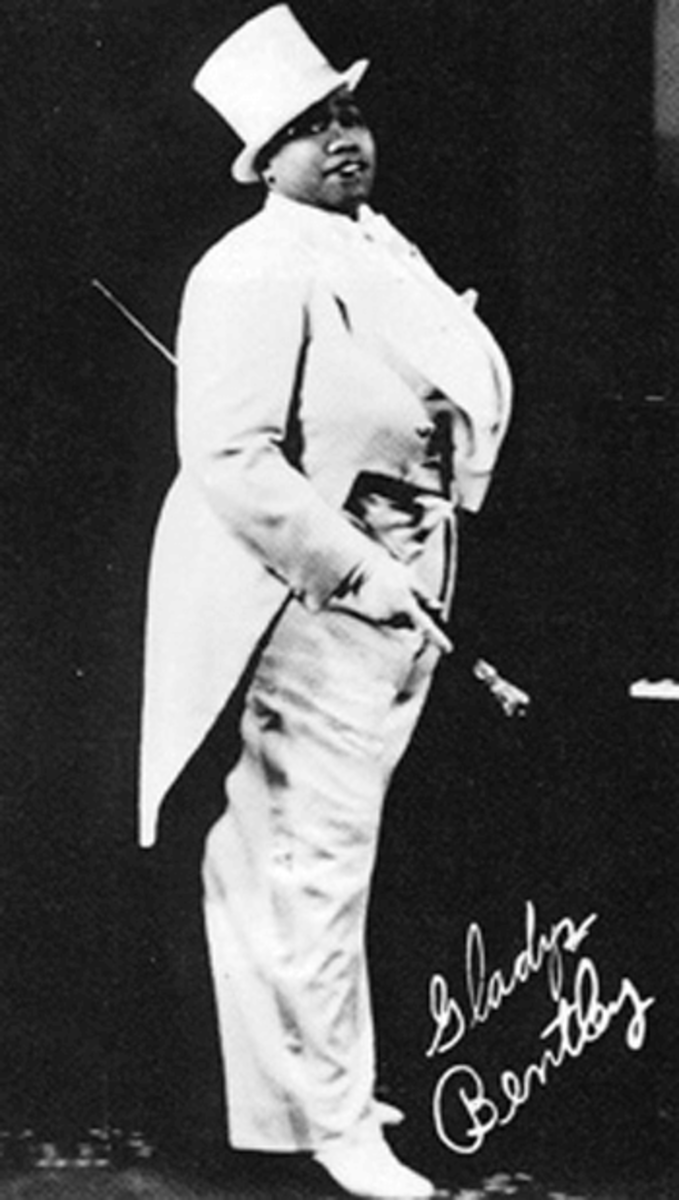
Who's That Queer [Gladys Bentley]

Brought to you by Pistol Pete

Gladys Bentley was a blues singer during the Harlem Renaissance. She was a 250 pound woman dressed in men's clothes (including a signature tuxedo and top hat), who played piano and sang her own raunchy lyrics to popular tunes of the day in a deep, growling voice while flirting outrageously with women in the audience.

She appeared at Harry Hansberry's "Clam House" on 133rd Street, one of New York City's most notorious gay speakeasies in the 1920s, and headlined in the early thirties at Harlem's Ubangi Club, where she was backed up by a chorus line of drag queens. Bentley was openly lesbian during her early career, but during the McCarthy Era she started wearing dresses, married a man (who later denied that they ever married), and studied to be a minister, claiming to have been "cured" by taking female hormones.

Read the rest at Wikipedia

Thursday, October 22, 2009

Who's That Queer

Brought to you by Pistol Pete


Mychal F. Judge, OFM (born Robert Emmet Judge on May 11, 1933; died September 11, 2001) was a Roman Catholic priest of the Franciscan Order of Friars Minor, Chaplain of the Fire Department of New York, the first recorded victim of the September 11, 2001 attacks and is oftern referred to as "the Saint of 9/11."


Upon hearing the news that the World Trade Center had been hit by hijacked jetliners, Judge rushed to the site. He was met by the Mayor of New York, Rudolph Giuliani, who asked him to pray for the city and its victims. Judge administered last rites to some lying on the streets, then entered the lobby of the World Trade Center north tower where an emergency command post was organized. There he continued offering aid and prayers for the rescuers, the injured and dead.

When the south tower collapsed at 9:59 AM, debris went flying through the north tower lobby, killing many inside, including Judge. Father Judge's body bag was labeled "Victim 0001," recognized as the first official victim of the September 11, 2001 attacks. Former President Bill Clinton was among the 3,000 people who attended his funeral, held on September 15 at St. Francis of Assisi Church in Manhattan. It was presided over by Archbishop Edward Egan. Clinton said his death was "a special loss. We should live his life as an example of what has to prevail."

There have been calls within the Roman Catholic Church to canonize Judge to Sainthood. While there is no indication that Rome is seriously considering this, several churches independent of Rome, most notably the Orthodox Catholic Church of America, have declared him a saint.

Following his death a few of his friends and associates revealed that Father Judge was gay — as a matter of orientation rather than practice, as he was a celibate priest. According to fire commissioner Thomas Von Essen: "I actually knew about his homosexuality when I was in the Uniformed Firefighters Association. I kept the secret, but then he told me when I became commissioner five years ago. He and I often laughed about it, because we knew how difficult it would have been for the other firefighters to accept it as easily as I had. I just thought he was a phenomenal, warm, sincere man, and the fact that he was gay just had nothing to do with anything."

Judge was a long-term member of Dignity, a Catholic LGBT activist organization that advocates for change in the Catholic Church's teaching on homosexuality. On October 1, 1986, the Vatican's Congregation for the Doctrine of the Faith issued an encyclical, On the Pastoral Care of Homosexual Persons, which declared homosexuality to be a "strong tendency ordered toward an intrinsic moral evil."In response, many bishops, including John Cardinal O'Connor, banned Dignity from diocesan churches under their control. Judge then welcomed Dignity's AIDS ministry to the Church of Saint Francis of Assisi, which is under the control of the Franciscan friars, thereby partially circumventing the Cardinal's ban of Dignity. Judge disagreed with the Vatican regarding homosexuality, though by all accounts, he remained celibate. Judge often asked, "Is there so much love in the world that we can afford to discriminate against any kind of love?"

Source: Wikipedia

Friday, August 14, 2009

It's Hip to Be Round... And Hippy

Rockin the pot


via New York Times, by Guy Trebay

THIS summer the unvarying male uniform in the precincts of Brooklyn cool has been a pair of shorts cut at knickers length, a V-neck Hanes T-shirt, a pair of generic slip-on sneakers and a straw fedora. Add a leather cuff bracelet if the coolster is gay.

In truth this get-up was pretty much the unvarying male uniform last summer also, but this year an unexpected element has been added to the look, and that is a burgeoning potbelly one might term the Ralph Kramden.

Too pronounced to be blamed on the slouchy cut of a T-shirt, too modest in size to be termed a proper beer gut, developed too young to come under the heading of a paunch, the Ralph Kramden is everywhere to be seen lately, or at least it is in the vicinity of the Brooklyn Flea in Fort Greene, the McCarren Park Greenmarket and pretty much any place one is apt to encounter fans of Grizzly Bear.

Read the rest.

Thursday, August 6, 2009

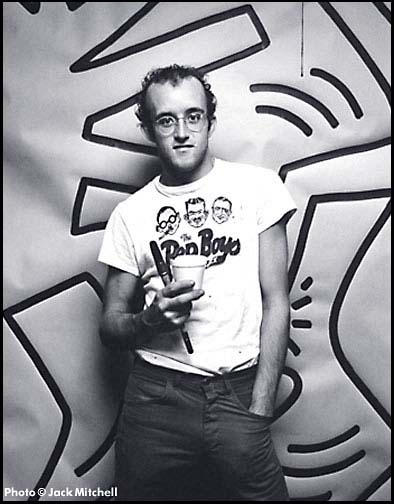
Who's that Queer?

Brought to you by Pistol Pete

Keith Haring was born May 4, 1958 in Reading, Pennsylvania, and was raised in the nearby town of Kutztown. At an early age, Haring developed a love for drawing, and was influenced by his father’s cartoonist skills and the popular culture images created by Dr. Seuss and Walt Disney.


In 1978, Haring had his first solo exhibition and later in the same year, moved to New York City where he enrolled in the School of Visual Arts (SVA). Haring was introduced to a community of artists that was developing in the city streets and subway stations. During this time, Haring became increasingly influenced by graffiti art and immersed himself among other musicians, performance artists, and graffiti writers including Jean-Michel Basquiat.

As a student at SVA , Haring experimented with a variety of mediums and tied his hand at performance, video, and installation art while always maintaining a commitment to drawing. Between 1980 and 1985, Haring utilized the unused advertising panels that lined the walls of the New York City subway stations. These panels, covered in black paper offered Haring a forum to reach a wider audience. Haring referred to the subway stations as his “laboratory”, where he would create as many as 40 paintings in a single day.


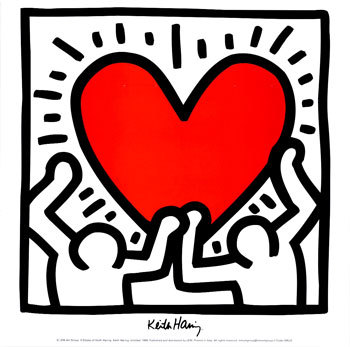
In April 1986, Haring opened the Pop Shop, a retail store in Soho selling T-shirts, toys, posters, buttons and magnets bearing his images. The shop was intended to allow people greater access to his work, which was now readily available on products at a low cost. The shop received criticism from many in the art world, however Haring remained committed to his desire to make his artwork available to as wide an audience as possible, and received strong support for his project from friends, fans and mentors including Andy Warhol.

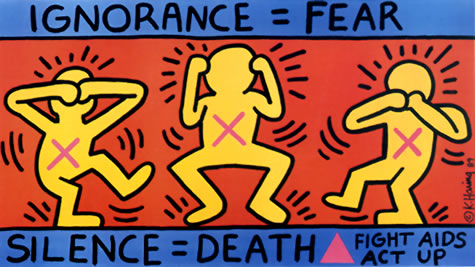
Throughout his career, Haring produced more than 50 public artworks between 1982 and 1989, in dozens of cities around the world, many of which were created for charities, hospitals, children’s day care centers and orphanages. By then, his work had begun to reflect more socio-political themes, such as anti-Apartheid, AIDS awareness, and the crack cocaine epidemic.

Haring was diagnosed with AIDS in 1988. Soon after, he established the Keith Haring Foundation, its mandate being to provide funding and imagery to AIDS organizations and children’s programs, and to expand the audience for Haring’s work through exhibitions, publications and the licensing of his images. Haring enlisted his imagery during the last years of his life to speak about his own illness and generate activism and awareness about AIDS.


In June 1989, on the rear wall of the convent of the Church of Sant'Antonio in Pisa, he painted the last public work of his life, the mural "Tuttomondo." Haring died in 1990 of AIDS- related complications. During a brief but intense career that spanned the 1980s, Haring was able to attract a wide audience and assure the accessibility and staying power of his imagery, which has become a universally recognized visual language of the 20th century.

Sources: Wikipedia, www.haring.com

Wednesday, July 22, 2009

Health Care, Homelessness & LGBTs

LGBTs and homelessness via Bilerico -

Empire State Pride Agenda has put out an interesting study of 3500 LGBT people who live in New York State and their access to health care. LGBT people generally receive less health care, and it's not just because of a lack of marriage or DP benefits. The number one reason is homelessness:

At the national level, researchers have estimated that LGBT people lag behind on seven of the ten targets set by the U.S. government to improve health nationally, called Healthy People 2010. In New York City, we know that LGBT lag behind on at least six of NYC's health goals, called Take Care New York. However, most states do not measure sexual orientation on their health surveys, and none have consistently measured gender identity.[...]

For example, fourteen percent of all LGBT people, including one-third of transgender New Yorkers, are or have been homeless at one time--and we know that people who are homeless also lack other basic services. As one service provider who works with youth told us, "Housing is health care." Youth and adults who are homeless frequently cannot access health services at all. Youth who are transgender are particularly vulnerable.

Read the rest at Bilerico

Related Posts Plugin for WordPress, Blogger...

select key words

2007 National HIV Prevention Conference 2009 National LGBTI Health Summit 2011 LGBTI Health Summit 2012 Gay Men's Health Summit 2012 International AIDS Conference ACT Up AIDS AIDS Foundation of Chicago Africa BUTT Bisexual Bisexual Health Summit Brian Mustanski Center on Halsted Charles Stephens Chicago Chicago Black Gay Men's Caucus Chicago Task Force on LGBT Substance Use and Abuse Chris Bartlett Coaching with Jake Congress David Halperin David Munar Dr. James Holsinger Dr. Jesus Ramirez-Valles Dr. Rafael Diaz Dr. Ron Stall ENDA Ed Negron Eric Rofes FTM Feast of Fun Feel the love... Friday is for Faeries Gay Men's Health Summit 2010 HCV HIV HIV care HIV drugs HIV negative HIV positive HIV prevention HIV stigma HIV strategic plan HIV testing HIV/AIDS HPV Howard Brown Health Center IML IRMA Illinois International AIDS Conference Jim Pickett LGBT LGBT adoption LGBT culture LGBT health LGBT rights LGBT seniors LGBT youth LGBTI community LGBTI culture LGBTI health LGBTI rights LGBTI spirituality LGV Leon Liberman LifeLube LifeLube forum LifeLube poll LifeLube subscription Lorenzo Herrera y Lozano Lymphogranuloma Venereum MRSA MSM Monday Morning Perk-Up National AIDS Strategy National Gay Men's Health Summit One Fey's Tale Peter Pointers Pistol Pete PnP PrEP President Barack Obama Presidential Campaign Project CRYSP Radical Faerie STD Senator Barack Obama Sister Glo Sisters of Perpetual Indulgence Susan Kingston Swiss declaration Ted Kerr Test Positive Aware Network The "Work-In" The 2009 Gay Men's Health Agenda Tony Valenzuela Trans Gynecology Access Program Trans and Intersex Association Trevor Hoppe Who's That Queer Woof Wednesday You Tube abstinence only activism advocacy african-american aging issues anal cancer anal carcinoma anal health anal sex andrew's anus athlete ball scene bareback porn barebacking bathhouses bears big bold and beautiful bisexuality black gay men black msm blood ban blood donor body image bottom chubby chaser circumcision civil rights civil union communication community organizing condoms crystal meth dating dating and mating with alan irgang depression disclosure discrimination domestic violence don't ask don't tell douche downlow drag queen emotional health exercise female condom fitness gay culture gay identity gay latino gay male sex gay marriage gay men gay men of color gay men's health gay pride gay rights gay rugby gay sex gay youth gender harm reduction hate crime health care health care reform health insurance hepatitis C hiv vaccine homophobia homosexuality hottie hotties how are you healthy? human rights humor hunk immigration international mr. leather internet intimacy leather community leathersex lifelube survey love lube lubricant masturbation mental health microbicides middle music negotiated safety nutrition oral sex physical health pleasure podcast policy politics poppers porn post-exposure prophylaxis prevention prostate prostate cancer public health public sex venues queer identity racism recovery rectal microbicides relationships religion research safe sex semen sero-adaptation sero-sorting seroguessing sex sexual abuse sexual addiction sexual health sexual orientation smoking social marketing spirituality stigma stonewall riots substance abuse treatment substance use suicide super-bug superinfection syphilis testicle self-examination testicular cancer testing top trans group blog transgender transgender day of remembrance transgendered transmen transphobia transsexual universal health care unsafe sex vaccines video violence viral load writers yoga youtube