Showing posts with label black gay men. Show all posts

Monday, August 6, 2012

8TH ANNUAL LOVEFEST CELEBRATION


BLACK GAY & BISEXUAL MEN TAKE CONTROL OF THEIR HEALTH AT
8TH ANNUAL LOVEFEST CELEBRATION

Chicago Black Gay Men’s Caucus (CBGMC) to Launch “Healthy Is Sexy” Lifestyle Campaign

Event to Bring Awareness to LGBT Health and Wellness Management

Performance by Legendary Dance Diva Crystal Waters

(Chicago, Illinois – Aug 1, 2012) – The Chicago Black Gay Men’s Caucus (CBGMC), will host the 8th Annual LoveFest Celebration on Sunday, August 26th from 12p – 8p at Jackson Park (63rd & Cornell Drive). A free event, LoveFest is an annual summer “edu-tainment” festival designed for the African-American LGBT community, more specifically gay and bisexual men, to bring awareness to health and wellness management with live entertainment, dancing, health screenings and physical fitness activities. Since 2005, CBGMC has produced LoveFest, which attracts more than 500 attendees each year.

The 8th Annual LoveFest Celebration will serve as the official launch of CBGMC’s “Healthy Is Sexy” (HIS) Lifestyle Campaign, which will consist of advertisements, events, social media interactions, health tools and access points for African American gay and bisexual to become more involved in managing their overall health.

“We are truly excited to launch the Healthy is Sexy Lifestyle Campaign at this year’s Lovefest,” stated Keith Green, CBGMC Chairman. “This campaign will present more opportunities for black gay and bisexual men to take an active role in their overall health which will improve the quality of their lives and in turn create a more healthy community,” he continued.

This year’s theme is Healthy.Sexy.We., which takes cues from the Chicago Department of Public Health’s Healthy Chicago LGBT Community Action Plan. Attendees will be able to enjoy a variety of physical activities in the park including yoga, physical challenge obstacle courses, kickboxing, and volleyball. The Healthy is Sexy (HIS) Lifestyle Health Village will mimic the ideal “health and wellness visit” experience for African American gay and bisexual men – offering free private “Doc Chat” sessions with skilled medical professionals, screenings for HIV/STIs, hepatitis C, diabetes, obesity and a number of other health issues facing men.


Legendary dance diva Crystal Waters and Chicago’s very own Cyon Flare are the event’s featured entertainers. In addition, LoveFest will host the Old School vs. New School Battle of the DJs, and the EGOmania Mini-Ball.

“It’s important that we continue to provide positive affirming environments where black gay and bisexual men can come together and have access to health services,” said Craig Johnson, interim chair of the CBGMC executive planning commission (EPC).

“This festival is an opportunity for the Chicago Black Gay Men’s Caucus to communicate to the Black MSM population the importance of taking control of their health and that with our [CBGMC] assistance we can change the overall health landscape for our community.”

The 8th Annual LoveFest partners include but are not limited to the Illinois Department of Public Health, Chicago Department of Public Health, the University of Chicago Medical Center, Test Positive Aware Network, Public Health Institute of Metropolitan Chicago, the AIDS Foundation of Chicago, Stroger Hospital of Cook County, the CORE Center, Medical Center, Howard Brown Health Center, Access Community Health Network, the Center on Halsted, Perfect Fit., Inc., and Yogatones.

For more information about LoveFest, please contact CBGMC at info@chiblackgaycaucus.org or visit www.chiblackgaycaucus.org

About the Chicago Black Gay Men’s Caucus (CBGMC)
The Chicago Black Gay Men’s Caucus (CBGMC), a nonprofit organization, was established in 2005 to improve the lives and well-being of Black gay, bisexual and other men who have sex with men. Since its inception, CBGMC has taken strategic action towards accurately identifying the HIV burden among Black MSM in Chicago, understanding the underlying causes of risk and acquisition, and identifying solutions to curb the epidemic in Chicago. CBGMC’s primary goal is to decrease new HIV infections through creative and collaborative programming that promotes HIV testing, education and risk reduction activities.

Wednesday, May 2, 2012

HBGC Event: Black and Latino Gay Men on Pornography

By: Chuck Colbert/TRT Reporter– The Rainbow Times
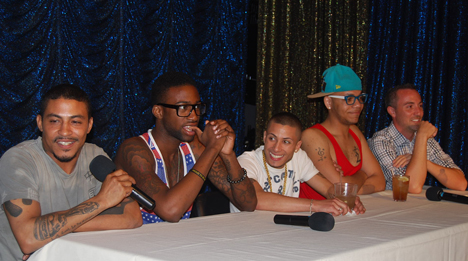
 Photo credit — Chuck Colber

It was a hot topic of conversation.
And talk about pornography they did as more than 50 people (mostly men of color) gathered Saturday evening, April 21, for an event sponsored by the Hispanic Black Gay Coalition (HBGC).
Held at Club Café, the panel discussion featured porn stars and research experts and dealt with the effect of pornography on Hispanic and black gay identity, behavior, and culture.
The title of the panel was “The Raw Realty: Pornography & Black and Latino Gay Representation.
The two-hour conversation was designed as “an innovative way to discuss safe-sex, sexuality, and the LGBTQ community with recognizable faces that are often glorified,” said Corey Yarbrough, HGBC’s executive director.
The panel was the closing session of HGBC’s two-day “Fantasy vs. Reality Weekend.”
Panelists included black porn star Tiger Tyson owner of Pittbull Productions, Latino porn star June Quinones, and black porn star HotRod.
Other panelists were Blake Rowley, a senior epidemiology research associate at Fenway Health, and Joshua Rosenberger, Ph.D., a professor of global community health at George Mason University. He also serves as a research consultant for Manhunt Cares.
Karyn Smith, a local transgender activist and HGBC member, served as moderator.


Monday, March 5, 2012

Black and gays: The shared struggle for civil rights

via The Washington Post, by Jonathan Capehart

You may recall that last month Gov. Chris Christie (R-N.J.) and I sparred over same-sex marriage on “Morning Joe.”

You may also recall that at the end of the interview, the show’s anchor, Joe Scarborough, asked me, “[W]ould you compare the civil rights struggles of African Americans over 300 years in America to marriage equity?” Without hesitation, I said, “Yes.”

“It’s an issue of civil rights, as you said. It’s an issue of equality. It’s an issue of equal treatment under the law,” I said. “No one is asking for special rights.

No one is asking for any kind of special favors. We’re just looking for the same rights and responsibilities that come with marriage and also the protections that are provided under marriage.

In that regard overall we’re talking about a civil rights issue and what African Americans continue to struggle with is exactly what lesbian, gay, bisexual and transgender people are struggling with today.”

That didn’t go over so well with more than a few African Americans. They don’t see the struggles as comparable, equivalent or even related.

Last Wednesday, @Brokenb4God tweeted to me, “@CapehartJ still can’t believe u think the choice of being gay is congruent to the struggle of blacks. Ain’t never seen no gay plantations!”

Clearly, she’s from the misguided pray-the-gay-away cabal, so no need to address that.

I’ll leave the cheap and provocative “gay plantations” stink bomb alone, too, and get to my main point.

What links the two struggles is the quest for equality, dignity and equal protection under the law. In short, gay rights are civil rights. It’s that simple.


Read the rest

Thursday, February 16, 2012

Conversation: Being Black and LGBT, Homophobia, and Transphobia

via HuffPost Gay Voices, by Janet Mock and Clay Cane

Our Voice To Voice conversation series began in January with a collection of interviews between LGBT authors discussing their work, queer life and some of the challenges of writing.

In February, celebrating Black History Month, we've asked some prominent and inspiring individuals to join the Voice To Voice series so we can get an window into some of the issues that define and challenge people who are both African-American and gay, lesbian, bisexual or transgender.

Last week we featured Laverne Cox and her twin brother M. Lamar and on Monday we offered a conversation between two Charlotte, North Carolina lesbian activists, LaWana Mayfield and Rhonda Watlington.

On Tuesday we shared Meshell Ndegeocello and Toshi Reagon's discussion.

Today we're featuring a conversation about identity between Clay Cane and Janet Mock.

Clay Cane is a radio personality and journalist who's contributed to numerous publications such as The Root, theGrio, The Advocate and BET.com, where he's the Entertainment Editor. Aspiring to be a James Baldwin with a pop culture twist, he spends his Thursday nights as host of Clay Cane Live on New York's WWRL 1600AM.

Janet Mock is a writer who earned a GLAAD Award nomination for her story about growing up transgender. She's also a Staff Editor at PEOPLE.com, hosts the relationships podcast "The Missing Piece" and is writing her memoir about her adolescent journey beyond gender.

In 2012, she was named one of theGrio's 100 most influential leaders making history today for "challenging the stigma surrounding gender identity."

Here, Cane and Mock discuss their decision to be out as journalists, the duality of being black and LGBT and dealing with homophobia and transphobia, respectively.

Janet Mock: So happy to finally meet you! I feel I already know you from reading your work and being a fan of your radio show.

Clay Cane: I feel the same way! I’ve wanted to interview you for a long time. I loved your article in Marie Claire because it created such a buzz in the community and sparked a dialogue I hadn't heard in a long time. And congratulations on the GLAAD Award nomination!

JM: Thank you. The outpouring of support is surreal to me. But I'm sure we can spend the hour fan-girling out. [Laughs]

CC: Yeah, I'm sure we could go on and on. Okay, I have a question for you: Having "come out" as trans in such a public way, when you think of gender identity, what does it mean to be a woman?

JM: I can only talk about what it means to be me. I intimately know what it means to be Janet, this young woman who comes from this evolutionary existence having grown up trans.

To be a woman means standing fully in your truth and owning the totality of your experiences -- things that have really nothing to do with gender.

That sense of owning who you are is what attracted me to you. You've talked about the duality of your experience as a black, gay man, quoting Zora Neale Hurston, saying, you're not tragically colored or tragically gay. Can you expand on that?

CC: For many people, they look at being LGBT as having a tragic life: living an existence of shame, rejection and anger. That's not my story and I will not let that be my story.

Actually, being gay saved my life. If I would've been straight, I would’ve more than likely been in jail or dead like the other boys in my neighborhood in West Philadelphia.

Because I was gay, I was introverted. I would stay home and study, listening to Madonna and Prince! [Laughs] I wouldn't be the writer that I am if I don’t fully accept all of the dimensions of myself.

JM: I find that to be fully you is amazing but it's a whole other thing when you do it in your profession as you've consciously done as an openly gay journalist.

CC: I got into the writing industry via other gay men who were closeted. They felt like it would hurt their careers if they were out. Well, from the start of my career I made the decision to be who I am because I didn't want anybody to say, "Well, he interviewed T.I., but he's a faggot!" Being out made me a better writer.

You can't sit down with a stranger and get the truth out of them when you're paranoid about somebody finding out your truth. The truth is, being who I am has never stopped me from getting a job.

I wouldn't have gotten my radio show on WWRL if I had been closeted. What about your coming out as a journalist?

JM: While making the decision to tell my story, I definitely took on other people's thoughts about me, internalizing other people's transphobia.

So when I came out publicly, I was armed for people to say awful things about me. Instead, I was overwhelmingly embraced.

I wasn't expecting the love and light that actually came my way, and the opportunities that arose as well because I chose to be open about my journey.


Read the rest

Monday, February 6, 2012

Artist Thomas Allen Harris on Black Gay Identity

via Advocate, by Neal Broverman

The varied issues of Africans and African-Americans is the point of "AfroPoP: The Ultimate Cultural Exchange," an innovative series that airs on the documentary channel WORLD and is hosted by The Daily Show's Wyatt Cenak.

Each episode is really a full-length documentary telling a different story, from the effort to get Africans hooked on solar energy to a profile on the queen of Calypso music.

Sunday's episodic film, That's My Face, is directed by Thomas Allen Harris, a prolific gay artist and producer who's shown work at the Whitney Biennial and won Guggenheim and Sundance fellowships.

Harris spoke to us about his Brazilian-based film, his childhood in Africa, and some of the projects he's working on through his company, Chimpanzee Productions.

The Advocate: Can you talk about "AfroPoP" and your film in it?
Harris: "AfroPoP" is a series being produced by the National Black Programming Consortium, a part of the minority consortium of PBS.

They’ve had this series for the last three years where they pick a certain number of films for the show. This year there are four different films, and my film, That’s My Face, is one of them. (Click here to find out where "AfroPoP" is airing near you.)

In the movie, I go to the Bahia region of Brazil. I was looking for another way of experiencing myself, kind of like a spiritual journey that Gertrude Stein and James Baldwin had when they went to Europe.

I lived in Europe and knew what that was like, so I went to Brazil. I was looking for what being black in the Americas was like outside of the U.S.

Brazil has more African-Brazilians than the U.S. has African-Americans. It’s also been interesting to me because I partly grew up in East Africa.

The Black-Brazilians were able to keep a lot more of their African roots through language and, most importantly, through religion.

I was very intrigued by their religious practices, some of which are very welcoming to gays and lesbians. It’s very different than what you hear in the press about what’s going in regards to the persecution of gays and lesbians in Africa.

Had you been to Bahia before?
I had been there before so I had experienced it. The time I went to make That’s My Face was the beginning of December.

From December all the way to February in the south coast of Bahia are all these public festivals that are inspired by these African deities and also Carnivale.

I was really doing my search in the middle of all this spectacular stuff. These Bahia festivals are very different than the Carnivale in Rio.

The latter is sort of a show and the Carnivale in Bahia takes over the whole city—all the shops close, with the exception of places selling beer and food.

It becomes a whole different world. Everything was sped up during the festival because the drums play all the night. In Brazil, the drums weren’t outlawed when Africans were brought over, like they were in the U.S.

So people in the U.S. weren’t able to pass on certain aspects of religion and communication. The drum is an important part of religious expression.

Through the drums, people start dancing and enter this trance. It’s transformative, and you’ll see that in the film.

You lived in Tanzania as a child. What do you remember of that time?
I remember people living close to the land. I went to a national school, with the local Tanzanians. We had to clean the toilets and work on the farm.

It was an African socialist country at the time, so the kids had to clean and cook.

When I was growing up there, intimacy between men was permissable.

With my friends, we could walk down the streets holding hands. Even if you hold your hands with brother in the U.S., you could get killed.

There's a very narrow way of how men can act in the U.S. What was also interesting, is that the capital of Tanzania, Dar es Salaam, is so cosmopolitan.

I had friends from India, Uganda, the Philippines, England, China. It was very different than the picture we have in our minds of Africa. It made me really want to see the world and played into me wanting to go to Brazil.

The U.S. and the U.K. have started applying pressure on African nations to end the criminalization of homosexuality. Do you think that’s helping?
It’s really important that the West get clear and articulate that attacks on gays and lesbians are human rights violations. The marriage equality effort here, it legitimizes the struggle in Africa, and also in Eastern Europe and the Middle East.

These countries are using gays and lesbians as scapegoats. In Africa, it’s not simply the African leadership that makes the violent crimes possible, it’s the missionaries who say homosexuality is an evil import from the West.


Read the rest

Friday, January 27, 2012

LGBT racial minority hit hard by social and financial inequality

via stuffqueerpeopleneedtoknow

Black* members of the LGBT community experience stark social, economic and health disparities compared to the general population and their straight black and white LGBT counterparts, according to a Center for American Progress report.

Data in the report emphasized the intersections of the black racial identity with sexual orientation and gender identity, revealing:

■Families headed by black same-sex couples are more likely to raise their children in poverty.

■Black lesbians are more likely to suffer from chronic diseases.

■Black gay and transgender youth are more likely to end up homeless and living on the streets.

CAP recommends overcoming these issues with a policy agenda that “seeks to understand and tackle the structural barriers—discriminatory systems, conditions and institutions around socioeconomic status, race, sex, sexual orientation and gender identity—that perpetuate negative economic, health, and other life outcomes among this population.”

The report also suggests gay policy priorities, like marriage equality, underserve many populations within the LGBT community.

“Despite significant gains in securing basic rights for LGBT Americans over the past decade, the quality of life for black gay and transgender Americans has remained virtually unchanged,”

Aisha Moodie-Mills, CAP advisor on LGBT policy and racial justice, wrote in a statement.

“Marriage equality is vital to overall progress, but marriage alone is not a silver bullet to reduce the disparities black gay and transgender populations face.”

In the report, CAP made the following recommendations to overcome issues faced by the people of color in the LGBT community:

CAP recommendations for addressing economic insecurity

■Adopt inclusive family policies and safety net programs.

■Pass housing anti-discrimination laws.

■Take a comprehensive federal approach to gay and transgender youth homelessness.

■Make consumer financial protection a priority.

■Pass employee non-discrimination laws.

■Support gay and transgender entrepreneurs.

■Legally recognize same-sex relationships.


Read the rest

Thursday, January 26, 2012

The Faces Missing from 'The Gay Rights Movement'

via HuffPost Gay Voices, by Zach Stafford

I am a gay, multiracial male who grew up in Tennessee. When I was little I felt like an outsider, like many gay folks, but my "outsider" position was not just because I was gay; it was much more complicated.

I was one of the only people of color in my school, and I was the most effeminate little boy there, as well, which pegged me immediately as a "faggot."

I also was pudgy, not very athletic, and liked video games too much, but those are all minor aspects of why I didn't fit in. Needless to say, no one around me was like me, the puggy, effeminate, brown boy living in the South -- and that was lonely.

As I grew up and got to high school, a few gay kids did start coming out, and I did make some gay friends, but these kids, due to being in a white suburb, were all white.

So my race and my gayness then began to work together, making me feel different, making me feel hopeless, making me unable to consider that it could get better.

When I watched some of my favorite gay-friendly TV shows, like Will & Grace, I would see gay folks having fun, being gay, and enjoying life in a city, most of the time.

This gave me my first insight into what being gay was, and my first suspicion that gay was not like me -- it was wealthy, it was white, and it didn't bother to have people who looked like me for me to look up to, or even begin to understand what my experience was like as a gay person of color.

After graduating from high school, moving to Chicago, and reaching drinking age, I went to the famous Boystown neighborhood and soaked in the abundance of gay bars, restaurants, centers, and anything you can imagine.

However, I felt out of place, like I didn't belong; I remember looking around and noticing that most of the men looked like Abercrombie models, or at least tried to look like them, and were mainly white.
I got very little attention there, and the little attention I got was due to my exoticism, because when one is brown, that could mean one is Brazilian, Egyptian, Puerto Rican... the list goes on. Gay had a look, and I wasn't that look.

So as I watched the YouTube Video "The Gay Rights Movement," which has recently gone viral, I got progressively sadder as the video played through footage of what the gay community seems to consider milestones.

Lots of familiar faces rolled by, and happy emotions did rise inside me, but I still felt hints of sadness, a sadness that was familiar, that wasn't new, and I knew exactly what it was: I, and a lot of other people within the gay community, were not there.

It's not like we weren't ever there; there have been tons of queer folks of color who have done amazing things in America.

For instance, the video shows Martin Luther King Jr., but not his advisor and one of the main powers behind him, Bayard Rustin, a gay black man.

The video shows Ellen Degeneres over and over talking about suicides, but not another famous lesbian who is black, Wanda Sykes.

It shows coverage of the suicides of gay male youths, but not the countless suicides of transgender people, which happen yearly and go quite unnoticed, just like the faces of trans people in the video.

It doesn't show a lot.


Read the rest

Monday, January 9, 2012

4 Colored Boys Like Me

via HuffPost Gay Voices, by Dane Harrington Joseph

I am not a racist.

There's a perfectly sound reason why my new project, Langston's, is subtitled "a film by (4) colored boys." Besides the obvious answer (it's a collaboration between four noted black and latino filmmakers), there's also a much more personal reason, dating back about 20 years to when I was a little colored boy myself (as my grandma would affectionately call me).

Back then, I would occasionally wet my bed at night. After such incidents I'd hide my gold-tinted "tighty whities" from my father, who would undoubtedly "whoop" me if he found them.

Nonetheless, despite my best efforts, he would sniff them out after they had festered for a few days in some ill-concealed location.

He would then call out for me in his ironically shrill, baritone voice, and, after a series of insults, proceed to beat me, accentuating verbally my various flaws with each lash.

My worst offense, however, would be crying, because "black men don't cry," an adage he'd bark at me whenever my eyes started to well up.

So I would just bite my lip until he was finished, then retire to my room and cry secretly into my pillow, all the while thinking, "I need help."

Of course, I didn't mean I needed to be rescued from my father's "tough love." Rather, I needed help controlling my compulsion to be me. I didn't want to be me. I hated me.

"Me" needed help, and I knew no other little "colored" boys like me who could show me the way.

So I looked to pop culture for guidance: music, movies, TV. Bill Cosby? No. Montel Williams? Denzel Washington? No. Flava Flav? Hell no.

There was not one media personality or public figure that reflected me. I wasn't relevant. I didn't matter.

I grew up, cried a little less, and, as a teen, became even more obsessed with the idea of finding someone to connect with -- other little colored boys like me. I discovered this newfangled thing called "the Internet" at the library.

I made new virtual "friends" and consequently put myself in unsafe situations, sexually and emotionally, just to feel something, to relate to someone.

I thought that love manifested physically between a 41-year-old Italian bear and a 15-year-old little colored boy could fill a void, could help substitute for the lack of love I felt for myself; it didn't.

I recall going to my mom a few months later and having her take me for my first HIV test, and crying, and then her crying, and then us crying again when the results came back negative.

And I remember thinking I would never be self-destructive in that way again.

I must admit, however, that the lure of boys and booze to fill a void still lingers, to gain instant gratification to temporarily replace constant feelings of illegitimacy.

And while this could, in truth, be the story of anyone of any race, I find that my existence as a gay man of color has rarely been validated; how I felt as a little colored boy looking to the media for validation still resounds today as a grown colored man.

Aside from a slew of big black men in pretty dresses (RuPaul, Tyler Perry, Eddie Murphy, Martin Lawrence, Jamie Foxx, and Flip Wilson, all of whom I admire, but almost all of whom aren't gay) and some admirable attempts by a few noted filmmakers (Patrick Ian Polk, Maurice Jamal, and Roger Omeus, to name a few), there has not been a constant presence of gay men of color in mainstream media or popular culture.

Coupled with negative societal perspectives on homosexuality, the diminished presence of black-themed entertainment that was so pervasive in the '80s and '90s, and the Euro-centric focus of most gay entertainment and advertising, it's not so surprising that self-destructive actions among young gay black men are on the rise, with the CDC reporting that new infections among said demographic saw a dramatic increase of 48 percent in recent years, with 59 percent of those carrying the disease unaware of their status.


Read the rest

Wednesday, November 30, 2011

Empowering Young, Black, Gay Men for HIV Prevention

via HuffPost Gay Voices, by Charles Stevens

The most recent statistics indicate that an entire generation is being impacted by HIV on an epic scale.

HIV cases among young, black, gay and bisexual men increased to an estimated 48 percent between 2006 and 2009, according to new data from the U.S. Centers for Disease Control and Prevention (CDC).

Ultimately, it is impossible to discuss HIV/AIDS in the black community without addressing the importance of tolerance.

It is up to us -- relatives, co-workers and friends -- to engage our black, gay brothers in a conversation that is constructive and rooted in concern, one that turns to them for insight instead of turning them away.

There have been significant political and medical advances made in HIV/AIDS prevention.

The National AIDS Strategy, a key achievement of Barack Obama's presidency, is a prime example. By focusing with laser precision on at-risk groups and prioritizing addressing disparities in HIV, there will be historic gains.

On the scientific front, advances in biomedical HIV-prevention tools, such as pre-exposure prophylaxis, or PrEP, have given us signs of hope even as we take a collective gasp at the work ahead of us.

However, HIV has never been merely a public health issue but a social one, as well. It is an issue that impacts us not only abstractly but also in a very real and tangible way.

The black community as a whole has made substantial progress, more than is credited, in terms of embracing our diversity. Many unsung heroes and heroines have taken great strides in challenging anti-gay attitudes.

Straight allies have also spoken out unapologetically in support of their gay brethren. However, there is still work to do, and HIV/AIDS makes building bridges across orientations even more critical.

The black community has just as much of an incentive to be a part of the solution: the "win" is the lives of our people, the lives of young, black, gay men. These men are valued; their lives are priceless. They are assets to our communities.


Read the rest

Friday, November 18, 2011

Does Gay Sex make one Homosexual?

via blackgaymensblog, by Storm

The previous blog post about black gay and bisexual men seducing straight men prompted a lot discussion on Facebook and on Skype.

I decided to start a separate dialog, because there was a lot of focus on whether or not a man could be considered straight if he has had gay sex.

For me, the previous blog post had more to do with wanting someone, who was unattainable and lusting after straight men, who are often perceived as sexually superior, than whether or not straight men who might engage in gay sex are still heterosexual.

The minute straight men are mentioned on Black Gay Men’s Blog, some of us immediately lose sight of the totality of the article and focus on whether or not straight men, who engage in gay sex can still be straight.  So, I thought we could explore that here.

Personally, I do not believe that engaging in gay sex once makes a man(or woman) gay. I don’t believe sexuality is that clear cut – it all depends on the circumstances surrounding the sexual encounter.

I am not suggesting homosexuality is a choice, but I think engaging in homosexual acts can be. Let me make one thing clear, I am not talking about repetitive, on-going sexual encounters or referring to those men, who might be in denial. 

I think that any man who has gay sex for a prolonged period of time, or has numerous male sexual partners is at the very least bisexual.

Especially, if he does so when he has free access to women and the life of a loved one is not threatened.  This is just my opinion and not the opinion of other contributors on Black Gay Men’s Blog. 

I have never claimed to be politically correct 100% of the time. Quite frankly, I prefer being thought-provoking and getting us to have some sort of dialog, than being politically-correct.

I think some gay men are too quick to want to label anyone who has had homosexual sex as gay or no longer straight. Sexuality is simply not that black and white – not all sexual encounters define one’s sexuality.

The label “gay” is a western concept and there are societies, in which that label doesn’t exist and others where the gender of one’s sexual partners is not as big a deal as it might be here in the USA. 

In those societies, “gay” is not a political statement  and Black Gay Men’s Blog does have readers from all corners of the globe, so I try to look at things more broadly.

We don’t have to agree, but we can respect and maybe learn from one another.


Read the rest

Black and Latino MSM Identity and HIV Risk

via Poz, by Trenton Straube

New research uncovers mistaken assumptions fueling HIV rates among black and Latino men who have sex with men (MSM).

The belief that having sex with someone of your own race lowers your risk of contracting HIV is a misperception that needs to be addressed among black and Latino men who have sex with men (MSM).

What’s more, health care workers are missing opportunities to test this population for HIV—even when the men are engaged in care and disclose their sexuality to their doctors.

These are just two findings of research looking at black and Latino MSM who are HIV positive but unaware of their status. The Centers for Disease Control and Prevention (CDC) estimates that 53 percent of new HIV cases in the United States are among MSM and that 54 percent of these MSM are black and Latino.

In addition, HIV-positive black and Latino MSM are less likely than their white counterparts to know their status—which is one factor that amplifies HIV rates among these populations.

To explore these dynamics, researchers led by Gregorio A. Millett, MPH, the CDC/HHS Liaison to the White House Office of National AIDS Policy (ONAP), analyzed data from 1,208 MSM (597 black and 611 Latino) who participated in studies in Los Angeles, New York City and Philadelphia.

Eleven percent of them (18 percent black, 5 percent Latino) turned out to be HIV positive but unaware of their status (referred to as “HIV-positive unaware”).

Researchers found that certain variables were more common among the MSM in this group.

For example:

Black HIV-positive unaware MSM were associated with:

•Gay identity
•Earning a moderately higher income
•Having health insurance
•Disclosing sexuality to current health care provider
•Fewer than three lifetime HIV tests
•High perceived risk of testing HIV positive
•Belief that sex with other black men reduces HIV risk

Latino HIV-positive unaware MSM were associated with:

•Nongay identity
•High perceived risk of currently being HIV positive
•Belief that sex with other Latino men reduces HIV risk


POZ spoke with Millett, who arrived at ONAP via the CDC, about the implications of these findings, which were printed in the September Journal of Acquired Immune Deficiency Syndromes in an article titled “Mistaken Assumptions and Missed Opportunities: Correlates of Undiagnosed HIV Infection Among Black and Latino Men Who Have Sex With Men.”

We also asked Millett how his team in DC might use the data as they implement the National HIV/AIDS Strategy.


Read the rest

Tuesday, October 25, 2011

Don't Delay HIV Prevention for Gay and Bi Men

by David Ernesto Munar, via HuffPo

Lives will be saved when the Food and Drug Administration puts its stamp of approval on a groundbreaking preventative approach called pre-exposure prophylaxis, or PrEP, recently found to reduce HIV infections.

With PrEP, people who are not infected with HIV take a daily pill, usually used to treat the disease, to help prevent infection -- as part of a broad HIV
prevention approach that includes condoms and safer-sex counseling.

But the longer the FDA waits before beginning its review of the HIV medication Truvada for prevention, the more lives will be unnecessarily lost. This is particularly true for those at greatest risk: gay and bisexual men.

We urge the FDA to immediately begin its review for approval of Truvada for PrEP for gay and bisexual men.

Read the rest.


Friday, October 21, 2011

The Down Low Made Me Do It!


As a black man, I've been very blessed to have an amazing career working as a producer in television. For more than three decades, I have worked for some of the biggest names on some of the most popular shows in television history.

I've seen it all -- from producing for local television stations to working on The Oprah Winfrey Show and The View. I've been to every award show red carpet possible through my years with Extra, E! News and Access Hollywood, just to name a few.

And more often than not, I have been the only black male on the team. And as a double whammy, I am almost always the only openly gay black man on staff.

So, when the media first became infatuated with the idea of the "Down Low" back in the late '90s, for me the issues and topics were magnified because it hit so close to home -- not because I was in the closet hiding anything, but because as the token gay black man, my straight colleagues assumed I had all the answers.

But they weren't asking the right questions. All over the tube, from Jerry Springer to CNN and everything in between, everyone was talking about the Down Low.

There were books and documentaries, newspaper commentaries and radio shows. The Down Low was everywhere.

 It was so prevalent that even the straight guys on my camera crews looked up from their sports pages to ask me about it.

As the only black gay rep on the staff, I got asked, "Why are so many black gay men in the closet?" "What is it about the black community that won't allow black gay men to come out?" "Is it true that these closet cases are spreading HIV/AIDS to black women?" (This is a huge myth, and according to the CDC, it's the prevalence of intravenous drug use that is to blame.)

Then, the discussion turned to my personal life. I got asked, "When did you decide to come out? Was it difficult for you?"

And that's when it hit me. I realized my story was still new to them because my experience as a gay black person is never seen in the mainstream media. I realized that even folks in the liberal entertainment industry needed to be educated.

 I was an anomaly; they were used to seeing gay people who looked like the characters on Will & Grace or, in today's world, like Cam and Mitchell on Modern Family.

And when they do see black gay men in the media, it's usually a discussion of the mysterious men on the Down Low.

Why are these nameless, faceless people who are creeping, so to speak, getting more media attention than the black same-gender-loving (SGL) people who are open and honest and living in their truth?

Where are the black SGL role models who are productive members of our communities? Where are the television segments, talk shows, newspaper articles and stories that feature people like my friends and me?

I realized that black gay, lesbian, bisexual and transgender people are the invisible people. Like Wanda Sykes has said, "There are no black gays. We're like unicorns. We don't exist [in the media]."


Read the rest

Wednesday, October 12, 2011

NBGMAC to Host a National Webinar for Young Black Gay, Bisexual and Same Gender Loving Men

The National Black Gay Men’s Advocacy Coalition (NBGMAC), co-sponsored by FHI 360, invites young Black Gay, Bisexual, and Same Gender Loving men from across the country to participate in a national webinar on October 14th, 2011 at 3:00PM (EDT) to develop solutions for addressing the HIV/AIDS epidemic within the young Black Gay, Bisexual, and Same Gender Loving community.

Click here to register!

Monday, September 26, 2011

Reversing the Alarming HIV Increase Among Black Gay Men, Part 2


The second of a two-part series examining the high rates of new HIV infection among Black gay and bisexual men.

 Part 1 described the new data detailing the dramatic increases in new infections, examined some of the reasons driving the numbers and described the CDC's new social-marketing initiative, designed to encourage testing among Black MSM.

In light of the persistent increase in new infections among MSM (men who have sex with men)--and despite the Centers for Disease Control and Prevention's new testing initiative--a consensus has emerged among prominent Black gay men who have leadership positions in HIV/AIDS policy, prevention and public health: A larger investment is needed from public and private sources, as well as a more "holistic" approach to Black gay men's sexual health.

"It's a question of dollars," says A. Cornelius Baker, senior policy adviser of the Washington, D.C.-based National Black Gay Men's Advocacy Coalition (NBGMAC), which delivered a forceful set of recommendations in response to the CDC's incidence report.

 Across the federal bureaucracy, "there is not a sufficient investment in line with the scope of the epidemic in Black and Latino gay populations," he says.

"The CDC must increase funding to organizations providing services to young MSM and transgender [people] of color from $9 million to $14 million," says Baker, who is also board chair of the Black AIDS Institute.

 "Five years after its initial commitment, the numbers are worse, and their investment remains at $9 million. That makes no sense."

Among NBGMAC's additional recommendations: increased funding, capacity building in Black gay organizations, continuing HIV education for medical professionals, high-level consultations with Black gay men and research on how to lower the viral load in MSM communities of color.


Thursday, September 8, 2011

You Are Not Alone: Gay Black Men and Depression


via ChicagoNow, by Imagee

I first learned of the documentary "You Are Not Alone," from a website called Healthy Black Men - Healthyblackmen.org is an online health and lifestyle magazine for Black men.  The story that grabbed my attention was one that outlined gay black men and how they're suffering from depression. Antoine B. Craigwell, author and filmmaker, wrote about events and issues of and in the Black gay community, and embarked on a book addressing depression in Black gay men. The stories shared from Black gay men are placed alongside what professionals and Black gay literature have said, and against a background of the effects of culture, ethnicity, religion, and society.

Craigwell announced the launch of Depressed Black Gay Men, a website to raise awareness about depression in gay Black men. After hearing several more stories of pain and suffering from other gay Black men, Craigwell realized that something was wrong and no one was talking about it. Antoine began scouring friends, friends of friends, and as many contacts on Facebook and other social networking sites, including gay sex sites, to find anyone who is Black and gay, suffering from depression and willing to share their stories. It was as if a floodgate had opened and a torrent of stories poured out.

Check out the trailer for the forthcoming documentary, "You Are Not Alone." Courageous Black gay men are breaking their silence and they are speaking out about their depression. It is hoped that a Black gay man, through what he sees and hears in this documentary, could feel emboldened to know he is not alone, and find the courage to reach out for help.

Craigwell wants your support toward the completion of this documentary. It would provide a resource and encouragement for other gay Black men, especially young gay Black men who feel imprisoned, are struggling with their sexual identity and acceptance in a world that rejects them.

These stories are really compelling and I encourage everyone to check them out. Here are their stories:


Thursday, August 18, 2011

7th Annual Love Fest - August 28th in Chicago


The Chicago Black Gay Men's Caucus (CBGMC) is pleased to present LoveFest, an end of the Summer celebration!

Our 7th annual event will include captivating performances by some of Chicago's most well-known entertainers! Also, don't forget to get your teams and talents together for a mini-ball, bid whist and volleyball tournaments, and so much more!

And most importantly, the Chicago Department of Public Health is sponsoring our 'Healthy Is Sexy!' (H.I.S.) village and will provide an assortment of screenings and information to ensure that we continue to live at our healthiest.

So come out and have fun! It'll be great opportunity to meet and mingle with the Caucus and our brothers and sisters! We better see you there!!!

More information about LoveFest.

Kick-Off Reception at Club Escape on Thur., Aug. 25.

Tuesday, August 16, 2011

New Campaign: Testing Makes us Stronger

lboards. “Your HIV test result expires every time you have risky sex. Stay strong and informed
Your HIV test result expires every time you have risky sex. Stay strong and informed.
lboards. “Your HIV test result expires every time you have risky sex. Stay strong and informed

Read about the CDC's new HIV testing campaign focused on gay black men which takes an assets-based approach to the effort - looks very nice. Some images from the campaign below. Waddya think?


Thursday, August 11, 2011

Room for Debate: How to Close the Race Gap in H.I.V.?


via New York Times

H.I.V. infection rates have stabilized in much of the American population -- an achievement that public health officials say points to the effectiveness of various long efforts, including H.I.V. education in schools, which began in New York in 1987. But data released last week by the Centers for Disease Control and Prevention show that rates are increasing sharply in one subgroup: young gay black men.

"Black teenage boys who realize they are attracted to men are often too poor to move to gay-friendly cities like San Francisco or New York," wrote Times reporter Donald G. McNeil Jr. This could lead many to hide their sexuality and engage in furtive, perhaps riskier sex. "They often lack health insurance, meaning they do not get checkups where a doctor might suggest testing," the article adds. "And while new surveys find that they use condoms at about the same rates as young gay white and Hispanic men, sex tends to stay within racial groups and more older black gay and bisexual men are infected."

How could public health officials close the race gap in H.I.V. infection rates?

Read the discussion.

Wednesday, August 10, 2011

TOMORROW! Conversations: A Discussion about the Impact of the National HIV/AIDS Strategy on Black Gay/Bisexual Men in Chicago

 The Chicago Black Gay Men’s Caucus present.........
Conversations: A Discussion about the Impact of the National HIV/AIDS Strategy on Black Gay/Bisexual Men in Chicago

 TOMORROW!!
Thursday, August 11, 2011
6:00pm-9:00pm

Gary Comer Youth Center
7200 S. Ingleside (Located 2 blocks southeast of the intersection of East 71st St., Cottage Grove Ave., and South Chicago Ave.)


 With special guests:
-- John A. Schneider, MD, MPH (Assistant Professor of Medicine and Epidemiology – University of Chicago)
-- Chris Brown (Assistant Commissioner of Public Health for the STI/HIV/AIDS Division – City of Chicago)
-- David D. Robertson (Prevention Specialist – Comer Children’s Hospital at the University of Chicago)
-- Mildred Williamson, PhD, MSW (HIV/AIDS Section Chief – Illinois Department of Public Health)

Moderated by: Keith R. Green, MSW (CBGMC Co-Chair/Director of Federal Affairs at the AIDS Foundation of Chicago)

Light refreshments will be served! Please RSVP to CBGMCevents@gmail.com
Related Posts Plugin for WordPress, Blogger...

select key words

2007 National HIV Prevention Conference 2009 National LGBTI Health Summit 2011 LGBTI Health Summit 2012 Gay Men's Health Summit 2012 International AIDS Conference ACT Up AIDS AIDS Foundation of Chicago Africa BUTT Bisexual Bisexual Health Summit Brian Mustanski Center on Halsted Charles Stephens Chicago Chicago Black Gay Men's Caucus Chicago Task Force on LGBT Substance Use and Abuse Chris Bartlett Coaching with Jake Congress David Halperin David Munar Dr. James Holsinger Dr. Jesus Ramirez-Valles Dr. Rafael Diaz Dr. Ron Stall ENDA Ed Negron Eric Rofes FTM Feast of Fun Feel the love... Friday is for Faeries Gay Men's Health Summit 2010 HCV HIV HIV care HIV drugs HIV negative HIV positive HIV prevention HIV stigma HIV strategic plan HIV testing HIV/AIDS HPV Howard Brown Health Center IML IRMA Illinois International AIDS Conference Jim Pickett LGBT LGBT adoption LGBT culture LGBT health LGBT rights LGBT seniors LGBT youth LGBTI community LGBTI culture LGBTI health LGBTI rights LGBTI spirituality LGV Leon Liberman LifeLube LifeLube forum LifeLube poll LifeLube subscription Lorenzo Herrera y Lozano Lymphogranuloma Venereum MRSA MSM Monday Morning Perk-Up National AIDS Strategy National Gay Men's Health Summit One Fey's Tale Peter Pointers Pistol Pete PnP PrEP President Barack Obama Presidential Campaign Project CRYSP Radical Faerie STD Senator Barack Obama Sister Glo Sisters of Perpetual Indulgence Susan Kingston Swiss declaration Ted Kerr Test Positive Aware Network The "Work-In" The 2009 Gay Men's Health Agenda Tony Valenzuela Trans Gynecology Access Program Trans and Intersex Association Trevor Hoppe Who's That Queer Woof Wednesday You Tube abstinence only activism advocacy african-american aging issues anal cancer anal carcinoma anal health anal sex andrew's anus athlete ball scene bareback porn barebacking bathhouses bears big bold and beautiful bisexuality black gay men black msm blood ban blood donor body image bottom chubby chaser circumcision civil rights civil union communication community organizing condoms crystal meth dating dating and mating with alan irgang depression disclosure discrimination domestic violence don't ask don't tell douche downlow drag queen emotional health exercise female condom fitness gay culture gay identity gay latino gay male sex gay marriage gay men gay men of color gay men's health gay pride gay rights gay rugby gay sex gay youth gender harm reduction hate crime health care health care reform health insurance hepatitis C hiv vaccine homophobia homosexuality hottie hotties how are you healthy? human rights humor hunk immigration international mr. leather internet intimacy leather community leathersex lifelube survey love lube lubricant masturbation mental health microbicides middle music negotiated safety nutrition oral sex physical health pleasure podcast policy politics poppers porn post-exposure prophylaxis prevention prostate prostate cancer public health public sex venues queer identity racism recovery rectal microbicides relationships religion research safe sex semen sero-adaptation sero-sorting seroguessing sex sexual abuse sexual addiction sexual health sexual orientation smoking social marketing spirituality stigma stonewall riots substance abuse treatment substance use suicide super-bug superinfection syphilis testicle self-examination testicular cancer testing top trans group blog transgender transgender day of remembrance transgendered transmen transphobia transsexual universal health care unsafe sex vaccines video violence viral load writers yoga youtube