Showing posts with label bullying. Show all posts

Monday, February 13, 2012

Dear America: You Have a Gay Problem

via HuffPost Gay Voices, by Josh D. Scheinert

Dear America,

It must be hard being you these days. You have so many big issues -- from the economy to national security and the looming election, just to name a few. If I may though, I'd like to focus on another one.

This is Canada, your northern neighbour (I spell it with a "u"). Blessed with a bird's eye view, I've watched troubling developments unfold below. Before more damage is done, I thought it best to offer some Canadian insight in the hopes that it may assist you as you move forward in your struggle.

I've wanted to write this for a while. During the lead up to Proposition 8 and the continued legal battle that has ensued, as debates over gay marriage spread to other states, you questioned if allowing soldiers to fight and die openly would ruin your military just as teenagers across your country tragically took their own lives after being bullied for who they were.

What finally forced my hand was a heartbreaking and infuriating article in Rolling Stone chronicling how one school district in Minnesota not only condoned but actively promoted the bullying of its LGBT students.

The result of the Anoka-Hennepin school district's policy has been devastating. One can only pray (isn't that what they'd want us to do?) that the souls of those who took their own lives are now at peace.

You Americans don't pay all that much attention to Canada. We know, and are mostly okay with it. But as you strive to build your land of the free, it might do you good to look up every now and then.

When you do, you'll discover something that might surprise many of you: We aren't all that concerned about gay people. Our Conservative government has said it has no intention of re-opening a debate on same-sex marriage, which is legal.

Abroad, it has become a consistent and strong advocate for gay rights. Contrary to some beliefs, no radical gay agenda came and hijacked our society. The sky hasn't fallen.

Now sure, things up here aren't perfect. We too have unfortunately been faced with instances of homophobic bullying and tragically, gay-teen suicide.

There are Canadians unhappy that Bob and Joe can express their love just like Bob and Joan. And I certainly don't want to imply that all, or even the majority, of Americans are anti-gay.

But there's something different, something malicious about the debate in your country. The haters are too hateful and the vilification of the LGBT community has spread too far.

In what other free and equal society would those seeking to be Commander-In-Chief stand silently as a crowd of citizens booed a soldier because he was gay?

It is a true juxtaposition of cowardice and courage, and such a moral deficiency should automatically qualify one as unfit to lead a nation.


Read the rest

Thursday, January 19, 2012

Silence=Violence=Death

via HuffPost Gay Voices, by Warren J. Blumenfeld

A few years ago, the Lesbian, Gay, Bisexual, and Transgender (LGBT) Alliance at a private Boston-area university asked me to give a presentation on LGBT history at one of its weekly meetings.

During my introductory remarks, in passing, I used the term "Stonewall," at which point a young man raised his hand and asked me, "What is a 'Stonewall?'"

I explained that the Stonewall Inn is a small bar located on Christopher Street in Greenwich Village in New York City where, in the early morning hours of June 28, 1969, during a routine police raid, patrons fought back.

This event, I continued, is generally credited with igniting the modern movement for LGBT liberation and equality.

The young man thanked me and stated that he is a first-year college student, and although he is gay, he had never heard about Stonewall or anything else associated with LGBT history while in high school.

As he said this, I thought to myself that though we have made progress over the years, conditions remain very difficult for LGBT and questioning youth today, because school is still not a very "queer" place to be.

In my own high school years during the 1960s, LGBT topics rarely surfaced, and then only in a negative context.

Once my health education teacher talked about the technique of electro-shock treatment for "homosexuals" to alter their sexual desires. In senior English class, the teacher stated that "even though Andre Gide was a homosexual, he was a good author in spite of it."

These references (within the overarching Heterosexual Studies curriculum at my high school) forced me to hide deeper into myself, thereby further damaging my self-esteem and identity.

I consider, therefore, the half-truths, the misinformation, the deletions, the omissions, the distortions, and the overall censorship of LGBT history, literature and culture in the schools as a form of violence.

I am seeing increasingly an emphasis within the schools on issues related to bullying and harassment prevention.

Current prevention strategies include investigation of issues of abuse and unequal power relationships, issues of school climate and school culture, and how these issues within the larger society are reproduced in the schools, among other concerns.

Often missing from these strategies, however, are multicultural curricular infusion. Unfortunately, still today educators require courage to counter opposing forces, for example, the current attacks on Ethnic Studies programs currently underway in states like Arizona.

Throughout the United States, under the battle cry of "preserving traditional American family values," conservative and theocratic forces are attempting to prevent multicultural curricula being instituted in the schools.

On the elementary school level related to LGBT issues, they are targeting books like And Tango Makes Three, by Justin Richardson and Peter Parnell, a lovely true story about two male penguins in the New York City Central Park Zoo raising a baby penguin; also, King and King, by Linda de Haan, about a king meeting his mate, another king.

Not so long ago, the Right went after Daddy's Roommate, written and illustrated by Michael Willhoite, about a young boy who spends time with his father and father's life partner, Frank, following the parents' divorce, and Gloria Goes to Gay Pride by Lesléa Newman, with illustrations by Russell Crocker, a portrait of young Gloria who lives with her two mommies: Mama Rose, a mechanic, and Mama Grace, a nurse.

For LGBT violence- and suicide-prevention strategies to have any chance of success, in addition to the establishment and maintenance of campus "Gay/Straight Alliance" groups, ongoing staff development, written and enforced anti-discrimination policies, and support services,

schools must incorporate and embed into the curriculum across the academic disciplines and at every level of the educational process multicultural perspectives, including LGBT, age-appropriately from pre-school through university graduate-level programs and courses, from the social sciences and humanities, through the natural sciences.

LGBT experiences stand as integral strands in the overall multicultural rainbow, and everyone has a right to information that clarifies and explains our stories.


Read the rest

Monday, January 9, 2012

Changing the Game for LGBT Students

via HuffPost Gay Voices, by Chris Murray

As a high school teacher and coach in Bethesda, Md., I have found our school to be a generally safe and wonderful place for our 2,500 students and faculty.

However, like any community of this many people, there is a wide range of views and opinions in terms of acceptance for lesbian, gay, bisexual and transgender (LGBT) issues.

But three specific and upsetting instances at school this year caused me to take action.

In September I had an idea for every teacher to display an equal sign in their classroom in order to show faculty support for all of our students.

When I proposed this idea to the sponsor of our high school's Gay-Straight Alliance (GSA), she questioned how many teachers would actually put them up. She added that the student club had tried this activity before and was met with resistance.

I was bewildered. It had never crossed my mind that a teacher would not be accepting of a student because of their sexual orientation or gender identity.

Why would an educator bring their personal beliefs into the classroom when we're supposed to support the needs of each student?

Later, in December, I had the opportunity to meet two representatives from the Gay, Lesbian and Straight Education Network (GLSEN) at a social studies conference in Washington, D.C. During our conversation I mentioned that it seemed as if things had been getting better for LGBT people in the country.

The look that I received was one of absolute astonishment, as if I were from another planet.

And really, I was. As a straight, white, upper-middle-class male, I have not had to face or endure any true injustice because of the personal characteristics that make me who I am.

It was after listening to these representatives that I realized that the D.C. metropolitan area has come a long way but is still far from perfect in the level of acceptance of LGBT issues compared with the rest of the country and world.

But the latest instance was an eye opener and what pushed me to do something for LGBT students. It did not come from a fellow teacher, or a GLSEN representative, but from a member of our student body.

I will call her "Emily." I have known Emily as a student for a while, but I never had the chance to sit down and listen to her story. I was astounded by what she had to say.

Thanks to Emily's courage to address the entire staff and administration of our school, she relayed to us with vivid detail what it means to be a gay student in high school.

Emily shared the hurtful words and acts that often sprout up, making sure that we all understood that pretending away or ignoring the anti-gay jokes and comments heard in school was not only unacceptable but sending a negative message to all students.

Emily made the point that our lack of intervention was telling students that it is not OK to be gay and that it is acceptable for a student to be hateful toward another student who is.

At that moment I knew I had to do more for students like Emily. I realized being a silent bystander was not only hurting people but in essence giving the green light to allow bullying and hatred to continue in my school.

I thought a lot after hearing this 17-year-old girl pour her heart out to people in both educational and administrative roles.

I couldn't help but ask myself if this really was the kind of world that I wanted my own son to grow up in.

What troubled me even more was that some of my colleagues, mentors like me, didn't applaud Emily for her courage in coming forward.

They didn't stand for the ovation at the end of her story and, more strikingly, didn't even acknowledge her speaking. They instead focused on their smartphones.


Read the rest

Wednesday, November 16, 2011

GSA is a OK!

via ThinkProgress

A new study from the Family Acceptance Project published in the current issue of Applied Developmental Science details many important benefits for middle and high school students who have access to a gay-straight alliance (GSA) in their school.

Of note are the ways LGBT students benefit from the mere presence of a GSA at their school, even if they do not actively participate.

Though the study has a limited sample size, it demonstrates the significant impact GSAs can make:

•Students at a school with a GSA were less likely to experience depression and more likely to have higher self-esteem.

•Students at a school with a GSA were less likely to drop out and more likely to succeed in higher education.

•Participation in a GSA was associated with fewer problems with substance abuse, depression, and lifetime suicide attempts.

•Having a perception that a GSA effectively promoted school safety was associated with less depression, fewer problems with substance abuse, and greater college attainment

So, while GSAs make a very big difference for LGBT youth, they do not solve all problems.

The study suggests that in addition to supporting the formation of GSAs, “school administrators and personnel should consider additional policies and programs that are associated with safer schools for LGBT students,” such as anti-harassment and anti-bullying policies.

Nevertheless, creating visibility and support for LGBT youth in schools clearly contributes to many positive outcomes.

GLSEN found similar GSA benefits in its 2009 National School Climate Survey with adolescents.

This new study from the Family Acceptance Project shows how the benefits of GSAs during adolescence affect LGBT young adults as well.


Read the rest

Monday, November 14, 2011

VIDEO: Holland Goes Way Beyond "It Gets Better" in Anti-Bullying PSA


The Dutch Children’s Ombudsman, a governmental child-rights group in Holland is tackling bullying in a new PSA, and they’re not pussyfooting around.

In the above clip, created by media firm Lemon Scented Tea and directed by Anne de Clercq, we follow the story of Dave, a Dutch 16-year-old who endures daily beatings and harassment at school because he’s gay. It’s one of four videos created as part of the “Every child has the right to…” campaign that puts children’s rights in the spotlight.

What’s truly unique, though, is that these stories are true. In fact, that’s David himself you see from behind in the video. Queerty reader David Pfister, who brought the campaign to our attention, says, “the film it is shaking up Holland.”

We were pretty shaken up after watching it too.


See it here too

Thursday, October 20, 2011

Spirit Day 2011

via GLAAD blog

Millions of Americans wear purple on Spirit Day as a sign of support for lesbian, gay, bisexual and transgender (LGBT) youth and to speak out against bullying.

Spirit Day was started in 2010 by teenager Brittany McMillan as a response to the young people who had taken their own lives.

Observed annually on October 20, individuals, schools, organizations, corporations, media professionals and celebrities wear purple, which symbolizes spirit on the rainbow flag.

Getting involved is easy -- participants are asked to simply "go purple" on October 20 as we work to create a world in which LGBT teens are celebrated and accepted for who they are.


Monday, October 10, 2011

Homophobia and our youth

via Huffpost Gay Voices, by Jason Mannino

"I always say how bullied I am, but no one listens. ... What do I have to do so people will listen to me? No one in my school cares about preventing suicide, while you're the ones calling me [gay slur] and tearing me down."

This article is my third in less than three years about teen bullying and the tragedy of suicide among LGBT youth. Today, I write an almost identical article with practically the same statistics that I have written for the past two years.

According to Massachusetts' 2009 Youth Risk Behavior Survey, LGBTQ youth are over four times more likely to attempt suicide.

A 2009 study, "Family Rejection as a Predictor of Negative Health Outcomes," led by Dr. Caitlin Ryan and conducted as part of the Family Acceptance Project at San Francisco State University, shows that adolescents who were rejected by their families for being LGBT were 8.4 times more likely to report having attempted suicide.

The rate of victimization among lesbian, gay, bisexual and transgender (LGBT) students has remained constant between 1999 and 2009, the latest date for which there are statistics, according to the National Climate Survey conducted by the Gay, Lesbian and Straight Education Network (GLSEN).

Once again, I feel my stomach doing backflips as I engage in dialogue about the homophobia and hatred entrenched in our culture. I have been having this conversation since I was an undergraduate student at, of all places, Rutgers University (where Tyler Clementi was harassed until he completed suicide last year), which is a place where I felt safe, accepted and free to explore and embrace diversity.

Reports indicate that Jamie Rodemeyer's suicide was preceded by severe harassment on social networking sites, including taunts like, "JAMIE IS STUPID, GAY, FAT ANND [sic] UGLY. HE MUST DIE!" according to local reports.

 Another post read, "I wouldn't care if you died. No one would. So just do it :) It would make everyone WAY more happier!"

Alarming research conducted by Sara Konrath and Edward O'Brien at the University of Michigan indicates that empathy among young adults and college students has dropped significantly since 2000.

They indicate that the fast-paced online world of social networking makes it easier to shut out the problems of others when we just don't feel like listening.

This research, together with the most recent example at Williamsville High (Rodemeyer was a freshman there), where, according to ACLU bullying expert Chris Hampton, the school's bullying policies, like those of other suburban Buffalo school districts, don't go far enough, begin to paint a picture of why our schools are failing to protect our youth.


Read the rest

Thursday, October 6, 2011

LGBT History Month

via GLAAD
This Saturday marked the beginning of the 17th annual celebration of LGBT History Month, a time dedicated to recognizing important moments in the history of lesbian, gay, bisexual and transgender people.

Encompassing a number of historically important days, this October is set to remind both the LGBT and wider communities of important roles LGBT people have taken in creating the social, legal, and political worlds we live in today.

GLAAD encourages media outlets to use this opportunity to explore the place of LGBT people in society and the changes they are making in their communities.

LGBT History Month was created in 1994 by a high school history teacher in Missouri called Rodney Wilson.

The month, which garnered early support from organizations such as GLAAD and the Gay, Lesbian and Straight Education Network (GLSEN), was initially chosen to include the by-then well-established National Coming Out Day on Oct. 11 and the anniversary of the first march on Washington by LGBT people in 1979 on Oct. 14.

The month now also includes Spirit Day on Oct. 20, on which people around the country wear purple in support of LGBT youth; Ally Week, a week in which allies against LGBT bullying are celebrated; and the anniversary of 21-year-old Matthew Shepard's murder on Oct. 12, 1998, which sparked the Matthew Shepard and James Byrd, Jr. Hate Crimes Prevention Act.


Read the rest

Friday, July 29, 2011

Facebook's Randi Zuckerberg: Anonymity Online 'Has To Go Away'

via Huffpost

Facebook requires all members to use their real names and email addresses when joining the social network -- a policy that has been difficult at times to enforce, as the prevalence of spam accounts or profiles assigned to people’s pets suggest.

Zuckerberg, who is Facebook co-founder Mark Zuckerberg’s sister, argued that putting an end to anonymity online could help curb bullying and harassment on the web.

“I think anonymity on the Internet has to go away,” she said during a panel discussion on social media hosted Tuesday evening by Marie Claire magazine. “People behave a lot better when they have their real names down. … I think people hide behind anonymity and they feel like they can say whatever they want behind closed doors.”

Read more. 

Wednesday, June 29, 2011

COMMENTARY: A time for us and marriage equality

via San Deigo Gay and Lesbian News, By Terry Angel Mason

This artilce captures Mason's  passion as he touches on marriage, church dynamics, bullying, and other issues that is faced in the LBGT community .

Prior to the passing of Proposition 8, African-American clergy, Catholics, Evangelicals, Mormons and some non-denominational Christians urged their parishioners to vote “Yes” on Prop. 8, ignoring and completely disregarding the fact that thousands of LGBT people attend their churches and participate in every aspect of ministry, pay their tithes, and have an undying devotion to the ministry. Parishioners were told, “We must do everything we can to preserve the institution of marriage.”

Oh, if they would have only acted earlier with the same fervor years ago, perhaps heterosexual Christians would not lead the country in divorces and separations -- long before Prop. 8, gay marriage, civil unions or domestic partnerships were ever established.

Yes, you heard me right! I was amazed to discover that born-again Christians are more likely than others to experience a divorce. These statistics have been the case for quite some time. Even more disturbing, perhaps is that when these divorcees publicly announce their divorce, many of them are rejected by their community of faith rather than provided with support and healing.

It is apparent that many Christians are quick to criticize gay unions, having forgotten to remove the beam from their own eye before trying to get the speck out of their brother’s eye (Matthew 7:5). And what of the bishops, whose stories garner constant media attention in the Black churches throughout our great country?
The same bishops, who bash from the pulpit, are on their third and fourth marriage, cleverly cover up sex and drug scandals, and violently abuse their wives.

The media is constantly exposing the fact that more and more of these same bishops are committing adultery and fathering illegitimate children with women in their congregations, other than their spouses. And let's not forget to mention the ones who are on the downlow (meaning they are closeted gays) who cheat with other men!

Read more.

Monday, May 16, 2011

Does it get better? Bullying linked to long term negative mental health, HIV risk

via LGBTQ Nation, by Dana Rudolph

A popular anti-bullying campaign has been telling bullied teens “it gets better” — but the effects of past bullying often linger, according to new research.

The study, released Monday (May 16) in the May 2011 issue of the peer-reviewed Journal of School Health, reports that anti-LGBT bullying at school “is strongly linked” to negative mental health for its victims.

Among those risks are an increased frequency of suicide attempts and increased risk for engaging in behaviors that can lead to infection with STDs and HIV. The increased risks exist not only while the victim is in adolescence, but also in young adulthood.

Read the rest.

Friday, April 29, 2011

Feast of Fun: David Munar and 30 Years of the Big A

via Feast of Fun

This year marks the 30th anniversary of the first AIDS diagnosis in the U.S.

It’s difficult to measure the devastating impact AIDS has had on humanity, not just the horrors of the disease itself but the inadequate response of governments and health care institutions to this incredible loss of life.

Gay activism in 1988. This poster could have been made yesterday, and yet, we've come a long way baby.
And yet through it all, people have risen to the challenges brought on by AIDS and created organizations to fight the disease and bring about change.

Today, we take a look at three decades of AIDS with David Ernesto Munar, the newly appointed President and CEO of the AIDS Foundation of Chicago. David got involved in the fight against AIDS at a very young age, and has seen our struggles and triumphs through the years as he’s risen through the ranks.

Most recently, young people have taken to digital media by storm as a way to inspire each other and find all kinds of information on how to create gay straight alliances or at schools.

The benefits of this are profound as studies show that LGBT people who’ve undergone severe trauma as a result of bullying are more likely to become HIV positive.


Listen to the podcast.


Thursday, April 28, 2011

It Gets Better Because We Grow Stronger: An interview with leading gay men’s health expert Dr. Ron Stall

by Jim Pickett Director of Prevention Advocacy and Gay Men’s Health LifeLube.org/AIDS Foundation of Chicago
In 1981, severe illness in a group of young gay men caught the attention of federal public health officials who could not explain the cluster of rare, deadly cases of pneumonia. This ominous medical mystery is widely regarded as the start of the HIV/AIDS epidemic, which continues to rage on every inhabitable corner of earth.

Over the past 30 years, HIV/AIDS in the U.S. has spread to many other populations, particularly low-income women of color and injection drug users. While no longer a singularly “gay disease,” gay, bisexual and transgender people remain severely impacted by HIV/AIDS in the U.S. For young gay, bi, and transgender youth of color, alarming rates of HIV rival those of some Sub-Saharan countries. What can we learn from the 30-year history of the HIV/AIDS epidemic in order to forge a better, future response?

These are just some of the questions the AIDS Foundation of Chicago (AFC) is posing this year as it reflects on lessons learned from the past 30 years of HIV/AIDS. Chief among these questions is why, 30 years into the crisis, are rates of HIV highest among young gay men, particularly men of color? According to federal officials, rates of HIV among gay men are 50-times higher than any other group and, while new cases have plateaued for other groups, among gay/bi men and transgender, they continue to climb.

To help inform AFC’s 2012 strategic plan, I interviewed Dr. Ron Stall, Professor and Chair of the Department of Behavioral and Community Health Sciences in the Graduate School of Public Health at the University of Pittsburgh, a leading HIV prevention expert. He began researching AIDS-related topics in 1984 on the AIDS Behavioral Research Project, one of the first longitudinal studies of AIDS risk-taking behaviors in the world.

Since that time he has published more than 140 peer-reviewed scientific papers on many different aspects of the AIDS epidemic, including research on determinants of risk-taking behaviors and HIV transmission, co-occurring epidemics, life-course issues important to AIDS-related risk-taking, and a portfolio of research on global AIDS issues. He is currently Co-Director of a Certificate Program in LGBT Health and is collaborating on several National Institutes of Health research projects focused on gay men’s health.

Ron and I recently had the opportunity to check in and talk about the needs of gay men and youth. Only by understanding and responding to the epidemic among gay youth and adults can efforts to end the epidemic in the U.S. have any chance of success. 

JIM: Your work concentrates on co-occurring health concerns that conspire to fuel the HIV/AIDS epidemic. Can you briefly describe this concept of “syndemics” and explain why it is so important to consider in terms of gay men's health and efforts to meet their HIV prevention needs?

RON: The term “syndemics” describes interacting and intertwining epidemics, or synergistic epidemics. Syndemics are found in many different human populations, but are very commonly found in populations that are at high risk for HIV. Syndemics research studies why HIV is so closely intertwined with epidemics of substance abuse, depression, violence and other psychosocial health problems. More important, syndemics research also studies how we can interrupt syndemic production by starting a larger health movement that works to lower risk for HIV by addressing multiple psychosocial health problems in a community. I’m part of a research group that has conducted a set of investigations into syndemic production among gay men, and we were able to show that epidemics of substance use, depression, childhood sexual abuse and violence victimization are intertwining and making each other worse and in the process raising risk for HIV transmission. Our study was the first to show that this phenomena exists among gay men, but this analysis has now been replicated in several different studies, including one among MSM in Thailand. One implication of our analysis is that there is a lot more to gay men’s health than a simple focus on HIV and that addressing these multiple health risks may work to lower HIV risk among gay male communities. 

There has been a lot of talk about bullying these days, thanks to the brilliant “It Gets Better” campaign. Do you see bullying as something that feeds into syndemic production? What kind of research do we have around bullying and health outcomes for gay men, or more broadly, for LGBT people? 

Once you buy the idea that syndemics exist among gay men, the next question would be why is that so? We think that a very important piece to this puzzle is that gay men not only suffer far greater rates of violence victimization as adolescents, but that nearly all young gay men watch schoolmates being publicly victimized for having the same sexual orientation that they do. This sets gay men up early on to have a sense of being different, of being less than, of not being deserving, of being alone – in short, for internalized homophobia at a very early age. And these experiences predispose young gay men to be more depressed, to have greater substance abuse profiles at a very early age, to have higher rates of having sex under the influence of alcohol or drugs and to suffer greater rates of violence victimization, each of which raise HIV risk profiles among young MSM. Dr. Mark Friedman in our group published an analysis to show the associations between the experience of violence victimization and bullying during adolescence and poorer health profiles – including HIV seropositivity – among adult gay men. We are conducting additional analyses from a separate cohort study to measure how the experiences of violence victimization at a young age predict syndemic production among middle-aged gay men.  

"It Gets Better" speaks to the transience of being harassed and bullied – that we won’t be in that situation all of our lives, so we basically just need to hang on. You just explained how bullying can have negative health outcomes for people, so while the bullying may end, the consequences can continue. But there is another side to this story – yes, it gets better, but you also get stronger. And coming out the other side of bullying can make people stronger, and more able to address challenges in their lives. This speaks to strength and resilience, which I know you have been thinking about. Tell us what we know about resilience and strength in terms of gay men's health and HIV prevention. 

While it is true that there are important health disparities that cluster and make each other worse among gay men, once you start looking for resilience to fight health problems among gay men, you start seeing it everywhere. For example, gay men may use more drugs than straight men, but for all of that drug use, we don’t have comparable increased rates of behaviors that look like addition. This suggests that there is an important, but unstudied, self-regulation process at work that men use to monitor their drug use and avoid addiction. And when gay men do get addicted to dangerous drugs such as tobacco and stimulants, we have very high rates of being able to resolve these addictions on our own.  

And, of course, there are many, many men who’ve enjoyed full sex lives for decades on end and have not become HIV seropositive, not to mention the large numbers of seropositive men who’ve led full, healthy and productive lives even while battling a serious viral infection. We also exhibit important strengths in the way that we’ve always managed to build families, communities and political movements in very unfriendly contexts. Once you start looking at the data this way, you could be excused for concluding that resilience and strength in the face of adversity may be the two most important characteristics that distinguish gay and heterosexual men. 

Why do you think we have focused so singularly on weaknesses and deficits? Why haven't we flipped this script and focused efforts on building the resilience of gay men, particularly toward improve their health? Why haven't we taken the collective wisdom of men - young and old - who have successfully avoided HIV infection to inform better HIV prevention responses? 

I think that our focus on deficits among gay men has to do with the long term effects of the shock of the discovery of the AIDS epidemic among gay men. We had this terrible new epidemic that seemed to miss most other populations. The questions of why we were so vulnerable to AIDS, and the study of our unique risk factors for this disease naturally followed. And, to be fair, this research frame has resulted in some important insights around HIV prevention and care.

That said, over time, it has also become clear that there are lots of men – indeed the majority of gay men – who’ve exhibited significant resiliencies when it has come to dealing with the HIV epidemic. The time has come to understand more about these resiliencies so that we can learn how better to respond to the many health problems affecting our community. Put another way, if we are interested in finding effective ways to treat substance abuse among gay men, are we better off studying men who became addicted or men who became addicted and quit on their own? Or men who use and don’t become addicted? Each group is important, but it may be that the men who resolved substance abuse on their own are the experts from whom we can learn the most valuable lessons. 

What are you currently doing to change the deficit dynamic, what can we look forward to? 

I’m working with a group of very smart colleagues to propose a theory of resilience among gay men, and to propose a research agenda to study strengths among gay men. There is an old saying that the most practical thing that one can do is to come up with a good theory. The time for a good theory to explain resiliencies among gay men – and make use of these strengths to promote health in our communities – is long overdue.

Next Monday AIDS Foundation of Chicago invites columnist and “It Gets Better” creator Dan Savage to its spring luncheon to discuss the role bullying plays in HIV infections – and what we can do about it. Please consider joining us.

Friday, April 15, 2011

Save The Lives Of LGBT Youth

by David Ernesto Munar

ItGetsBetter.org
—the revolutionary online video project designed to draw attention to bullying and abuse of LGBT youth—jumped from the internet to bookshelves across the country this month with the publication of an anthology of essays edited by Dan Savage and his partner Terry Miller. Like its online counterpart, the hardback It Gets Better is drawing much needed national focus to the plight of LGBT youth who all too often face horrendous verbal and physical abuse from their peers and adults, including parents, teachers, and family members.

A tragic consequence of anti-gay bullying is the endemic rates of suicide and attempted suicide among LGBT youth. However, the accumulated harms on young people do not end there. Increasingly, behavioral scientists are documenting an array of adverse health impacts directly related to growing up in an anti-gay environment. For example, surveys show that gay/bisexual men harassed or physically attacked as youth (including at home) have higher rates of unprotected sex, HIV acquisition, depression, substance use, and partner violence than their peers who did not grow up in such hostile environments.

For AIDS activists, these findings underscore the urgency to combat homophobia and other forms of discrimination if we are going to make a dent in the epidemic. Acceptance of HIV prevention education, testing, and treatment is too often hampered by the fears of being labeled gay and the torturous existence that can follow. Without adequate support, nurturing environments, and comprehensive sexual education, gay teens and young adults are getting infected with HIV at disturbing, unconscionable rates as they face the compounding obstacles of homophobia and HIV stigma.

The AIDS Foundation of Chicago (AFC) has been at the forefront of addressing these challenges by supporting HIV-related anti-stigma campaigns, engaging young people online through withmecomesacure.org, Peter Pointers on Facebook, and ringonit.org, and promoting healthy, resilient images of gay men through a project akin to It Gets Better called “How are you healthy?” Our health promotion portal LifeLube.org engages transgender, gay, and bi men in health topics and community mobilization activities.

Read more at aidsconnect.org

Thursday, December 16, 2010

The Real Story Behind Gay Bullying in American Schools

via Salon.com, by Thomas Rogers

When 18-year-old Rutgers student Tyler Clementi jumped off the George Washington Bridge on Sept. 22, he meant to kill himself -- he probably didn't mean to spark a national uproar. But Clementi's death, along with a series of ensuing gay teen suicides, has prompted an intense conversation over the problem of anti-gay bullying. Dan Savage's "It Gets Better Project," a video project aimed at gay teens, has solicited heartbreaking contributions from everyone from President Obama to Tim Gunn (who admitted his own early suicide attempt) to the employees of Google.

But gay suicide is hardly a new problem -- and, by most accounts, homophobia is on the decline in American culture. So why are we suddenly so concerned? As Stuart Biegel, a professor at the UCLA School of Law, explains in his new book, "The Right to be Out," anti-gay prejudice remains a pervasive problem in American schools. Despite tremendous legal strides over the past two decades, gay students are still punished more severely than their straight counterparts, their pleas for help are often ignored, and, most surprisingly, many LGBT teachers still feel enormous pressure to remain in the closet for fear of reprisal from parents.

Salon spoke to Biegel over the phone about the current state of gay bullying laws, what parents can do if their kids are attacked and the flaws of the "It Gets Better" campaign.

Read the interview.

Friday, November 12, 2010

LGBTQ Youth Symposium: Addressing the Challenges of Bullying, Suicide and Homophobia

The Illinois Psychological Association is hosting a symposium on LGBTQ youth bullying and suicide issues on November 30th. Check out more info and sign up here!

Monday, November 8, 2010

NYT: In Efforts to End Bullying, Some See Agenda

via NYT, by Erik Eckholm

 Alarmed by evidence that gay and lesbian students are common victims of schoolyard bullies, many school districts are bolstering their antiharassment rules with early lessons in tolerance, explaining that some children have “two moms” or will grow up to love members of the same sex.

But such efforts to teach acceptance of homosexuality, which have gained urgency after several well-publicized suicides by gay teenagers, are provoking new culture wars in some communities.

Read the rest.

Tuesday, October 26, 2010

Religious Leader Jim Wallis Urges Christians to Stand with Gays and Lesbians

The homophobic proselytizing done from pulpits each Sunday has directly contributed to the verbal, emotional, mental and physical abuse that LGBT youth face each day in school. At least some spiritual leaders are stepping up and defending these kids.

Jim Wallis, founder of Sojourners Magazine and a Christian leader is among them:


I wore purple to commemorate "Spirit Day," in memory of the many young people who have taken their own lives as a result of harassment and bullying inflicted on them because they are gay. I wore purple because I am a follower of Christ.

A bully is a person who habitually intimidates, harasses, or commits violence against those who are smaller, weaker, or more vulnerable because of their "outsider" status. A bully stands in opposition to all of what Christ taught and lived. There is broad opposition within the Christian community to bullying, especially the sort that leads to the deaths we have seen as of late. This sort of harassment is indefensible. And the stories of young kids being so bullied that they take their own lives have been heartbreaking to hear.

Read the rest at HuffPo.

Friday, October 22, 2010

Obama Tells Teens: "It Gets Better"

Via Whitehouse.gov - Some words of hope by President Obama for Dan Savage's It Gets Better project. Now if we could only get him to strike down institutionalized discrimination with DADT and ENDA, then we'd be in business..

Wednesday, October 20, 2010

Bullying Only One Part of Violence Against Gay Youth


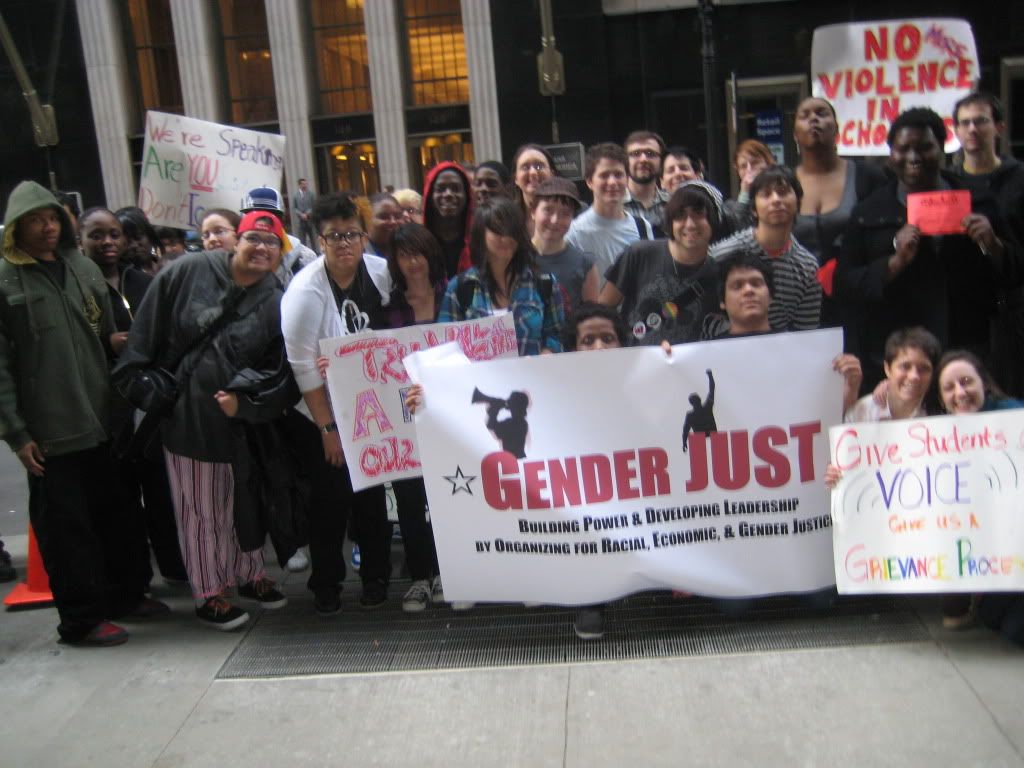
The nation has been totally swept up in Dan Savage's "It Gets Better" project, but Gender Just is skeptical about how much better it gets:

We have seen an overly simplistic and un-nuanced reaction to the recent violence; from Dan Savage telling young people to wait it out until "it gets better" and from Kathy Griffin declaring that passing Gay Marriage and overturning Don't Ask Don't Tell would somehow stop the violence in our lives, we have found this response to be as misguided, irrelevant, and offensive as the conservative LGBT Movement itself.

While youth violence is a very serious issue in our schools, the real bullies we face in our schools take the form of systemic violence perpetrated by the school system itself: a sex education that ignores queer youth and a curriculum that denies our history, a militarized school district with cops in our schools, a process of privatization which displaces us, increasing class sizes which undermine our education and safety. The national calls to end the violence against queer youth completely ignore the most violent nature of our educational experience.


Read the entire post at Gender Just.
Related Posts Plugin for WordPress, Blogger...

select key words

2007 National HIV Prevention Conference 2009 National LGBTI Health Summit 2011 LGBTI Health Summit 2012 Gay Men's Health Summit 2012 International AIDS Conference ACT Up AIDS AIDS Foundation of Chicago Africa BUTT Bisexual Bisexual Health Summit Brian Mustanski Center on Halsted Charles Stephens Chicago Chicago Black Gay Men's Caucus Chicago Task Force on LGBT Substance Use and Abuse Chris Bartlett Coaching with Jake Congress David Halperin David Munar Dr. James Holsinger Dr. Jesus Ramirez-Valles Dr. Rafael Diaz Dr. Ron Stall ENDA Ed Negron Eric Rofes FTM Feast of Fun Feel the love... Friday is for Faeries Gay Men's Health Summit 2010 HCV HIV HIV care HIV drugs HIV negative HIV positive HIV prevention HIV stigma HIV strategic plan HIV testing HIV/AIDS HPV Howard Brown Health Center IML IRMA Illinois International AIDS Conference Jim Pickett LGBT LGBT adoption LGBT culture LGBT health LGBT rights LGBT seniors LGBT youth LGBTI community LGBTI culture LGBTI health LGBTI rights LGBTI spirituality LGV Leon Liberman LifeLube LifeLube forum LifeLube poll LifeLube subscription Lorenzo Herrera y Lozano Lymphogranuloma Venereum MRSA MSM Monday Morning Perk-Up National AIDS Strategy National Gay Men's Health Summit One Fey's Tale Peter Pointers Pistol Pete PnP PrEP President Barack Obama Presidential Campaign Project CRYSP Radical Faerie STD Senator Barack Obama Sister Glo Sisters of Perpetual Indulgence Susan Kingston Swiss declaration Ted Kerr Test Positive Aware Network The "Work-In" The 2009 Gay Men's Health Agenda Tony Valenzuela Trans Gynecology Access Program Trans and Intersex Association Trevor Hoppe Who's That Queer Woof Wednesday You Tube abstinence only activism advocacy african-american aging issues anal cancer anal carcinoma anal health anal sex andrew's anus athlete ball scene bareback porn barebacking bathhouses bears big bold and beautiful bisexuality black gay men black msm blood ban blood donor body image bottom chubby chaser circumcision civil rights civil union communication community organizing condoms crystal meth dating dating and mating with alan irgang depression disclosure discrimination domestic violence don't ask don't tell douche downlow drag queen emotional health exercise female condom fitness gay culture gay identity gay latino gay male sex gay marriage gay men gay men of color gay men's health gay pride gay rights gay rugby gay sex gay youth gender harm reduction hate crime health care health care reform health insurance hepatitis C hiv vaccine homophobia homosexuality hottie hotties how are you healthy? human rights humor hunk immigration international mr. leather internet intimacy leather community leathersex lifelube survey love lube lubricant masturbation mental health microbicides middle music negotiated safety nutrition oral sex physical health pleasure podcast policy politics poppers porn post-exposure prophylaxis prevention prostate prostate cancer public health public sex venues queer identity racism recovery rectal microbicides relationships religion research safe sex semen sero-adaptation sero-sorting seroguessing sex sexual abuse sexual addiction sexual health sexual orientation smoking social marketing spirituality stigma stonewall riots substance abuse treatment substance use suicide super-bug superinfection syphilis testicle self-examination testicular cancer testing top trans group blog transgender transgender day of remembrance transgendered transmen transphobia transsexual universal health care unsafe sex vaccines video violence viral load writers yoga youtube