via Chelsea Now, By Sam Spokony
A recent sense of optimism surrounding PrEP was a result of the Chemoprophylaxis for HIV Prevention in Men study (also known as iPrEx), a Phase III clinical study — sponsored by the National Institutes of Health (NIH) through a grant to the J. David Grant Institutes at the University of California at San Francisco — that began in July 2007 and was published in the New England Journal of Medicine of November 23, 2010.
The iPrEx study focused on 2,499 sexually active men who have sex with men and transgendered women who have sex with men — all of whom were HIV-negative at the time of enrollment. The study’s experimental group received a PrEP treatment — a daily tablet that combined 200 milligrams of the drug emtricitabine, or FTC, and 300 milligrams of the drug tenofovir (a combination known by the brand name Truvada) — while the control group received a placebo.
In all, 100 cases of HIV infection occurred among participants in the iPrEx study. Thirty-six infections occurred among the 1,251 participants who were chosen to receive Truvada, while 64 occurred among the 1,248 participants who had received the placebo. Based on those numbers alone, PrEP was approximately 44 percent effective in preventing seroconversion.
While 44 percent efficacy might not be seen as wholly significant, what created perhaps a greater stir among researchers was analysis of the infected members of the experimental group. Blood tests revealed that, of the 36 men receiving PrEP who had seroconverted, 33 had no traces of the drug in their body prior to their positive HIV tests.
This data presented a startling result: if the subjects who were supposed to have been taking Truvada daily — but were apparently not — were not counted, the efficacy of PrEP treatment rose from 44 percent to more than 90 percent.
Read more.
Your field guide to gay men's health. The blog is no longer active, but is still available to use as an information resource.
Showing posts with label Truvada. Show all posts
Thursday, July 14, 2011
Sunday, June 5, 2011
Is a Daily Pill the Answer to HIV Prevention Among Gay Men? Is This a Prevention Revolution, or Magical Thinking?
LifeLube, Association of Latin Men for Action, Chicago Black Gay Men's Caucus, Communities of Color Collaborative, Project CRYSP, and Feast of Fun are teeming up to bring you and yours a free podcast forum to explore this hot issue.
Wednesday, June 15 - Center on Halsted - be there.
Hear from real guys who are taking “the pill.”
Ask tough questions about costs, risks.
Why can't people just wear condoms?
How far YOU would you go to protect yourself?
Wednesday, June 15 - Center on Halsted - be there.
Hear from real guys who are taking “the pill.”
Ask tough questions about costs, risks.
Why can't people just wear condoms?
How far YOU would you go to protect yourself?
Click for more info and to RSVP.
Click to download the flyer you see below. Please share.
Wednesday, May 4, 2011
I Haven't Given Up, I've TAKEN CHARGE - One Man's Story of Taking HIV Meds for Prevention
... a "How are you healthy?" super deluxe installment, by Nick Literski
Recently, I was surprised to learn that I had allegedly “given up on gay men.”
According to Michael Weinstein, president and founder of the so-called “AIDS Healthcare Foundation,” I now consider the lives of gay men, including myself, “disposable.” What great crime have I committed to deserve Mr. Weinstein’s condemnation? I take Truvada once a day, as pre-exposure prophylaxis (PrEP), in order to protect myself from HIV infection.
My partner and I have a mutually open relationship. In reaching that point, we did the responsible things that a new couple should do to protect themselves. We used condoms until we’d been together long enough to rely on HIV testing. We then chose to be fluid bonded, while always playing “safe” with other sexual partners. Every six months, we were both dutifully tested for the HIV virus, usually going to the local testing facility together. We were screened on a regular basis for other sexually transmitted infections. If we made a mistake with regard to our agreed precautions (and yes, I did so on at least one occasion) we were honest with each other.
About two years into our relationship, we were surprised to hear that my partner’s HIV test was “inconclusive,” and that the testing facility would be submitting it for further testing. A week later, we called back for the final report, and were relieved when an obviously hurried staffer told my partner he was “just fine.” We continued our very active sex life, which almost always involved me being the receptive partner in anal intercourse. During the next few months, however, my normally robust partner had an unusual number of illnesses, particularly skin infections. He became suspicious, and since we were nearly due for our six month testing anyway, he scheduled another test.
As I sat in the waiting area, I received a two word text from my partner: “I’m positive.”
To make matters worse, the staffer had pulled my partner’s chart, and found that his last “inconclusive” test had actually been positive. Due to the mistake of a careless (former) staffer, we had received an incorrect report.
As traumatizing as it was for my partner to find out that he was HIV positive, and as angry as he was about the earlier false report, he was truly terrified that he had exposed me to the virus innumerable times over the past several months. I was promptly tested, and we were relieved to learn that both my rapid testing and RNA results were negative.
Even so, my partner continued to experience tremendous anxiety over the possibility of infecting someone he loved. His worry extended to all sorts of seemingly-mundane possibilities, even to the point of not wanting me to share the same handle on our interchangeable-head electric toothbrush. While it’s normal for newly-seroconverted men to experience high levels of anxiety regarding sex, the impact on our intimate life was profound. My partner had experienced enough broken condom incidents over the years that his concerns weren’t alleviated by using them. At the same time, it was difficult for me to adapt to continuous condom use, due to both physical discomfort and my own emotional response to a physical barrier. Sex became much less frequent, and was burdened by worry and frustration.
In time, and with the help of an outstanding physician, my partner’s viral load became undetectable. In the meantime, both of us had educated ourselves on HIV. We knew that a Swiss study indicated that the risk of my being infected by my partner was now extremely low (due to his undetectable viral load), even to the point that some physicians in Switzerland believed protection was unnecessary.
My partner was able to relax more, and we began to settle into the “new normal” of being a serodiscordant couple.Even at this stage, however, there were emotional challenges.
I still hated using condoms, and I still wanted to feel my partner inside me.
I felt the risk was low enough to be acceptable, and a selfish part of me wanted to be the one making the decision on whether to use protection. Another part of me knew, deep down, that by encouraging unprotected sex with my partner, I wasn’t giving my partner’s emotional well-being the importance he deserved. All too often, I placed my partner in the difficult position of wanting to protect me from infection, while at the same time wanting to satisfy my desire for sex without physical barriers. When my partner gave in to my preference, he generally pulled out before ejaculating, but afterward he dealt with understandable worry. The combination of anxiety and infrequency continued to wear on our relationship.
Somewhere in the midst of all this, I reached a state of mind that seems almost universal among HIV negative partners of HIV positive men.
As low as the risk of infection seemed to be, I still had a nagging worry that I might become positive.
I hated using condoms. I hated seeing my partner constantly worry about infecting me. I worried that my partner would grow so tired of that worry that he might choose to leave the relationship in pursuit of an HIV positive partner. I resented that at times, my partner seemed more comfortable having sex with another HIV positive man than with me. None of these feelings were particularly rational, but they existed.
In keeping with that irrationality, I felt what so many HIV negative men in serodiscordant relationships feel. In a very real sense, part of me wished that I would become infected, just so the whole issue would “go away.” What seemed like a “manageable condition” with new medications seemed preferable to the ongoing stress and frustration. In time, and with seeing the physical problems my partner suffered as a result of his HIV infection, I got past that stage. Unfortunately, many HIV negative men in serodiscordant relationships seem to go through that stage, and some don’t to their senses before permanently affecting their health.
We gradually settled into a “serodiscordant detente,” in which my partner reluctantly agreed that it was up to me whether I wanted to take the risks inherent in unprotected sex, but he almost always pulled out before ejaculation.
At times, I selfishly prevented the latter from happening, not considering the stress I was causing him. There was no simple solution, so while we could still have great sex, it was always accompanied by some level of anxiety and guilt. We were handling it imperfectly, but perhaps the best we could at the time.
Then came November of 2010, and the New England Journal of Medicine’s publication of a study showing the effectiveness of PrEP for men who have sex with men. Our physician, a true expert in the field of HIV prevention and treatment, was familiar with the study prior to its publication. Once results were published, he had a frank discussion with my partner about our sexual activities (something like “Don’t lie to me, I have a really big needle that I can jab you with if you’re lying”). Because we have a great deal of trust in our doctor, my partner was honest with him about our behaviors. Based on that discussion, our doctor asked me to visit him and discuss the possibility of taking PrEP. I made an appointment for a week later.
In the meantime, I agonized over the issue. I searched the Internet and read everything I could find on the subject, both for and against PrEP. In particular, I carefully read the actual study report in the New England Journal of Medicine. I made notes of the questions raised in my mind, and brought them with me when I visited my doctor. We discussed my questions thoroughly, along with the fact that I already had a recent HIV test establishing that I was still negative. My doctor outlined the requirement that I would take the medication every day as directed, and that he would test me for kidney function and other potential side effects on a regular basis. In the end, I decided that the benefits outweighed the risks, and I chose to begin taking Truvada.
The cost of PrEP is naturally a major factor. My physician informed me that several insurance companies were actively considering coverage of PrEP, knowing that it was much less expensive than treatment of an HIV positive patient. Fortunately, my health insurance company had already chosen to cover PrEP, and I’ve never had a problem obtaining Truvada with a reasonable copay.
Perhaps the second most common question I’m asked is whether I’ve had side effects from using PrEP. It’s true that for some men, Truvada can cause nausea or diarrhea (usually only for the first month of use), or even kidney damage. I’m pleased to say that I haven’t experienced such problems. I take my medication every night. The first morning after I began taking Truvada, I had some very minor diarrhea, but this has never recurred, so it may have been entirely coincidental. True to his word, my physician has insisted on regular tests to monitor my kidney function, HIV status, and other health measures. My test results have been entirely normal.
In fact, the only “side effect” I’ve experienced while using PrEP is frustration over the anti-PrEP propaganda efforts of Michael Weinstein and his AIDS Healthcare Foundation.
I’ve read a great deal of the material issued by Mr. Weinstein, and I recently participated with him in a public forum on the use of PrEP, along with several committed advocates of HIV prevention. Where experts presented factual data regarding PrEP, Mr. Weinstein attempted to inspire fear of PrEP, and advocate against the makers of Truvada. Mr. Weinstein’s fear-mongering should come as no surprise, given that he previously attempted to sue the makers of Viagra, claiming that the erectile dysfunction drug contributed to the spread of HIV.
Mr. Weinstein consistently misrepresents the study data. First, he claims that PrEP only proved to be 44% effective in preventing HIV infection. He avoids stating that closer examination of the study results shows that those in the study group who became infected with HIV were found to have no Truvada in their bloodstream, or only trace levels. In other words, the infected individuals failed to actually take Truvada daily as directed. None of the men who were found to actually be taking Truvada on a daily basis throughout the study became infected with HIV.
Second, Mr. Weinstein complains that the study wasn’t “real world,” because those enrolled received monthly prevention counseling and health monitoring. To Mr. Weinstein, it was really the counseling that prevented infection, rather than PrEP. What Mr. Weinstein fails to recognize is that all study participants, including those taking a placebo, were given the same counseling and monitoring. In other words, the controlled study took this factor into account, so that the use of PrEP would truly be the only difference between the groups. When the study reports that PrEP was effective in reducing HIV infections, it reflects a situation in which all other factors were equal. For the men taking placebo, counseling alone didn’t protect them from HIV infection.
Perhaps knowing that consistent, daily use of PrEP really did prevent HIV infection, Mr. Weinstein insists that gay men cannot be relied upon to take Truvada daily. Mr. Weinstein doesn’t explain why he believes that the same men who can’t be trusted to take a pill every day can be expected to use a condom every time they have sex (the only prevention method he seems to approve).
My own anecdotal experience contradicts Mr. Weinstein’s theory. I take my Truvada every night before bed. In the five months I’ve been taking the drug, I’ve forgotten only once, and I took it the following morning, making it a “late” dose, rather than a “missed” dose. I’m not always the most responsible person on the planet, but I take my medication as directed, because I realize that as part of a serodiscordant relationship, I have a comparatively high risk of infection. I take my medication as directed, because I have an excellent physician who reminds me about how important that is.
I take my medication as directed, because I love my partner, and knowing that I take PrEP daily helps reduce his worry and stress.
Mr. Weinstein complains that the availability of PrEP will make men less likely to use condoms, thus making them less protected against HIV infection. While I can’t deny that this may occur for some men, my own experience reflects quite differently. While my partner has an undetectable viral load, resulting in a less than 1% chance of him infecting me, that chance continues to exist. Before PrEP became available, I was taking a calculated risk with my partner, because even with counseling from my trusted physician, physical comfort and intimacy without barriers were ultimately more important to me than further reducing that tiny 1%. My physician, having directly asked about this, determined that I was a good candidate for a method that would overcome those objections.
PrEP didn’t make me stop using condoms.
Instead PrEP provided me with protection that I would use consistently, rather than protection that I was already rejecting. With PrEP, that 1% risk of infection from my partner’s undetectable viral load has been further reduced by my own level of personal protection (92% for those who use PrEP daily).
In the end, my belief that the benefits of PrEP would outweigh the risks has proven true for me. I’m carefully monitored to ensure that I don’t develop harmful side effects. I comply with the treatment regimen faithfully. My insurance covers the medication. My overall level of protection against HIV infection has increased dramatically. Just as importantly, however, PrEP has made a real difference in my relationship with my partner. We’re able to be intimate in a way both of us prefer, without the fears and conflicting feelings that were present even with condoms.
I haven’t “given up on gay men,” or deemed my life “disposable.”
Rather, I’ve made a responsible health choice that works for me, and I’m happy with it.
Nick Literski
Seattle, WA
How are you healthy?
Join in the conversation.
Tell us HERE. Send a pic to the same place.
And we'll blog it, right here.
Gay men and all allies welcome to participate.
Read past posts.
Learn more about the campaign
Recently, I was surprised to learn that I had allegedly “given up on gay men.”
According to Michael Weinstein, president and founder of the so-called “AIDS Healthcare Foundation,” I now consider the lives of gay men, including myself, “disposable.” What great crime have I committed to deserve Mr. Weinstein’s condemnation? I take Truvada once a day, as pre-exposure prophylaxis (PrEP), in order to protect myself from HIV infection.
My partner and I have a mutually open relationship. In reaching that point, we did the responsible things that a new couple should do to protect themselves. We used condoms until we’d been together long enough to rely on HIV testing. We then chose to be fluid bonded, while always playing “safe” with other sexual partners. Every six months, we were both dutifully tested for the HIV virus, usually going to the local testing facility together. We were screened on a regular basis for other sexually transmitted infections. If we made a mistake with regard to our agreed precautions (and yes, I did so on at least one occasion) we were honest with each other.
About two years into our relationship, we were surprised to hear that my partner’s HIV test was “inconclusive,” and that the testing facility would be submitting it for further testing. A week later, we called back for the final report, and were relieved when an obviously hurried staffer told my partner he was “just fine.” We continued our very active sex life, which almost always involved me being the receptive partner in anal intercourse. During the next few months, however, my normally robust partner had an unusual number of illnesses, particularly skin infections. He became suspicious, and since we were nearly due for our six month testing anyway, he scheduled another test.
As I sat in the waiting area, I received a two word text from my partner: “I’m positive.”
To make matters worse, the staffer had pulled my partner’s chart, and found that his last “inconclusive” test had actually been positive. Due to the mistake of a careless (former) staffer, we had received an incorrect report.
As traumatizing as it was for my partner to find out that he was HIV positive, and as angry as he was about the earlier false report, he was truly terrified that he had exposed me to the virus innumerable times over the past several months. I was promptly tested, and we were relieved to learn that both my rapid testing and RNA results were negative.
Even so, my partner continued to experience tremendous anxiety over the possibility of infecting someone he loved. His worry extended to all sorts of seemingly-mundane possibilities, even to the point of not wanting me to share the same handle on our interchangeable-head electric toothbrush. While it’s normal for newly-seroconverted men to experience high levels of anxiety regarding sex, the impact on our intimate life was profound. My partner had experienced enough broken condom incidents over the years that his concerns weren’t alleviated by using them. At the same time, it was difficult for me to adapt to continuous condom use, due to both physical discomfort and my own emotional response to a physical barrier. Sex became much less frequent, and was burdened by worry and frustration.
In time, and with the help of an outstanding physician, my partner’s viral load became undetectable. In the meantime, both of us had educated ourselves on HIV. We knew that a Swiss study indicated that the risk of my being infected by my partner was now extremely low (due to his undetectable viral load), even to the point that some physicians in Switzerland believed protection was unnecessary. My partner was able to relax more, and we began to settle into the “new normal” of being a serodiscordant couple.Even at this stage, however, there were emotional challenges.
I still hated using condoms, and I still wanted to feel my partner inside me.
I felt the risk was low enough to be acceptable, and a selfish part of me wanted to be the one making the decision on whether to use protection. Another part of me knew, deep down, that by encouraging unprotected sex with my partner, I wasn’t giving my partner’s emotional well-being the importance he deserved. All too often, I placed my partner in the difficult position of wanting to protect me from infection, while at the same time wanting to satisfy my desire for sex without physical barriers. When my partner gave in to my preference, he generally pulled out before ejaculating, but afterward he dealt with understandable worry. The combination of anxiety and infrequency continued to wear on our relationship.
Somewhere in the midst of all this, I reached a state of mind that seems almost universal among HIV negative partners of HIV positive men.
As low as the risk of infection seemed to be, I still had a nagging worry that I might become positive.
I hated using condoms. I hated seeing my partner constantly worry about infecting me. I worried that my partner would grow so tired of that worry that he might choose to leave the relationship in pursuit of an HIV positive partner. I resented that at times, my partner seemed more comfortable having sex with another HIV positive man than with me. None of these feelings were particularly rational, but they existed.
In keeping with that irrationality, I felt what so many HIV negative men in serodiscordant relationships feel. In a very real sense, part of me wished that I would become infected, just so the whole issue would “go away.” What seemed like a “manageable condition” with new medications seemed preferable to the ongoing stress and frustration. In time, and with seeing the physical problems my partner suffered as a result of his HIV infection, I got past that stage. Unfortunately, many HIV negative men in serodiscordant relationships seem to go through that stage, and some don’t to their senses before permanently affecting their health.
We gradually settled into a “serodiscordant detente,” in which my partner reluctantly agreed that it was up to me whether I wanted to take the risks inherent in unprotected sex, but he almost always pulled out before ejaculation.
At times, I selfishly prevented the latter from happening, not considering the stress I was causing him. There was no simple solution, so while we could still have great sex, it was always accompanied by some level of anxiety and guilt. We were handling it imperfectly, but perhaps the best we could at the time.
Then came November of 2010, and the New England Journal of Medicine’s publication of a study showing the effectiveness of PrEP for men who have sex with men. Our physician, a true expert in the field of HIV prevention and treatment, was familiar with the study prior to its publication. Once results were published, he had a frank discussion with my partner about our sexual activities (something like “Don’t lie to me, I have a really big needle that I can jab you with if you’re lying”). Because we have a great deal of trust in our doctor, my partner was honest with him about our behaviors. Based on that discussion, our doctor asked me to visit him and discuss the possibility of taking PrEP. I made an appointment for a week later.
In the meantime, I agonized over the issue. I searched the Internet and read everything I could find on the subject, both for and against PrEP. In particular, I carefully read the actual study report in the New England Journal of Medicine. I made notes of the questions raised in my mind, and brought them with me when I visited my doctor. We discussed my questions thoroughly, along with the fact that I already had a recent HIV test establishing that I was still negative. My doctor outlined the requirement that I would take the medication every day as directed, and that he would test me for kidney function and other potential side effects on a regular basis. In the end, I decided that the benefits outweighed the risks, and I chose to begin taking Truvada.
The cost of PrEP is naturally a major factor. My physician informed me that several insurance companies were actively considering coverage of PrEP, knowing that it was much less expensive than treatment of an HIV positive patient. Fortunately, my health insurance company had already chosen to cover PrEP, and I’ve never had a problem obtaining Truvada with a reasonable copay.
Perhaps the second most common question I’m asked is whether I’ve had side effects from using PrEP. It’s true that for some men, Truvada can cause nausea or diarrhea (usually only for the first month of use), or even kidney damage. I’m pleased to say that I haven’t experienced such problems. I take my medication every night. The first morning after I began taking Truvada, I had some very minor diarrhea, but this has never recurred, so it may have been entirely coincidental. True to his word, my physician has insisted on regular tests to monitor my kidney function, HIV status, and other health measures. My test results have been entirely normal.
In fact, the only “side effect” I’ve experienced while using PrEP is frustration over the anti-PrEP propaganda efforts of Michael Weinstein and his AIDS Healthcare Foundation.
I’ve read a great deal of the material issued by Mr. Weinstein, and I recently participated with him in a public forum on the use of PrEP, along with several committed advocates of HIV prevention. Where experts presented factual data regarding PrEP, Mr. Weinstein attempted to inspire fear of PrEP, and advocate against the makers of Truvada. Mr. Weinstein’s fear-mongering should come as no surprise, given that he previously attempted to sue the makers of Viagra, claiming that the erectile dysfunction drug contributed to the spread of HIV.
Mr. Weinstein consistently misrepresents the study data. First, he claims that PrEP only proved to be 44% effective in preventing HIV infection. He avoids stating that closer examination of the study results shows that those in the study group who became infected with HIV were found to have no Truvada in their bloodstream, or only trace levels. In other words, the infected individuals failed to actually take Truvada daily as directed. None of the men who were found to actually be taking Truvada on a daily basis throughout the study became infected with HIV.Second, Mr. Weinstein complains that the study wasn’t “real world,” because those enrolled received monthly prevention counseling and health monitoring. To Mr. Weinstein, it was really the counseling that prevented infection, rather than PrEP. What Mr. Weinstein fails to recognize is that all study participants, including those taking a placebo, were given the same counseling and monitoring. In other words, the controlled study took this factor into account, so that the use of PrEP would truly be the only difference between the groups. When the study reports that PrEP was effective in reducing HIV infections, it reflects a situation in which all other factors were equal. For the men taking placebo, counseling alone didn’t protect them from HIV infection.
Perhaps knowing that consistent, daily use of PrEP really did prevent HIV infection, Mr. Weinstein insists that gay men cannot be relied upon to take Truvada daily. Mr. Weinstein doesn’t explain why he believes that the same men who can’t be trusted to take a pill every day can be expected to use a condom every time they have sex (the only prevention method he seems to approve).
My own anecdotal experience contradicts Mr. Weinstein’s theory. I take my Truvada every night before bed. In the five months I’ve been taking the drug, I’ve forgotten only once, and I took it the following morning, making it a “late” dose, rather than a “missed” dose. I’m not always the most responsible person on the planet, but I take my medication as directed, because I realize that as part of a serodiscordant relationship, I have a comparatively high risk of infection. I take my medication as directed, because I have an excellent physician who reminds me about how important that is.
I take my medication as directed, because I love my partner, and knowing that I take PrEP daily helps reduce his worry and stress.
Mr. Weinstein complains that the availability of PrEP will make men less likely to use condoms, thus making them less protected against HIV infection. While I can’t deny that this may occur for some men, my own experience reflects quite differently. While my partner has an undetectable viral load, resulting in a less than 1% chance of him infecting me, that chance continues to exist. Before PrEP became available, I was taking a calculated risk with my partner, because even with counseling from my trusted physician, physical comfort and intimacy without barriers were ultimately more important to me than further reducing that tiny 1%. My physician, having directly asked about this, determined that I was a good candidate for a method that would overcome those objections.
PrEP didn’t make me stop using condoms.
Instead PrEP provided me with protection that I would use consistently, rather than protection that I was already rejecting. With PrEP, that 1% risk of infection from my partner’s undetectable viral load has been further reduced by my own level of personal protection (92% for those who use PrEP daily).
In the end, my belief that the benefits of PrEP would outweigh the risks has proven true for me. I’m carefully monitored to ensure that I don’t develop harmful side effects. I comply with the treatment regimen faithfully. My insurance covers the medication. My overall level of protection against HIV infection has increased dramatically. Just as importantly, however, PrEP has made a real difference in my relationship with my partner. We’re able to be intimate in a way both of us prefer, without the fears and conflicting feelings that were present even with condoms.
I haven’t “given up on gay men,” or deemed my life “disposable.”
Rather, I’ve made a responsible health choice that works for me, and I’m happy with it.
Nick Literski
Seattle, WA
How are you healthy?Join in the conversation.
Tell us HERE. Send a pic to the same place.
And we'll blog it, right here.
Gay men and all allies welcome to participate.
Read past posts.
Learn more about the campaign
Monday, May 2, 2011
Taking a Pill for HIV Prevention: a great explanation of the science and its impacts
via AIDS Treatment News, by John S. James
This is an excellent description of the iPrEx study that showed daily Truvada could protect against HIV, and the implications for gay men.
Excerpt:
This is an excellent description of the iPrEx study that showed daily Truvada could protect against HIV, and the implications for gay men.
Excerpt:
No one we know thinks that all gay men should take Truvada.Read the rest.
But using this new prevention option in a targeted way should help a lot to control the HIV/AIDS epidemic. Remember that in any epidemic, if each person infected infects fewer than one other person on the average, and this can be maintained, then the epidemic will end.
And it turns out that a disproportionate amount of transmission takes place very early in someone's HIV infection -- when viral load is extremely high, but people do not know and seldom even suspect that they are infected, so they are much less careful about risk to others, than if they did know their status.
Friday, April 8, 2011
SEATTLE - APRIL 27: How far would YOU go to stay HIV negative?
If you are in Seattle, please make it a point to attend this forum Wednesday, April 27 on the potential promises, and possible perils, of using HIV meds for prevention...
Feast of Fun podcast: The Battle Over HIV Prevention
Last time there was a lot of fuss over a little blue pill, Bob Dole was doing Viagra ads on TV.
via Feast of Fun
Check out the podcast now.
The AIDS Healthcare Foundation launched a national ad campaign to discredit PrEP or Pre Exposure Prophylaxis, a new HIV prevention technique that involves taking Truvada (an existing HIV medication) on a daily basis.
The LA based health organization blasted this approach, saying there is no magic pill, and that it’s just a misguided attempt to put HIV negative men on unnecessary meds to enrich the fat cats in the pharmaceutical industry to the tune of $10,000 a year per patient.
Why is the leadership of the nation’s largest AIDS organization arguing against a treatment that could potentially save millions of gay men from becoming HIV positive?
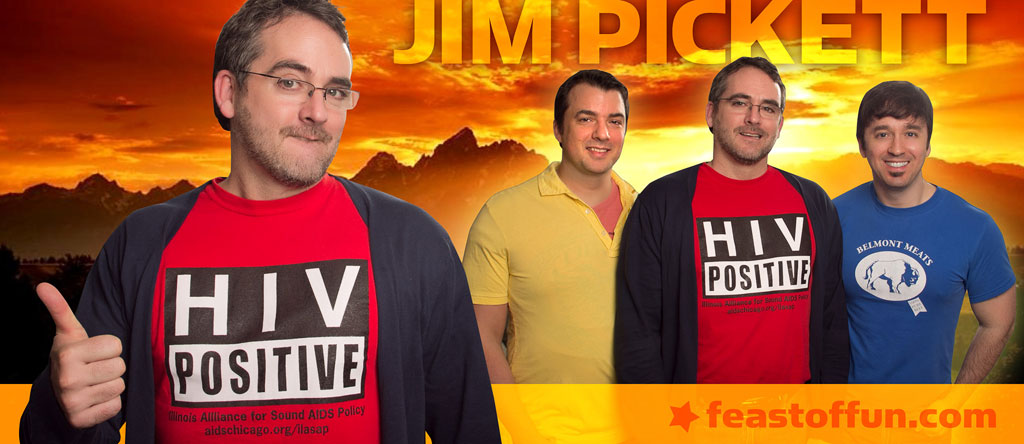
Today, gay men’s health advocate, Jim Pickett, from the AIDS Foundation of Chicago, joins us to explain the controversy surrounding this new treatment, and the possible reasons it may be misunderstood.
Listen to the podcast.
And that smart HIV-positive shirt Jim is wearing? Part of a cool anti-stigma campaign out of the Illinois Alliance for Sound AIDS Policy. Check it out.
via Feast of Fun
Check out the podcast now.
The AIDS Healthcare Foundation launched a national ad campaign to discredit PrEP or Pre Exposure Prophylaxis, a new HIV prevention technique that involves taking Truvada (an existing HIV medication) on a daily basis.
The LA based health organization blasted this approach, saying there is no magic pill, and that it’s just a misguided attempt to put HIV negative men on unnecessary meds to enrich the fat cats in the pharmaceutical industry to the tune of $10,000 a year per patient.
Why is the leadership of the nation’s largest AIDS organization arguing against a treatment that could potentially save millions of gay men from becoming HIV positive?
Today, gay men’s health advocate, Jim Pickett, from the AIDS Foundation of Chicago, joins us to explain the controversy surrounding this new treatment, and the possible reasons it may be misunderstood.
Listen to the podcast.
And that smart HIV-positive shirt Jim is wearing? Part of a cool anti-stigma campaign out of the Illinois Alliance for Sound AIDS Policy. Check it out.
Subscribe to:
Posts (Atom)
select key words
2007 National HIV Prevention Conference
2009 National LGBTI Health Summit
2011 LGBTI Health Summit
2012 Gay Men's Health Summit
2012 International AIDS Conference
ACT Up
AIDS
AIDS Foundation of Chicago
Africa
BUTT
Bisexual
Bisexual Health Summit
Brian Mustanski
Center on Halsted
Charles Stephens
Chicago
Chicago Black Gay Men's Caucus
Chicago Task Force on LGBT Substance Use and Abuse
Chris Bartlett
Coaching with Jake
Congress
David Halperin
David Munar
Dr. James Holsinger
Dr. Jesus Ramirez-Valles
Dr. Rafael Diaz
Dr. Ron Stall
ENDA
Ed Negron
Eric Rofes
FTM
Feast of Fun
Feel the love...
Friday is for Faeries
Gay Men's Health Summit 2010
HCV
HIV
HIV care
HIV drugs
HIV negative
HIV positive
HIV prevention
HIV stigma
HIV strategic plan
HIV testing
HIV/AIDS
HPV
Howard Brown Health Center
IML
IRMA
Illinois
International AIDS Conference
Jim Pickett
LGBT
LGBT adoption
LGBT culture
LGBT health
LGBT rights
LGBT seniors
LGBT youth
LGBTI community
LGBTI culture
LGBTI health
LGBTI rights
LGBTI spirituality
LGV
Leon Liberman
LifeLube
LifeLube forum
LifeLube poll
LifeLube subscription
Lorenzo Herrera y Lozano
Lymphogranuloma Venereum
MRSA
MSM
Monday Morning Perk-Up
National AIDS Strategy
National Gay Men's Health Summit
One Fey's Tale
Peter Pointers
Pistol Pete
PnP
PrEP
President Barack Obama
Presidential Campaign
Project CRYSP
Radical Faerie
STD
Senator Barack Obama
Sister Glo
Sisters of Perpetual Indulgence
Susan Kingston
Swiss declaration
Ted Kerr
Test Positive Aware Network
The "Work-In"
The 2009 Gay Men's Health Agenda
Tony Valenzuela
Trans Gynecology Access Program
Trans and Intersex Association
Trevor Hoppe
Who's That Queer
Woof Wednesday
You Tube
abstinence only
activism
advocacy
african-american
aging issues
anal cancer
anal carcinoma
anal health
anal sex
andrew's anus
athlete
ball scene
bareback porn
barebacking
bathhouses
bears
big bold and beautiful
bisexuality
black gay men
black msm
blood ban
blood donor
body image
bottom
chubby chaser
circumcision
civil rights
civil union
communication
community organizing
condoms
crystal meth
dating
dating and mating with alan irgang
depression
disclosure
discrimination
domestic violence
don't ask don't tell
douche
downlow
drag queen
emotional health
exercise
female condom
fitness
gay culture
gay identity
gay latino
gay male sex
gay marriage
gay men
gay men of color
gay men's health
gay pride
gay rights
gay rugby
gay sex
gay youth
gender
harm reduction
hate crime
health care
health care reform
health insurance
hepatitis C
hiv vaccine
homophobia
homosexuality
hottie
hotties
how are you healthy?
human rights
humor
hunk
immigration
international mr. leather
internet
intimacy
leather community
leathersex
lifelube survey
love
lube
lubricant
masturbation
mental health
microbicides
middle
music
negotiated safety
nutrition
oral sex
physical health
pleasure
podcast
policy
politics
poppers
porn
post-exposure prophylaxis
prevention
prostate
prostate cancer
public health
public sex venues
queer identity
racism
recovery
rectal microbicides
relationships
religion
research
safe sex
semen
sero-adaptation
sero-sorting
seroguessing
sex
sexual abuse
sexual addiction
sexual health
sexual orientation
smoking
social marketing
spirituality
stigma
stonewall riots
substance abuse treatment
substance use
suicide
super-bug
superinfection
syphilis
testicle self-examination
testicular cancer
testing
top
trans group blog
transgender
transgender day of remembrance
transgendered
transmen
transphobia
transsexual
universal health care
unsafe sex
vaccines
video
violence
viral load
writers
yoga
youtube